

Why Mercedes’ W16 rear suspension backtrack could prove crucial for F1 2026


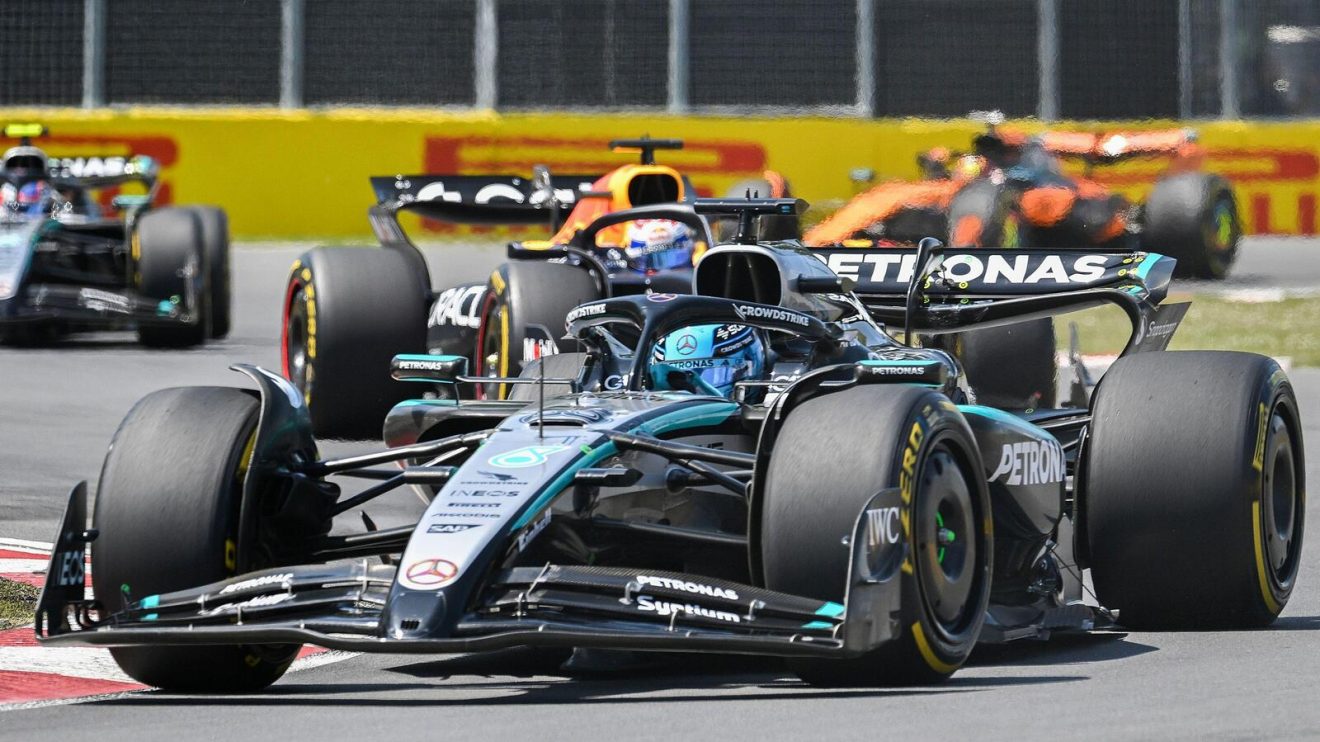
George Russell takes a turn ahead of the pack during the F1 Canadian Grand Prix
Mercedes believes identifying the unintended consequences of a development path will allow the Brackley-based squad to learn lessons for F1 2026.
Mercedes is currently 24 points behind second-placed Ferrari in the Constructors’ Championship, having seen its performance become sporadic through the second quarter of the season.
Mercedes ‘retracing its steps’ to identify wayward development
Throughout the first six races of F1 2025, Mercedes was no stranger to the podium as George Russell initially even appeared a dark horse for the championship as the W16 started the year brightly.
A 1-3 finish in Canada saw George Russell win his first race of the year as Kimi Antonelli scored his maiden F1 podium, but this was a positive blip in what was otherwise a difficult run of races for Brackley.
This clear division between the good days and the more difficult was addressed by Mercedes team representative Bradley Lord over the Hungarian Grand Prix weekend, as he reviewed the first half of the season.
“I think we’ve seen across the first half of the season two pretty clear halves for us. A half where we’ve had consistent performance, the drivers have felt confident in the car and we’ve had a gap to the fastest cars,” he told a small group of select media, including PlanetF1.com.
“But we’ve been in regular podium contention. That was sort of from Melbourne up until Miami. And then from Imola to where we are now, we’ve seen a more inconsistent performance, which has had a higher peak in Canada.
“So we’ve had obviously the race win and Kimi’s first podium in Canada, which was a great highlight of the season so far. But also, on average, we’ve been further from the field and we’ve slipped from regular podium contention to more being top five, top six territory in our average race performance.”
This slip backwards, according to Lord, hasn’t just been relative to the team’s usual competitors, ie. Ferrari and Red Bull, but against those nipping at the heels of the top four teams as well.
“It’s not just a bigger gap to the front,” he said.
“It’s that we’ve moved backwards in the relative pecking order. So that’s what gives us a measure of belief.
“It’s something we have brought to the car and the unintended consequences of that, rather than a lack of development, for example, or a general loss of performance versus every other team on the grid.
“So what the drivers are saying is that they are struggling with confidence in the car. So instability on corner entry and that they’re not able to fully commit to the corners.
“And that is costing them confidence, which is costing us performance as well. So that’s the main limitation that we’ve got at the moment.
“Now, we are retracing our steps to sort of unpick the many things we’ve brought to the car, what has introduced that to the car, because it definitely wasn’t the case earlier in the year and has become the case in the second quarter.
“That loss of competitiveness has put us in situations that are more borderline for getting into Q3 and how we’re racing too.”
In Hungary, the team opted to row back to an older-specification rear suspension that had been used throughout the first handful of races, in order to try re-establishing a tried and trusted stable baseline for the second half of the year.
Based on the performance of that one weekend at what is an idiosyncratic circuit, the decision looks to have been a correct one. Not only were the drivers happier with the stability of the car, but Russell returned to the podium for the first time since winning in Canada.
Andrew Shovlin, Mercedes’ head of trackside engineering, said after Budapest that the newer-spec suspension had created a situation for the drivers where they lacked confidence in stability, particularly on high-speed entry.
“A lot of the work that’s going on now is to understand exactly what it is that has caused that problem,” he said.
“It’s not something that was dead obvious. Otherwise, we wouldn’t have had the issue in the first place. But there’ll be a lot of learning in there.”
With only 10 race weekends left, the work might appear to have diminishing returns and be a potential waste of resources and a distraction while the team creates a brand-new, revolutionary W17 for the new regulations.
But, having seemingly figured out a problem of this scale still allows the team 10 full race weekends of data gathering across a wide selection of circuit types, and Shovlin said much of the learning will still apply for next year.
“Some of it will benefit us this year. But importantly, it’ll benefit us for the future,” he said.
“The cars for 2026 are very, very different. But there will be a lot of elements, particularly around the learning on suspension, where we should be able to take lessons from this year into next year.”
More on Mercedes in F1
? Who is Bradley Lord? Meet Toto Wolff’s trusted Mercedes lieutenant
? F1 team principals’ rich list: Net worth figures revealed for Wolff, Horner and more
It’s not the first time a leading team has headed in the wrong direction of development under the current ground-effect regulations, with Red Bull’s 2024 drop-off perhaps the prime example of this confusion.
Asked by PlanetF1.com whether this has been a primary factor in the team’s development going awry, Lord said, “It’s a set of rules and the way the cars run that is difficult to fully capture in simulation, and you’re looking to operate the cars within very, very narrow windows of performance.
“So I think the level of sensitivity of the cars to that is potentially reflected in the fact that we have seen, I think, all the different teams at various points across the last four years, what appear to be either sort of development cul-de-sacs or false steps that they then had to back out of as well. They’re very, very sensitive cars to set up and develop, and I’m sure that it does reflect some of that as well.
While the rear suspension does appear to account for much of Mercedes’ relative performance loss, it’s likely that it’s not the only area of scrutiny.
Lord acknowledged that there have been some “decent ideas of higher probability influences” on where the W16 has gone astray throughout the second quarter of the year, and said that it’s also crucial that the team doesn’t take any of the “goodness” out of the car from attempting to change unrelated areas of influence.
Aside from the rear suspension, one possibility of what could have had an effect is the changes to the front wing brought on by the FIA’s flexi-wing technical directive in Spain, which resulted in most of the teams having to make tweaks of varying degrees to conform with the new stiffness tests.
The picture for Mercedes may have been muddied by the fact that the W16 won in Canada shortly after this came into effect, but Lord said the TD could have had some impact on the car’s handling.
“It’s a potential factor. But there’s no one sort of smoking gun or single thing. It would be a combination of factors,” he said.
“But that’s something that has happened in that period that I’ve talked about, where our performance has become more inconsistent. You can’t say it’s a sole thing because we’ve also been strong, as we said, the highest peak of our season so far. But that’s one of the factors that we need to consider.”
Read Next: Mercedes ‘couldn’t wish for better number one’ as Russell and Hamilton claim made


