

How Antonelli beat Verstappen in Miami despite Mercedes resisting upgrade trend


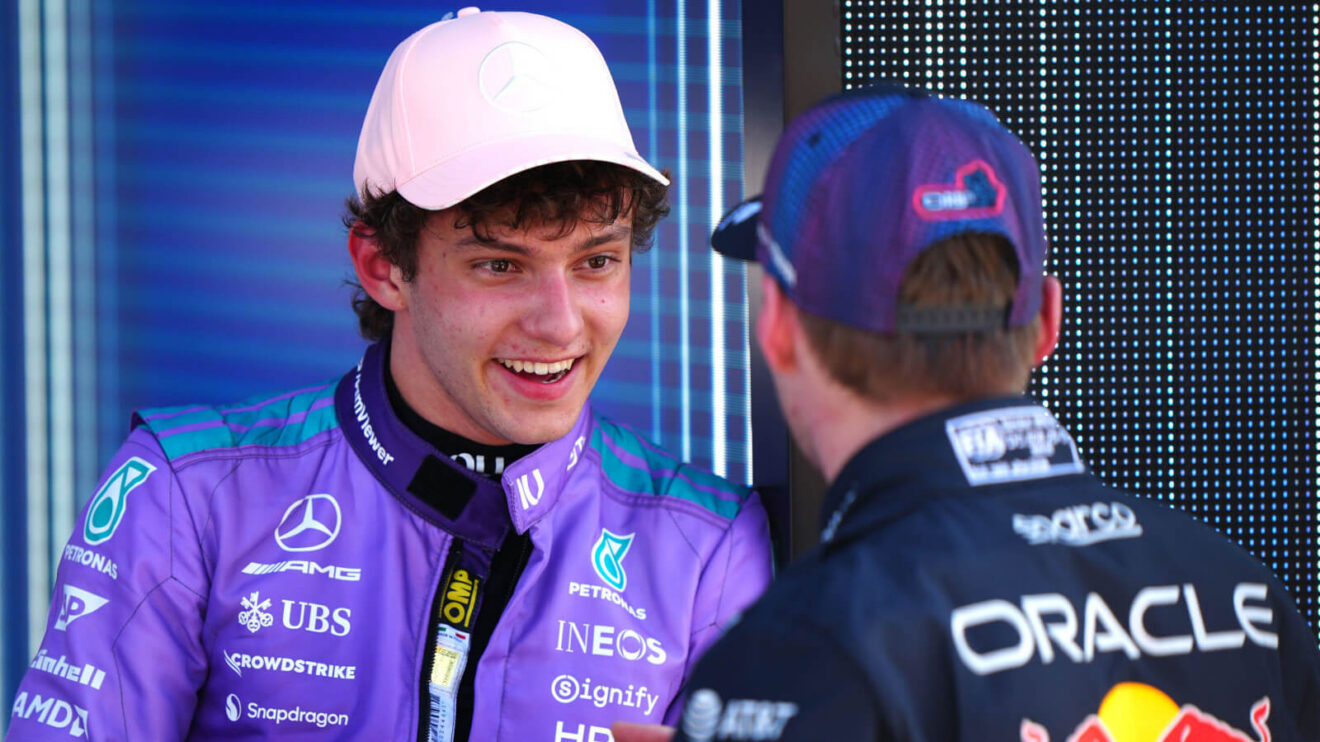
Kimi Antonelli beat Max Verstappen to pole in Miami
Formula 1’s 2026 reset arrived in Miami — but one constant remains: Kimi Antonelli on pole.
Let’s take a look at how the young Italian held off the heavily updated cars from Red Bull, Ferrari, and McLaren to secure the best starting position for the main race.
How Antonelli denied Verstappen pole in Miami
Want more PlanetF1.com coverage? Add us as a preferred source on Google to your favourites list for news you can trust
The race weekend in Miami represents almost a new beginning for the F1 season. Along with the regulations seeing quite a few changes, the vast majority of the cars on the track look very different from their appearance at the last race in Japan.
Among the massive list of upgrades that the top teams brought, the only team that did not want to make drastic changes in Miami was Mercedes – the very team that has dominated both qualifying and the main races so far this season.
Has their faith in retaining their advantage cost them?
If you ask Kimi Antonelli, definitely not, while his team-mate might have a different opinion. The gap between George Russell and Antonelli during this qualifying session was the largest we’ve seen yet – the Briton could do no better than P5, trailing by as much as four-tenths of a second.
However, alongside Mercedes, the team that stood out the most during the main qualifying in Miami was definitely Red Bull. From the fourth-fastest team, they became the second fastest, with a very small gap to pole position. Their completely redesigned sidepods, along with the “Macarena-style” rear wing, seem to be yielding real results.
What is also interesting in comparing Max’s and Kimi’s fastest laps from Q3, very big differences in energy deployment strategy can be seen.

Even before entering Turn 1, Max’s speed is noticeably higher due to a more aggressive energy deployment, which brings him about 0.15 seconds in the first few metres of the track. In Turns 2 and 3, their speeds are quite matched, while on the mini-straight from Turn 3 to Turn 4 we can see very aggressive harvesting by the Red Bull car.
The speed delta in this part of the track is massive, as can be seen in the graph above. By Turn 8, the Italian makes up more than half a second of time.
But as is usually the case, this causes a deployment seesaw, meaning that on the very next straight, the situation reverses. The graph shows how after Turn 10, the speed on the Mercedes car drops more quickly, and Verstappen regains the advantage. Moreover, after a series of slow corners at the end of Sector 2, both drivers are quite even.

Kimi, however, had a better exit out of Turn 16 and, with the help of the electrical system, manages to be the one who achieves better top speeds this time, albeit with smaller deltas.
Combined with better braking into Turn 17, which is also the heaviest braking point on the track (made even more difficult by the fact that the wind was a big factor here), Kimi steals another tenth and takes the victory in this duel.
As you can see, the main differences during the qualifying battles between drivers are down to the electrical energy deployment strategy itself. This makes our job much harder, because we cannot clearly see the points on the track where the driver was actually the one making the difference, rather than the software managing the MGU-K unit.
Because of this, it is worth taking a look at the comparison between Antonelli and his team-mate Russell, as the mentioned effect is largely eliminated.

What we can highlight when analysing these two drivers is definitely the fact that Antonelli was faster in every single sector on the track.
Despite Russell’s higher speed going into Turn 1, Kimi is more aggressive, uses more curbs, and opens up a gap of about 0.15 seconds in this corner alone.
Generally, the Italian was significantly faster through the slow corners on the track all weekend. We can also see the difference he manages to make with a better run through the chicane at the end of Sector 2, as well as Turn 16, which leads onto the longest straight on the circuit.
Therefore, although it is less visible now, the driver still makes a real difference on the track during qualifying. Unfortunately for him, Isack Hadjar confirms this fact, trailing his team-mate by more than 0.8 seconds in qualifying.
It is not uncommon to see that along with a team’s performance upgrade, an increase in the performance gap between the drivers within that team comes as a consequence. When Verstappen is one of the drivers, this effect seems to happen even more easily.
The assumption that Red Bull’s new upgrades were brought to better suit the four-time world champion’s driving style has some basis, but at the same time, it cannot be proven in any way.
What is certain is that this new beginning for Formula 1 has absolutely brought a new type of excitement. Mercedes is no longer dominant, and with Kimi really struggling with race starts this year, the main race will certainly bring plenty of drama.
Want to be the first to know exclusive information from the F1 paddock? Join our broadcast channel on WhatsApp to get the scoop on the latest developments from our team of accredited journalists.
You can also subscribe to the PlanetF1 YouTube channel for exclusive features, hear from our paddock journalists with stories from the heart of Formula 1 and much more!
Read next: Winners and losers from the 2026 Miami Grand Prix Qualifying


