

Mercedes explain ‘roll the dice’ dry tyre gamble for wet British GP start


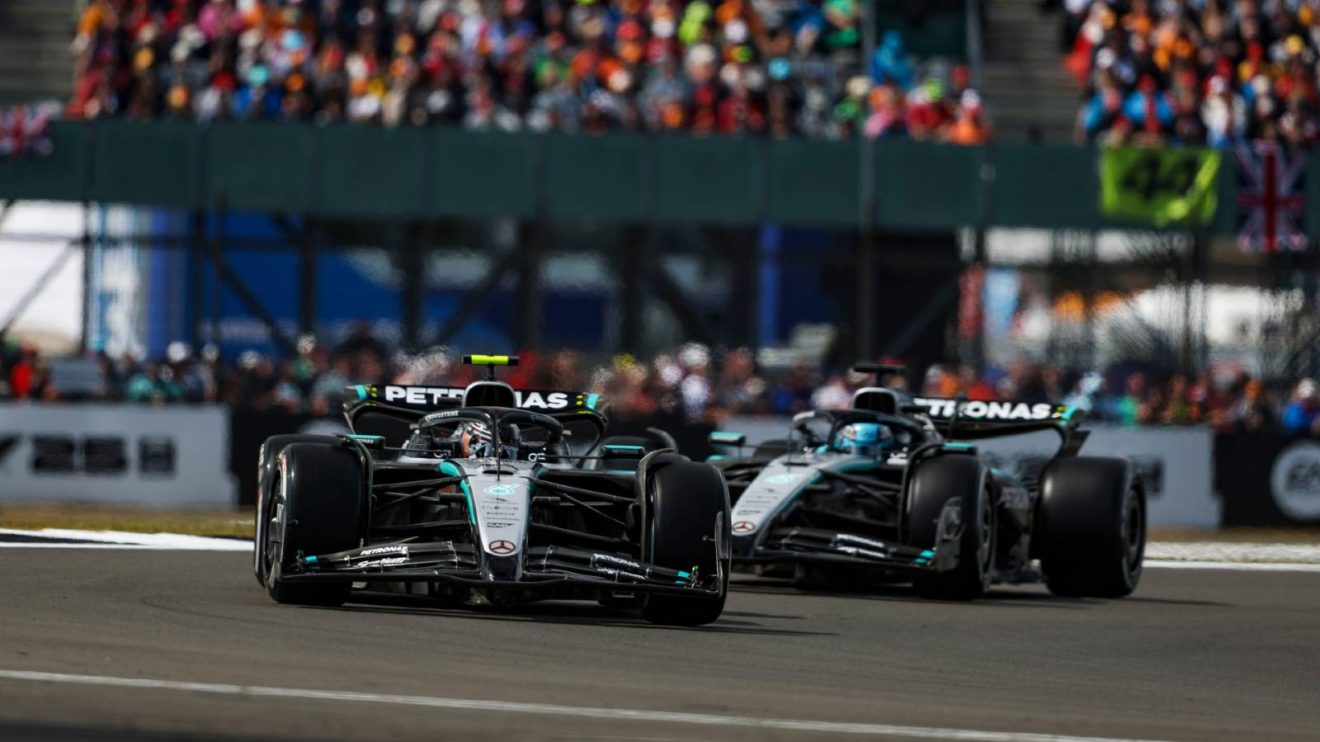
The two Mercedes drivers on track at the 2025 British Grand Prix.
George Russell was one of several drivers to start the British Grand Prix on dry tyres, despite the track still being mostly wet.
Most of the field took the race start on the intermediate tyre due to the largely wet conditions, but Russell was one of five drivers to gamble on slick tyres as he came into the pits at the end of the formation lap to fit the hard tyre compound.
Mercedes explains the ‘marginal call’ for slick tyres
At the time, the sun was shining and the track was drying, and Russell, as well as other slick tyre runners, wasn’t off the pace as the race started to unfold. But lengthy Virtual Safety Car interventions meant that the pace of the hard tyre couldn’t be exploited during the time period where an advantage could have been gleaned.
Just a few laps in, the rain intensity began to pick up and, on Lap 10, Russell admitted defeat and returned to the pits to fit the intermediate tyre.
The British driver wound up in 10th place at the chequered flag, having spent the rest of the race recovering ground as a Safety Car intervention helped bring him back into contention, only for a late-race spin to cost him further ground.
It had been a tough day at the office, and Mercedes’ team representative, Bradley Lord, explained the logic the team had applied in deciding upon the slick tyre for the race start.
“Obviously, we went to the grid yesterday. It was wet, and we could also see that it was going to stay dry probably for about 20, 25 minutes,” he said in Mercedes’ official race debrief.
“So we knew there was a window where the circuit might dry out, the sun came out as well, and you could start to see a dry line emerging.
“But we knew there was a big weather front coming in behind. So the call was to try and maximise that dry window and hope that you can make the most of dry tyre performance and make up a pit stop gap, or sort of play it a little bit safer and a bit more conservative, stay out there on the inter and try and make that last into the next rain shower.
“As we were on the formation lap, George said, ‘I think we should go for it’. We followed that call and agreed with that call and decided to do it, and rolled the dice.
“We weren’t the only cars. [Charles] Leclerc did so from right behind us as well. So at that point, as the lights went out at the end of the pit lane, it looked like a marginal call, but a roll of the dice that might work out.
“Then, unfortunately, what followed were VSC periods and other things that meant any dry tyre advantage that might’ve been there was squandered because we were all running at reduced speed, costing temperature in the tyres. And it meant we couldn’t really take advantage of that early bold call.”
So convinced was Mercedes that the dry tyre gamble was the right path, Kimi Antonelli was brought in at the end of Lap 2 to shed his intermediates for the hard. He was back in again just seven laps later to revert this choice.
“We decided to mirror what we’d done with George and to take the dry tyre,” Lord said of this doubling down.
“The reasoning being, if you think that’s the right call to have made, then you want both cars on the right strategy, what you think is the right one rather than the wrong one. As it turned out, that was also a mistake.
“We should really have split our chances, left Kimi out there, and we could have then seen what he could have achieved.”
More on Mercedes in F1
? Who is Bradley Lord? Meet Toto Wolff’s trusted Mercedes lieutenant
? F1 team principals’ rich list: Net worth figures revealed for Wolff, Horner and more
What might have been possible had the Virtual Safety Cars not held up George Russell?
With Russell unable to exploit any potential advantage due to the constant VSC in the opening laps, how might things have played out if he had been able to use his full potential during those opening handful of laps?
“Had we not had the VSCs and then also the Safety Car and other things that took place, there was the opportunity, obviously, to have a decent advantage on a drying track and therefore to catch back up to the cars in front who were running on intermediate tyres,” Lord explained.
“Now, as always in these wet/dry or dry/wet races, it’s not usually the first decision that is critical. It’s normally the final one. And so we actually took the inter at a good point [on Lap 10].
“George had made decent progress from the back of the field through to the points. And even then, it looked like maybe P3, P4 could be on. We were in and around Lewis’ Ferrari and racing there.”
Russell looked on for a strong points finish and suggested aggression on the swap back to dry tyres in the final stint. Fernando Alonso had gambled on medium compound slicks on Lap 37 on a drying track, with Russell following suit on Lap 38 to take the hards.
Lord admitted this swap had been “a bit too optimistic”, as Russell quickly discovered the track wasn’t quite ready for dry tyres.
“The circuit was still too wet for dry tyres,” he said.
“Alonso was in the process of finding out the same thing halfway around his own outlap. George had the spin at Becketts, which cost him position.
“Then from there, really, it was very difficult to build an overtaking delta on similar-aged tyres. We were offset on tyre compound.
“We had some apprehension about taking the medium, so we went for the hard tyre. That, in hindsight, was probably also not the right call, and it meant that we, in the end, were left fighting pretty hard to hold on to 10th place rather than potentially in much better points-paying positions.”
Read Next: Marko casts blunt Red Bull RB21 verdict after fresh McLaren triumph


