

Why Singapore GP result ‘means a lot’ to Red Bull as high-downforce question answered


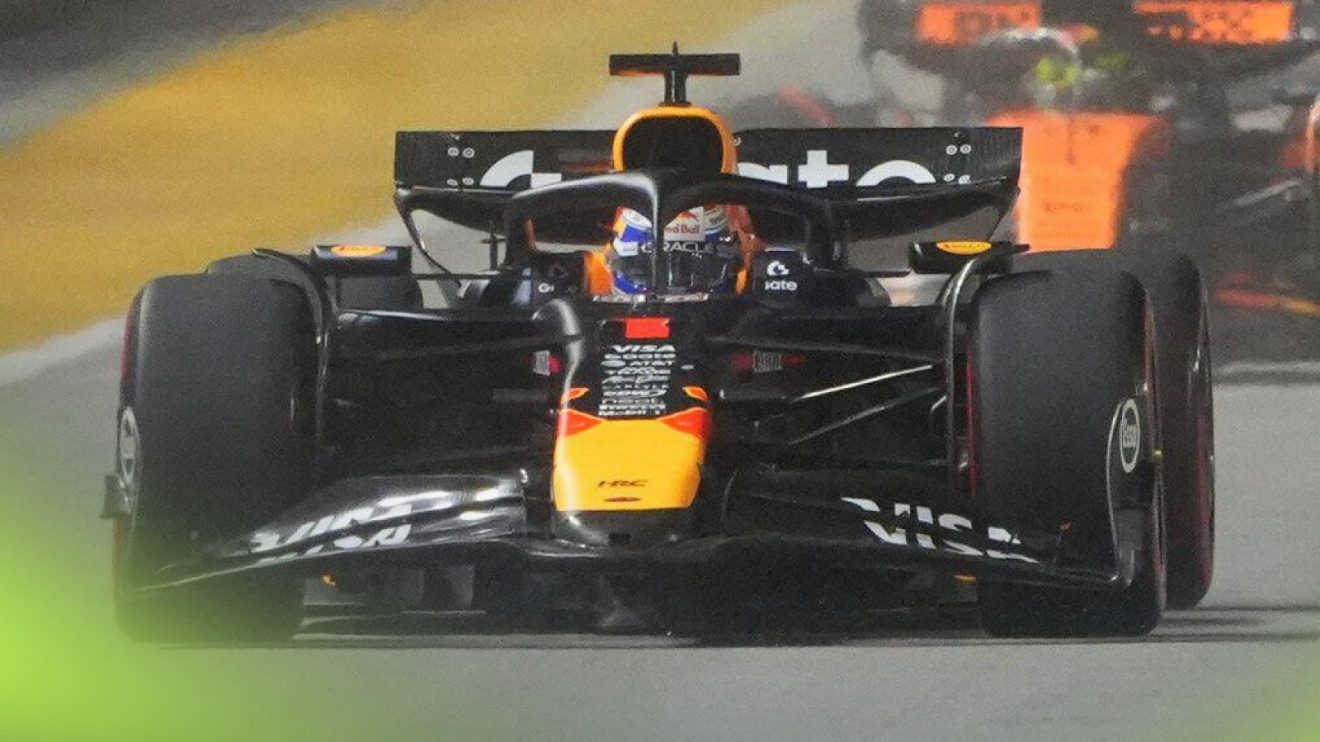
Laurent Mekies believes Red Bull has unlocked performance across the downforce spectrum
Laurent Mekies believes Red Bull has unlocked performance across the downforce spectrum, with Singapore a good litmus test for its high-downforce balance.
Max Verstappen raced to second place at Marina Bay on Sunday, putting in a very competitive showing despite complaining about braking and balance issues from his RB21.
Laurent Mekies: Fighting for the win in Singapore means a lot
Singapore has proven to be a tough nut to crack for Red Bull in recent years, with the Marina Bay Circuit being the only one at which the 2023 World Champions lost during their record-breaking season two years ago.
Having taken two consecutive wins at Monza and Baku as Verstappen proved extremely competitive at the high-speed venues, all eyes were on the Dutch driver in Singapore to see whether his World Championship rejuvenation could continue at a circuit that is at the opposite end of the downforce spectrum.
Verstappen and Red Bull duly delivered, although the four-time F1 World Champion was defeated by Mercedes’ George Russell in qualifying and the race. Nonetheless, Verstappen was able to race to second place, having been of comparable race pace to the Mercedes, and held off the attentions of McLaren’s Lando Norris in the closing stages.
But it wasn’t all smooth sailing. Not only did Verstappen have braking and balance issues that saw him take to the radio to complain about the rear being “like a handbrake”, but his job was made more difficult by starting on the soft tyre.
With rain having hit Marina Bay hours before the race, the slightly questionable conditions could have rewarded the soft tyre gamble but, having been unable to clear Russell off the line, it quickly became apparent the soft didn’t offer a pace advantage and, instead, meant Verstappen had to extend his first stint in order to get far enough to make a one-stop strategy work against the medium-tyre runners around him.
Red Bull had brought along two small revisions to the RB21 in Singapore, minor updates that nonetheless appeared to play a part in the team’s improved competitiveness at its bogey circuit.
For Mekies, the competitive showing at Marina Bay illustrates that the steps forward made with the car during the summer appear genuine, but that upcoming circuits may play more to the strengths of McLaren as Verstappen aims to close down a 63-point deficit to championship leader Oscar Piastri.
“For us, being able to fight for the win means a lot after Monza and Baku, which are very different. You never know until you come to a high-downforce track,” he told media in Singapore.
“We’ve been able to be in the right rhythm from Friday; we were in the right rhythm in qualifying, and we were very, very close to pole.
“And we were in the right rhythm in the race. We finished only a few seconds away from George. So this is good news.
“It means that what we have unlocked is not only low downforce-specific. We will not change our approach. We’ll continue to take it race by race.
“We’ll continue to take the learnings. There are probably quite a few learnings we can make from this race on some small pockets of performance that we may be able to unlock for the future.
“Austin will be a very different equation. Again, it’s back to the famous mid-speed corners, where McLaren has been very strong. Here, Turn 5, Turn 9, they have been very, very strong all weekend against us, and you have a lot of them in Austin and in Mexico. So we take it race by race, and then we’ll see.”
More key Singapore GP talking points from PlanetF1.com
? FIA confirms Lewis Hamilton penalty after Singapore GP breach
? Piastri fumes at Norris’ ‘pretty **** job’ but Brundle defends actions
Laurent Mekies explains Red Bull’s soft tyre choice
Mekies also explained the thinking behind choosing the soft tyre at the race start, the choice that had made Verstappen’s life more difficult in the first place.
“Yeah, it was tricky, honestly,” he admitted.
“Because, as you have seen, nobody tried the dry tyre at first – going to the grid, all the drivers stuck on intermediates, so it was tricky out there. Even though on TV, it appeared a bit dry, it was certainly tricky.
“Then, after, we felt it was the only way we could have a shot at George. We also felt that, with the tricky conditions, it could be an advantage in the opening laps.
“As it turned out, the track was a bit drier than we would have expected, and we could not quite capitalise on George.
“Yes, after, it probably had a cost to the overall race time, but Max did a very good job at defending, both on the soft and then after, on the hard, he had to put on quite early.”
With Verstappen, at one point, bemoaning how “everything was going against him” following his swap to the hard tyre before his balance issues became more pronounced, Mekies said the tyre choice, in terms of magnitude, was probably the biggest compromising factor in Red Bull’s race.
“In terms of a single issue for the race, I’m not able to tell you. I think it was very tough out there,” he said.
“I think we started with the soft tyre; we were one of the only cars on the soft tyre, to try to, obviously, maximise our chance to get Russell at the start. It didn’t happen, and I think that very quickly exposed us to having more deg, to have basically a more difficult car to deal with.
“As a result of that, we pitted earlier and pushed very hard on the hard tyres, and managed to close the gap. But what it meant is that, most of the race, Max has been defending with older tyres, against his competition.
“It’s a choice of aggressiveness that we felt was necessary if we wanted to have a shot at the win. So the good news is that he did a great job at managing to bring the car back in second, despite the pressure from Lando.
“Nonetheless, underneath that, there are probably a few things that we need to work on that were disturbing him during the race, but I will qualify them as being probably of a lower magnitude.”
Read Next: Oscar Piastri v Lando Norris clash: Why McLaren refused to intervene


