

FIA issue strict flexi-wing action with Chinese GP TD


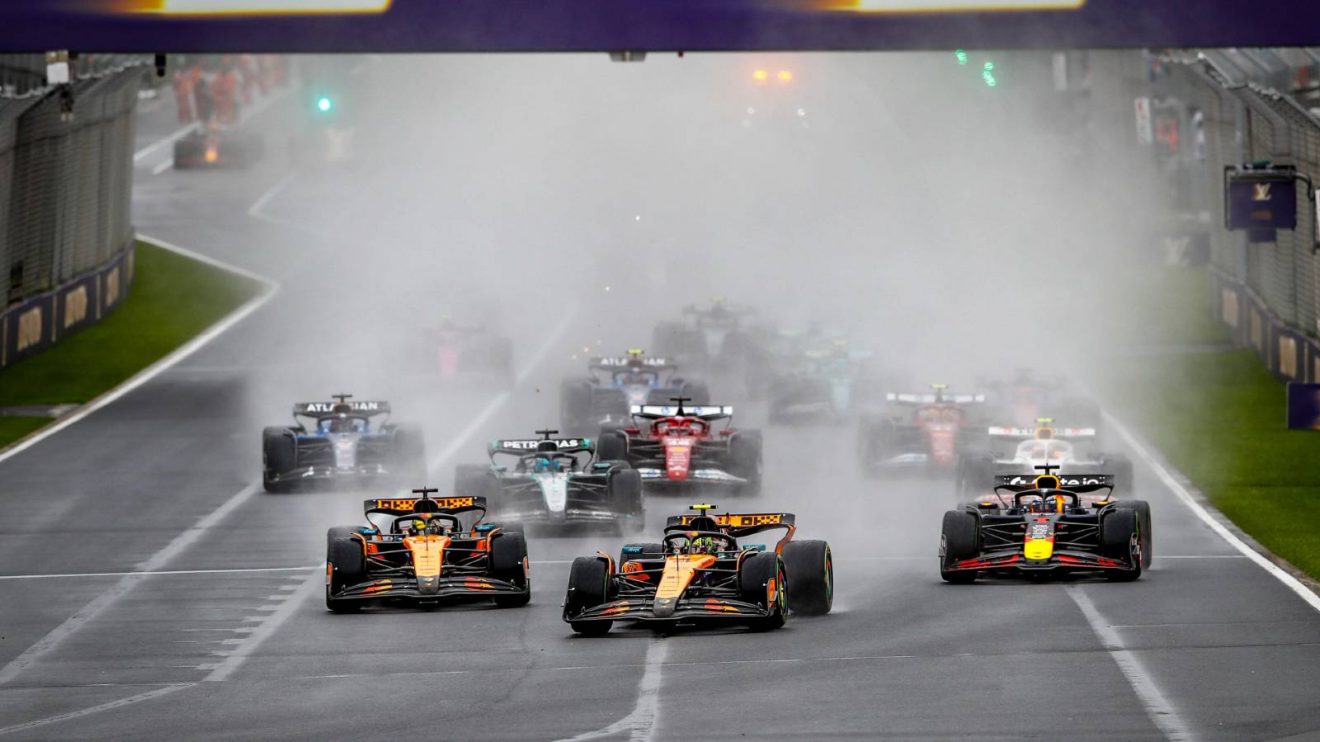
Lando Norris leads at the start of the 2025 Australian Grand Prix
The FIA has confirmed that a new Technical Directive will be introduced in time for this weekend’s Chinese Grand Prix in Shanghai.
It comes amid the ongoing debate surrounding so-called flexi wings at the start of the F1 2025 season.
FIA announced further flexi-wing clampdown for Chinese Grand Prix
After flexi wings emerged as a hot topic in 2024, F1’s governing body has taken a firm stance on the issue in the early months of 2025.
It emerged last month that the FIA will implement more stringent load-deflection tests to the front wing from the Spanish Grand Prix, the ninth race of F1 2025.
Ahead of last weekend’s season-opening Australian Grand Prix, meanwhile, teams were informed of an update to Technical Directive TD034, instructing them to install a rear-facing housing to accommodate a camera for the FIA to monitor rear wing deflection in Friday’s practice sessions at Albert Park.
Analysis: Australian Grand Prix
? Australian GP conclusions: Norris 2.0, the Max factor and why Hamilton needs time
? Australian GP driver ratings: Who mastered the storm in Melbourne?
All cars were found to comply with the deflection limits in Australia.
However, the FIA has found ‘sufficient grounds’ for a ‘tougher test’ to be introduced at the second race of the season in China with a focus on the upper rear wing.
The change dictates that the rear wing’s slot gap ‘must not vary’ by more than 0.5 millimetres when 75 kilograms of vertical load is applied to the rear wing mainplane, down from a range of 2mm stated in the F1 2025 regulations, with a tolerance of 0.25mm.
It leaves the 10 teams, who were informed of the change on Monday, facing a scramble to ready their cars to meet the new demands before the Chinese Grand Prix this weekend.
An FIA statement read: “As has been previously communicated, between the end of the 2024 season and the start of the 2025 season, the FIA exercised the authority it is granted under Article 3.15.1 of the Technical Regulations to introduce either new or more challenging load-deflection tests for the front wing (from Race 9, Spanish Grand Prix), the upper rear wing, and the beam rear wing.
“In addition, the FIA requested to the teams to use cameras in Free Practice Sessions to monitor the on-track deformations exhibited by the cars during the Australian Grand Prix.
“Having analysed footage from the rear wing deformations combined to the static deflections measured inside the FIA garage in Melbourne, the FIA has concluded that sufficient grounds exist for a tougher test to be introduced from the forthcoming Chinese Grand Prix on the upper rear wing.
“More specifically, Article 3.15.17, introduced in 2025, states that if 75Kg of vertical load is applied on either extremity of the rear wing mainplane, the distance between the mainplane and the flap (also known as “slot gap”) must not vary by more than 2mm.
“From the forthcoming Grand Prix in Shanghai, this limit will be reduced to 0.5mm. Due to the short notice for Shanghai only a tolerance of 0.25mm will be added to this new limit.
“The Teams were informed of this revised test early Monday 17th of March.
“The FIA wishes to further confirm that during the Melbourne event all cars tested against the requirements of Article 3.15.17 and found to comply, therefore all cars raced in Melbourne were deemed to be legal.”


