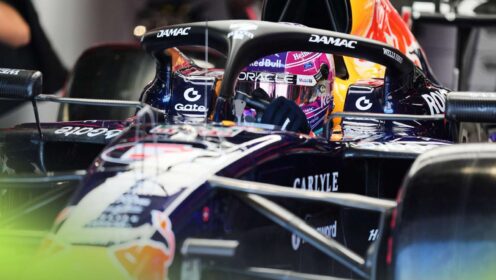

FIA makes late rule change over energy fears at Japanese Grand Prix


The FIA has announced changes to energy rules for this weekend's Japanese GP.
The FIA has acted to address growing concerns over energy-harvesting tactics in Formula 1, introducing a qualifying rule change ahead of the Japanese Grand Prix.
The governing body, in collaboration with the 11 teams, has elected to reduce the amount of energy cars can recharge during qualifying from 9MJ to 8MJ.
FIA adjusts energy regulations ahead of Japanese GP
Want more PlanetF1.com coverage? Add us as a preferred source on Google for news you can trust.
Energy harvesting, and superclipping, have proved major talking points during the opening two rounds of the F1 2026 season.
New power unit regulations have brought with them an all-new style of driving, where cars and drivers sacrifice speed in unusual places.
It’s a practice that is clear in data traces, as top speed flattens out or even drops on a straight, or where drivers clearly lift in areas of the track they’d have otherwise easily been full throttle.
That is done in an attempt to recharge the battery, and deploy that stored energy at a more efficient part of the circuit.
In the opening two rounds, rules have allowed drivers to recharge 9 MJ during the course of a qualifying lap.
The process of doing that is either via recovery under braking, lifting and coasting, or superclipping – when the electrical system siphons power from the internal combustion engine into the battery.
This effectively starves the combustion engine of power, and results in the car reducing in speed despite the driver remaining at full throttle.
It’s a practice that has seen intense criticism from drivers and fans alike with Max Verstappen likening it to Mario Kart while Oscar Piastri branded it an unintuitive driving style.
Ahead of the Japanese Grand Prix, the 9 MJ limit has been reduced to 8 MJ for qualifying, lowering the need for energy recovery practices such as lift-and-coast and superclipping.
“Following discussions between the FIA, F1 teams and Power Unit Manufacturers, a minor adjustment to the energy management parameters for Qualifying at the Japanese GP has been agreed with the unanimous support of all Power Unit Manufacturers,” read a statement from the FIA.
“To ensure that the intended balance between energy deployment and driver performance is maintained, the maximum permitted energy recharge for Qualifying this weekend has been reduced from 9.0 MJ to 8.0 MJ.
“This adjustment reflects feedback from drivers and teams, who have emphasised the importance of maintaining Qualifying as a performance challenge.
“The FIA notes that the first events under the 2026 Regulations have been operationally successful, and this targeted refinement is part of the normal process of optimisation as the new regulatory framework is further validated in real-world conditions.
“The FIA, together with F1 teams and Power Unit Manufacturers, continues to embrace evolutions to energy management, with further discussions scheduled in the coming weeks.”
Read more on the Japanese GP from PlanetF1.com
FIA makes surprise decision for Japanese Grand Prix as key change emerges
Suzuka 130R and Esses set for slower speeds under F1 2026 rules
The change is expected to allow drivers to attack the Suzuka circuit in a more traditional sense during qualifying, with reduced need for additional energy harvesting through lifting and coasting.
Speaking ahead of the weekend, Alpine’s Dave Greenwood suggested speeds in key locations would be reduced as a result of the reduced downforce on F1 2026 cars.
However, he also suggested exit speeds in some corners could be higher because of the additional acceleration offered by the electrical systems.
It was yesterday revealed that drivers will be able to run in the reduced downforce ‘straight’ mode around the famed 130R corner
Throughout the F1 2026 season, the sport as a whole has maintained an open mind about making tweaks to the regulations as more is learned about them.
For now, the reduction in energy recovered during a qualifying lap applies only to this weekend’s event, though that does not mean a similar stance can’t, or won’t, be adopted elsewhere as the season progresses.
Want to be the first to know exclusive information from the F1 paddock? Join our broadcast channel on WhatsApp to get the scoop on the latest developments from our team of accredited journalists.
You can also subscribe to the PlanetF1 YouTube channel for exclusive features, hear from our paddock journalists with stories from the heart of Formula 1 and much more!
Read Next: Aston Martin issues Fernando Alonso statement ahead of Japanese Grand Prix