
Why Adrian Newey’s future is a bigger deal than most F1 drivers


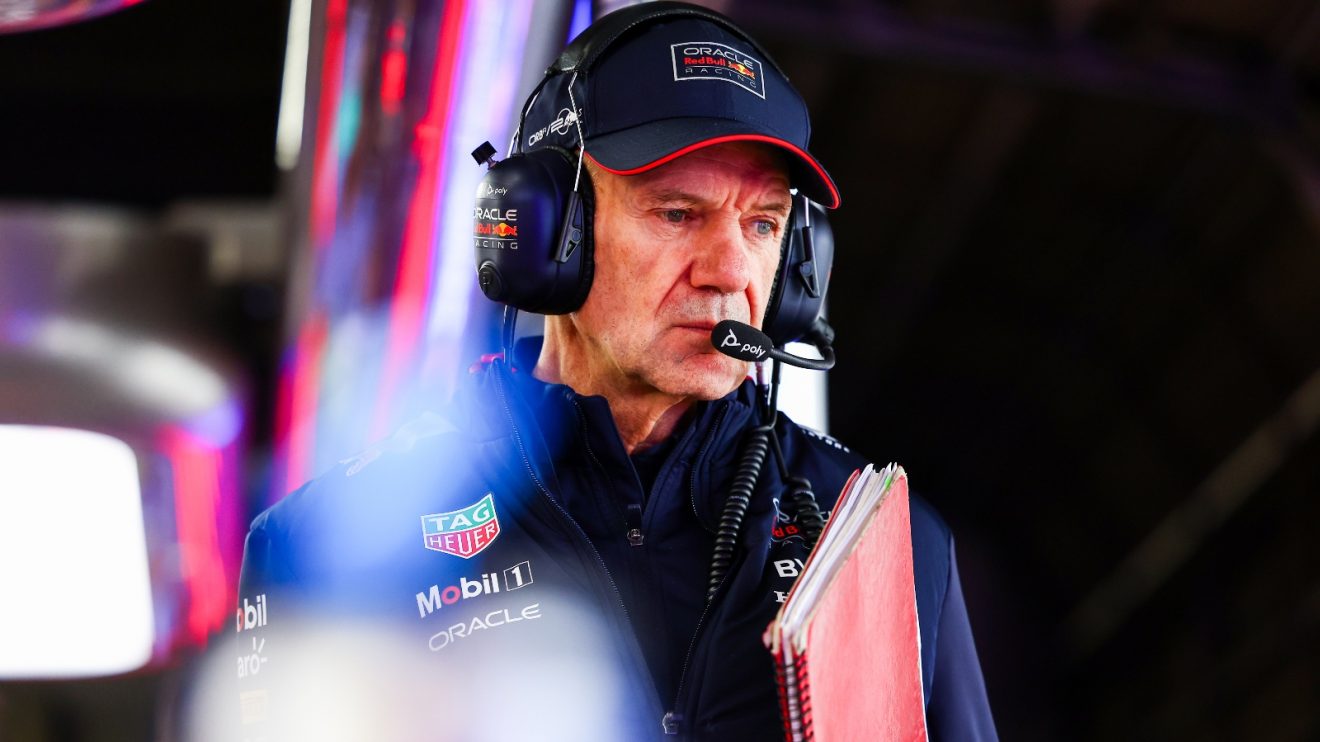
Adrian Newey will leave Red Bull in the first quarter of 2025
Adrian Newey’s future is likely to be confirmed on Tuesday, but why is there so much fuss about which team this particular design engineer works for?
Having confirmed his intention to step away from Red Bull after almost two decades with the Milton Keynes-based squad earlier this year, the F1 world has been agog to find out what Adrian Newey is up to next – but why is there so much fuss around what the 65-year-old engineer chooses to do?
Adrian Newey’s future expected to be confirmed at Aston Martin
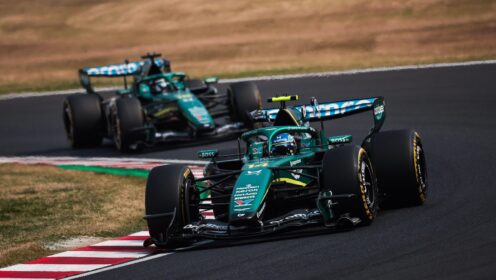
Newey is expected to be confirmed as joining Lawrence Stroll’s Aston Martin F1 team in a press conference at the squad’s Silverstone base on Tuesday, marking the end of months of speculation over what he might choose to do next in his career.
On May 1st, Red Bull confirmed Newey had handed in his notice to leave Red Bull Technologies by the middle of 2025. He had been under contract until the end of ’25, but negotiated an early exit that involved him almost immediately entering a period of ‘soft’ gardening leave, in which he continues to loiter on the peripheries as he keeps working on Red Bull’s RB17 hypercar project while being hands-off from the F1 branch of the company.
Citing a desire to take a step back from F1 as he spoke of his tiredness after almost four decades at the forefront of motorsport design, the big question was whether Newey might opt for retirement, dabbling in the sport via consultancy roles, or commit himself entirely to a new project.
All sorts of speculation have abounded in the months since, with Newey linked to pretty much every other team on the grid – whether that be a return to his former stomping grounds at Williams or McLaren, taking on the mystique of leading Ferrari’s technical efforts, or something else entirely.
Lawrence Stroll’s increasingly impressive Aston Martin outfit appears to have won the squabble over his services, with his state-of-the-art facilities at the team’s base at Silverstone the newest of any on the grid as a brand-new wind tunnel – so crucial to any outfit’s aerodynamic development – comes online before the start of the F1 2025 season.
With the world’s media set to descend on Aston Martin for the expected confirmation of Newey’s arrival, why is there so much fuss about where Adrian Newey ends up? With absolutely no disparagement meant, there’s no other engineer in the F1 paddock who would get this level of attention. Nor would they get the salary figures that are being bandied about.
The BBC has reported an estimated salary of around £30m annually, over five years. Currency adjusted, this would result in Newey being paid just under £150m ($200m) for an expected five-year deal.
While the exact nature of this remuneration isn’t confirmed, nor is it likely to be, PlanetF1.com understands the figures are likely to include team shares offered, as well as annual bonuses, and isn’t just a base salary.
This figure, if accurate, is around double what Newey was on at Red Bull Racing, which was already a formidable figure for engineering talent. Only F1’s superstar drivers earn such eye-watering figures, with Newey’s pay thus being more than some three-quarters of the driving talent on the grid.
More on Adrian Newey and Aston Martin
? Ranked: The top 10 most successful Adrian Newey Formula 1 car designs
? Lawrence Stroll: How the Aston Martin F1 owner made his $3.9 billion fortune
But why does Newey command such salaries, one may ask.
Put simply, Newey is one of the most striking common denominators between several periods of team domination over the last 30 years in F1. Starting off in the sport with March/Leyton House at the end of the 1980s, Newey quickly built a name for himself with quick and agile car designs, before being snaffled up by Williams to work alongside Patrick Head.
Newey’s arrival to oversee the designs of the Williams in the early 1990s coincided with the team going on a run of utter dominance. The 1992 Williams won 10 of 16 races that season, with Nigel Mansell dominating the championship as the Grove-based squad won both titles.
1993 saw a repeat as Alain Prost claimed the title after replacing Mansell, and Williams won the 1994 Constructors’ Championship against Benetton – their season had been one of tragedy as Ayrton Senna died behind the wheel of the FW16 at Imola, although Damon Hill did well to bring the championship battle to the last race at Adelaide.
Neither Hill nor David Coulthard performed particularly well in 1995, meaning the potential of the FW17 went unrealised, but Hill bounced back in 1996 to deliver the title as Williams landed another on the team side. 1997, the last of that regulation cycle, also went to Williams as Jacques Villeneuve followed up on Hill’s success to win his own title.
For 1998, Newey had taken a career gamble to switch to McLaren to coincide with the regulation changes as F1 introduced narrow-track cars and grooved tyres. The MP4/13 was the first designed by Newey, and the car duly delivered – again dominating in the early stages of the season. Mika Hakkinen went on to win the title, as did McLaren. Hakkinen followed it up in ’99, although McLaren fell short in the Constructors’.
McLaren entered a period of being competitive but not quite having enough for titles over the following years, with Hakkinen’s successor Kimi Raikkonen falling short in 2003 and 2005 due to engine unreliability.
With Coulthard switching to Red Bull in 2005, the Scot brought Newey to the attention of Red Bull’s senior management and, a year later, the Milton Keynes-based squad secured the services of the engineer – a huge coup at the time as Newey turned his back on the established big teams to commit to the uncertainty of what the former Stewart and Jaguar team might achieve.
Under Newey’s technical leadership, Red Bull became truly competitive in 2009 as the RB5 proved the outright quickest car in the first year of another big aerodynamic rule change. But Ross Brawn’s eponymous team has started the season in dominant fashion, building enough of a lead to keep Sebastian Vettel and Red Bull from securing its first title.
Having learned its lessons, Red Bull came back the following year and proceeded to dominate the next four seasons as Vettel delivered title after title.
With Newey’s reputation now firmly established and having overseen the growth of the Red Bull team, the dynamic began to change over the following seasons. With the hybrid engines era having started in 2014, Red Bull found itself unable to challenge Mercedes for titles as Renault’s power units proved insufficiently competitive, and Newey took more of a back seat as his role with Red Bull began to change.
This resulted in him becoming Red Bull’s chief technical officer, a broader role overseeing the technological output of the F1 team and its other engineering projects, while Pierre Waché was promoted to technical director. This dynamic has remained in place ever since, with Newey’s role becoming something more akin to advisory, consultancy, and supervisory rather than being glued to his drawing board on a daily basis.
Newey and Waché duly delivered a title-capable car in ’21, which Max Verstappen brought home to win his maiden title, before another regulation reset saw Red Bull steal a march for the start of the ground-effect era to dominate the 2022 and ’23 seasons – ’23 being the most dominant season for a team in the entire history of the sport as the RB19 was only beaten in one race out of 23.
While 2024 has seen Red Bull’s competitiveness fall away for the first time since 2020, coinciding with Newey’s decision to leave, the team still looks capable of securing the Drivers’ Championship, although will now have to fend for itself in 2025 as the team adjusts to life without their long-time technical leader.
Having overseen three periods of dominance at three different teams during three different regulation sets, it’s clear that Newey is a key ingredient for success. While he isn’t infallible, as some of McLaren’s early 2000s offerings proved, his designs have landed 12 Constructors’ Championships and 13 Drivers’ Championships since 1990.
In an interview with the BBC, Newey revealed how part of his skill set is in his ability to picture the airflow over a car – a skill that wasn’t common even amongst the old-school designers that plied their trade before the arrival of CFD and modern software.
As an aerodynamicist first and foremost, Newey initially told the British publication that “of course” he couldn’t see the airflow in his head, but then explained it in a way that suggests that’s exactly what goes on in his mind.
“I can picture it,” he said. “And that’s perhaps, if I try to be objective, one of my strengths, that I can actually picture things quite well in my mind’s eye.”
Of Newey’s contemporaries, only current Mercedes technical director James Allison comes close, with 11 Constructors’ championships and 10 Drivers’ Championships, secured at Ferrari, Renault, and Mercedes – perhaps the only other engineer on the grid who could cause a similar stir to Newey.
Assuming Newey is confirmed at Aston Martin, it marks a line in the sand for the former Jordan/Force India squad – a huge statement signing that underlines the serious intent of Lawrence Stroll’s efforts to disrupt the established F1 hierarchy. Just like Red Bull sought to do two decades ago, this factor of being the unproven underdog appears to appeal to Newey’s competitive spirit.
But, with Newey on board and his proven track record, it means there’s nowhere left to hide and no excuses for Aston Martin in the coming years…
Read Next: Astonishing new Adrian Newey salary figures come to light in $200m deal – report