

What do all-new Monaco GP pit stop rules actually fix?


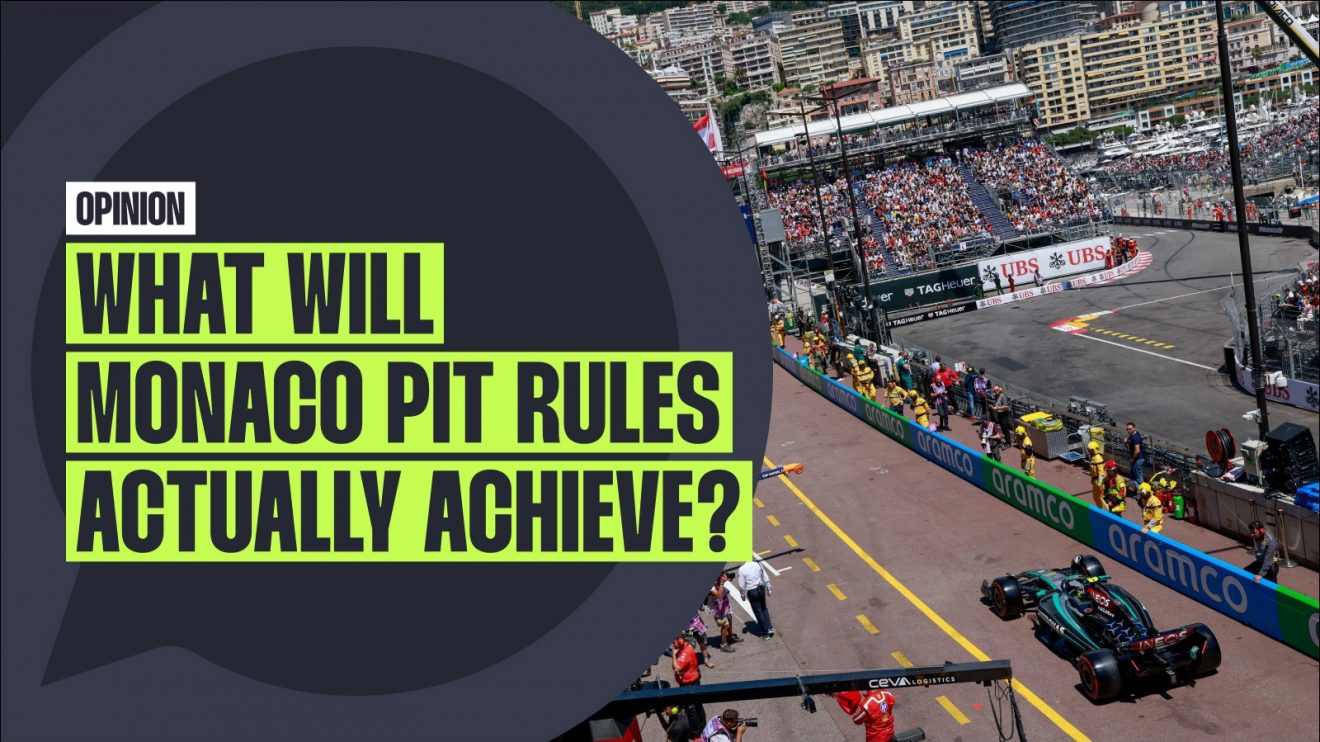
What will Monaco's new pit stop rules actually achieve?
The Monaco Grand Prix is an anachronism on the modern F1 calendar, a throwback from an era many decades passed, clung to amidst the glitz and glamour of the Principality.
It’s the postcard image of the world championship, a revered venue steeped in history at which more concessions are made than anywhere else.
Has Monaco been reduced to a caricature of itself?
But why are such concessions being made to fix a problem that is either beyond repair? Or is the latest move a further blurring of the lines between sport and entertainment?
For this year’s event, new rules have been introduced mandating two pit stops during the course of Sunday’s 78 laps.
It’s a move made to spice up the show as the narrow Monaco streets have historically produced stagnant races; Saturday’s qualifying session has long been the most important of the weekend.
One could argue the new rules are simply a pragmatic concession towards making such a renowned and high-profile event the spectacle it deserves to be.
Monaco is a special event, the postcard of F1 in many respects, though it wasn’t always.
It really came of age in the late 1950s when actress Grace Kelly married Prince Ranier and all her Hollywood friends began to visit.
Princess Grace, as she became known, added a layer of elegance, sophistication, and celebrity to the event which lingers to this day.
Set that against the picturesque Mediterranean Sea and the Monaco GP quickly became a useful place to schmooze potential sponsors and investors.
While less important now, that legacy remains and Monaco remains a high value asset for teams and F1; be honest, would you rather walk the grid in Monaco, or Miami?
And therein lies the challenge. Despite the growth and evolution of F1, Monaco retains an intrinsic value that can’t be quantified in the same way as other venues.
Just last weekend, F1 visited Imola for probably the last time.
The venue is no longer financially viable; it contributes far too little to Formula One Management’s coffers.
With nobody willing to underwrite it to the necessary level, to hell with history and tradition, it has no place on the calendar in Formula One Management’s eyes.
A week later, we’re in Monaco, which also pays comparatively little for its event and yet rather than facing the axe has recently inked a lengthy new deal.
What’s more, new rules have been written purely for this event in an attempt to make it relevant.
The sporting spectacle in Monaco – Saturday afternoon’s qualifying session aside – has been wanting for decades, but we’re all somehow too polite to say so.
And even now, rather than accepting the problem in Monaco is so intrinsic that it likely can’t be fixed, gimmicks are being employed that threaten to cheapen what has been a blue riband event.
Is that really what Monaco has been reduced to; have commercial motivations belittled a revered event a step too far?
And what is the two-stop rule actually meant to achieve?
More on the Monaco GP from PlanetF1.com
? Incredible Ayrton Senna data released from iconic 1988 Monaco Grand Prix
? Motorsport Triple Crown explained: Its prestigious races, history and only winner
The natural response is ‘it’ll make the racing better’, but will it? And what is the end product of ‘the racing being better’? How is that quantified and qualified?
Some races are naturally good, and some are bad. Some venues promote overtaking, others push driver’s to the very limit and punish the tiniest lapse in concentration.
All a second pit stop is likely to do is jumble the order; it’s unlikely to be the magic recipe that introduces wheel-to-wheel action – the cars are too big, too fast, too aero dependent for that to be a realistic chance.
So what it’s likely to achieve is create a couple of sprints from the pit stops, akin to the sport during the refuelling era.
And if we’re honest; was the Monaco Grand Prix back then any better than it was last year, or the year before?
The classic Monaco events have come about organically, naturally, usually thanks to a sudden downpour that serves to highlight what is perhaps otherwise forgotten: that racing a modern F1 car around narrow streets is incredibly difficult and should be revered.
But that message is being lost in pursuit of an answer to a likely impossible question.
It’s change for change’s sake, one that might change the order across the line but seems unlikely to improve the actual action.
Read next: Lewis Hamilton ‘nervous’ with Max Verstappen F1 movie snub explained