

The ‘travesty’ of a Grand Prix track hated by Formula 1 drivers and featured in the F1 75 launch


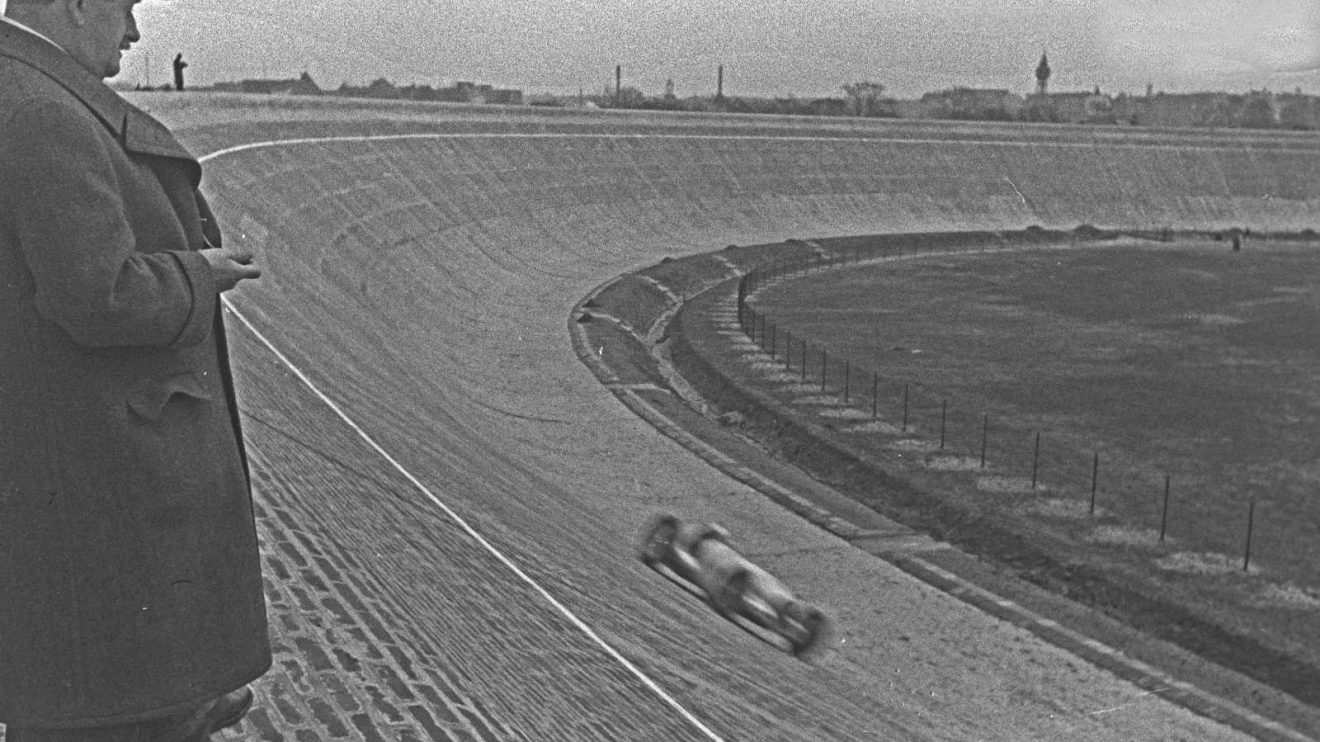
The defining feature of Germany's AVUS circuit is its drastic cobblestone banking.
For every beloved and iconic race track in the world, there are others that drivers simply cannot stand — and one such Formula 1 track was AVUS.
Home of the 1959 German Grand Prix, the Berlin circuit was somehow used for racing between 1921 and 1998, but it was so hated by the F1 contingent that it never made another open-wheel return. And if you tuned into the F1 75 Live launch at the O2 Arena, you’ll have caught a glimpse of the banked track in Mercedes’ seven-minute presentation.
Meet AVUS, the “travesty” of a Grand Prix track
AVUS, or Automobil-Verkehrs- und Übungsstraße (English for ‘automobile traffic and training road’) was first dreamed up in 1907 by the Kaiserlicher Automobilclub as a fee-financed race track and testbed for the automotive industry.
Funds were hard to find, and World War I brought a halt to the circuit construction (at least, until Russian Army prisoners were tasked to work on it).
Businessman and politician Hugo Stinnes finally wrapped up construction of the track in 1921, which was 12.160 miles (19.569 km) in length, and very oddly shaped.
Basically, AVUS was designed as a dual carriageway, so one of its defining features were its ultra-long straights where cars could theoretically hit their top speed. Then, at one end of the circuit was a flat turn that required ample braking to make it around.
But to make the turn at the other end, you’d need to keep your foot pressed firmly to the floor, because AVUS’ second curve was a 43-degree banked turn, and to make it around that fearsome corner, you needed to battle the opposing forces of gravity and speed to find the perfect racing line.
Get it wrong, and you could fly off the top of the banked turn; it wasn’t protected by any barriers, making it extremely dangerous. By 1936, it had earned the nickname “the wall of death.”
More on race tracks from Formula 1 history:
? Ranked: The best and worst F1 circuits designed by Hermann Tilke
? Ranked: The 10 most dangerous corners on the F1 calendar
AVUS was an unlikely track for Formula 1 in the late 1950s, which was, at the time, characterized by either city-center street circuits or classic road courses that twisted through the European countryside. And the F1 drivers hated it.
Allow me to quote from Cars at Speed, a 1961 book by Robert Daley that delves into the historic motor racing circuits at the time:
The drivers hate AVUS. Stirling Moss calls it a “dump,” unworthy of a world-championship race. “If something goes wrong mechanically,” says Cliff Allison, “you have more or less had it.”
The AVUS is a freak track, and has always been recognized as one. […] Today, the AVUS is a truncated version of itself, due to the fact that the old track crossed into what is now the East German sector. When [World War II] ended, it had to be cut down to stay inside the border. Its only feature, then as now, was the north curve banking, located just at the edge of downtown West Berlin. Unfortunately, this escaped the bombing and so racing on the AVUS has continued year after year.”
Daley posits that part of what made the track such a poor fit for F1 was the fact that its inclusion on the calendar was a political move: “To show West Berliners in a sporting way that they are truly a part of the Federal Republic, and to show off the glories of the West in front of presumably envious East Berliners.”
He continued, “Such motives may be noble, but racing on the AVUS is not. The AVUS is a travesty of a road-racing circuit. Its use for teh 1959 German Grand Prix indicates only that motor racing and politics are not only strange bedfellows, but probably permanent ones.
“Whatever the political crisis, motor racing seems destined to be bent to serve it.”
Now, those are some harsh words from Robert Daley, but he wasn’t the only one frustrated by the decision.
“To hold the German Grand Prix on such a circuit, when for years it has been held on the wonderful Nurburgring seems idiotic,” Denis Jenkinson wrote in Motor Sport Magazine.
He continued in his race report, “Apart from the added complications of getting to West Berlin the move was not popular with drivers and entrants as the AVUS track bears no resemblance at all to a Grand Prix racing circuit, as exemplified by the Nurburgring.
“Being 90 per cent a pure speed track it was felt that holding a leg of the Drivers’ World Championship on the AVUS was to make an absurdity of the whole thing.”
The 1959 German Grand Prix was strange for a variety of reasons that had nothing to do with the much-derided track.
According to Jenkinson, the pits and the paddock were so far apart that it was challenging to transport cars, tools, and personnel — resulting in “some pretty violent shouting matches between entrants and organizers.”
Making matters worse was the fact that, rather than focus on hosting a Grand Prix, AVUS also scheduled a sports car race, a touring car race, and a GT race for the same weekend. In the sports car race — which was run in rainy conditions — Jean Behra slipped over the top of the banking and was killed.
And on Sunday, rather than the Grand Prix being held one all at once, the event was contested in two different heats. Drivers had to qualify for their heats, and then the overall finishing order was determined by aggregate placings based on the results of both 30-lap heats.
Both heats were dominated by Ferrari, with the Scuderia placing 1-2-3 on the podium. Briton Tony Brooks crowned the top step, flanked by Americans Dan Gurney and Phil Hill. The rest of the field had either retired or been lapped.
Even though Formula 1 never again returned to AVUS, the track remained in use until 1998, hosting primarily GT racing during the last decade of its existence.
Read next: The nine most unbelievable circuits F1 no longer races on