

Riverside Raceway: The US Grand Prix venue that never got a fair shake


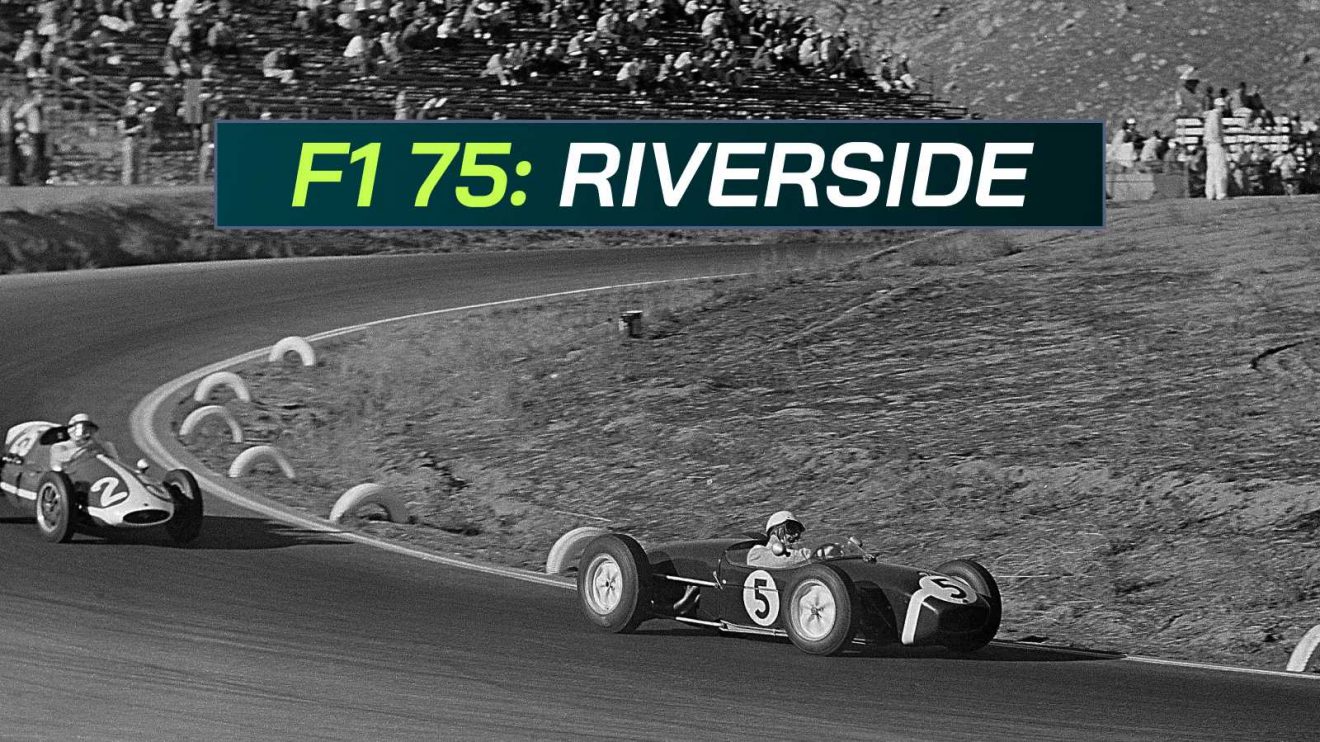
Stirling Moss (5) leads Pete Lovely at the 1960 US Grand Prix at Riverside.
Formula 1 entered the American market with a whimper, not a bang. A first, troubled outing at Sebring was followed by a US Grand Prix at Riverside that should have been a success… had it not been for the hubris of the race organizers.
In honor of Formula 1’s 75th anniversary, PlanetF1.com is celebrating some of the most iconic venues from the sport’s history — and today, we’re looking at Riverside.
Riverside Raceway: A history
Rudy Cleye was working as a maitre d’ in New York City when he realized he was unsatisfied with where his life had ended up. Born in Germany, Cleye had been an irregular feature in the European racing scene before moving to the United States in the 1940s, and he was keen to revive that part of his life.
Many American soldiers returning home from World War II had laid eyes on the gorgeous sports cars rusting away in barns, and they’d learned about the European style of motorsport that simply didn’t exist in America — and they were hungry to replicate it when it was time to return to normal life.
So, Cleye packed up and moved out to Los Angeles, where he founded a company called West Coast Automotive Testing Corp. LA was becoming a hotspot for racing talent, but few proper tracks existed there to facilitate proper racing.
Upon arriving in Los Angeles, Cleye set up a new restaurant — aptly named the Grand Prix — and set to work scoping out a good place for a race track. He settled on a 640-acre parcel of land located in the desert about 60 miles outside of Los Angeles and, stating his intentions to build a race track on it, he earned a permit from the local government to do exactly that.
A man named James E. Peterson was tasked with designing a European-style race track with a handful of configurations, enabling the venue to host everything from drag racing to ultra-professional endurance events. The primary layout was a 3.275-mile course composed of nine turns.
The only problem was that Cleye ran out of money. He’d spent a small fortune to buy the land, but his savings had been sapped; construction needed to kick off within 90 days of earning the development permit, and Cleye simply didn’t have the funds to make it happen. Thankfully, a racing fanatic and regular patron of Cleye’s LA restaurant had just stepped into a fantastic inheritance and was able to front the cash to get started.
Finally, the first race was hosted in late September of 1957; over 250 entries arrived for a variety of races held in front of an impressive 30,000-strong crowd. It was impressive enough that Riverside managed to land the impressive Los Angeles Times as a primary sponsor for its first big sports car racing event in 1958 — an event aptly titled the Los Angeles Times Grand Prix.
With ample promotion in the region’s biggest newspaper, locals flocked to the track in droves. The first event in 1958 is said to have drawn 70,000 spectators, and crowds only grew as NASCAR headed to the track.
In a matter of mere months, Riverside had gone from a dusty patch of desert to one of the premier road racing venues in the United States — and in 1960, Formula 1 came calling.
More from US Grand Prix history:
? How Watkins Glen truly defined F1’s place in the United States
? How a storm-hit race at COTA almost killed the US Grand Prix
How Formula 1 ended up at Riverside
Back when Formula 1 first got its start, series organizers realized that in order to call their championship a “World” Championship, it would be smart to schedule a race outside of the European continent. And for the first 11 years of the sport, the Indianapolis 500 counted as an F1 event, simply because it was the only big-name racing event that took place in America.
Only Alberto Ascari ever tried the 500 while it counted toward the F1 championship; then, in 1959, Sebring Raceway hosted the first proper US Grand Prix. It was a barnburner of a race, but the track itself left a lot to be desired in terms of amenities, location, and more.
Alec Ulmann, the Russian-born emigré turned American race promoter, had inked a three-year deal with Formula 1. For those years, he was in charge of negotiating the promotion of Grands Prix in America, and after the disaster at Sebring, he knew he needed to look elsewhere for 1960’s event.
Enter: Riverside.
As we’ve already touched on, Riverside was a beloved hub for American road racing, and it was a natural new location for the US Grand Prix. The only problem seemed to be Alec Ulmann.
Riverside had close ties with the local press — particularly the Los Angeles Times. One of the paper’s writers, Paul Schlisser, headed up the promotional team for the circuit, which was a great sell considering the paper also sponsored the track’s biggest annual sports car event.
In negotiating an event at Riverside, Ulmann had promised both the track and Formula 1 that he anticipated a crowd of upward 70,000 — a figure he’d landed on based on the attendance numbers for the track’s highly popular Los Angeles Times Grand Prix.
In reality, the 1960 US Grand Prix attracted 25,000 people — with some sources putting the number closer to a measly 5,000.
There were many reasons why that could have been the case. The championship had already been wrapped up, so promotional hype was limited. Plus, F1 was still a relatively new phenomenon to Americans, so they had less reason to turn up when compared to the LA Times GP.
But Ulmann blamed the media.
“I am afraid there will have to be a change of attitude on the part of local press before I or any other organization would bring big time racing in [southern California] again,” he lamented.
Ulmann alleged that the Los Angeles Times had intentionally failed to promote the US Grand Prix due to its sponsorship of the Riverside sports car race.
He claimed that the paper only began promoting the race in “the last few days” before it would take place, and that “the advertising we could buy… looked like nothing after what the public had become used to expecting from events organized by the local papers.”
For their own part, the local media took exception to the way Ulmann had “bounced in with the missionary attitude so typical of New York types arriving on these shores […] that they were the big town bringing light and urbanity to the grateful provincials.
Another concluded that Ulmann “may be a hard man to do business with in the future.”
Even though the World Championship had been settled by that point, and even though big-name teams like Ferrari saw no point in traveling so far for an unwinnable championship, the race was a hit.
Though the California community was familiar with race cars, it had seen nothing like the spectacle of Formula 1. Local announcers at the track were so overwhelmed by Jack Brabham’s mighty push into the first corner that the only commentary they could muster was, “Wow!”
Stirling Moss arrived at the track with a privately-entered Lotus and promptly took his 14th Grand Prix victory after the competition struggled to come to terms with the twisty desert circuit.
The event was nowhere near successful; with so few fans on hand, the anticipated ticket money never turned up, forcing Alec Ulmann to cover the prize purse from his own savings account — and his confidence had convinced him that the winner should earn a hefty $7,500 check (or about $80,000 today!).
Riverside was naturally out the question for 1961, and Ulmann’s baby, Sebring, was so unloved by the Formula 1 fraternity that another race there was out of the question. He pitched ideas for events at Daytona, Laguna Seca, and even in the Bahamas — but as the 1961 F1 season got underway, there was a big ‘TBD’ slapped beside the US Grand Prix when it came to a firm date or location.
As it turned out, Ulmann would be unable to secure that third event. Instead, Formula 1 found a willing participant in the form of Cameron Argetsinger, a man in charge of an upstate New York track known as Watkins Glen International.
Read next: Mario Andretti: The American racer who rocked the world of Formula 1