

Why post-race FIA verdicts can take so long – and how huge delays can be fixed


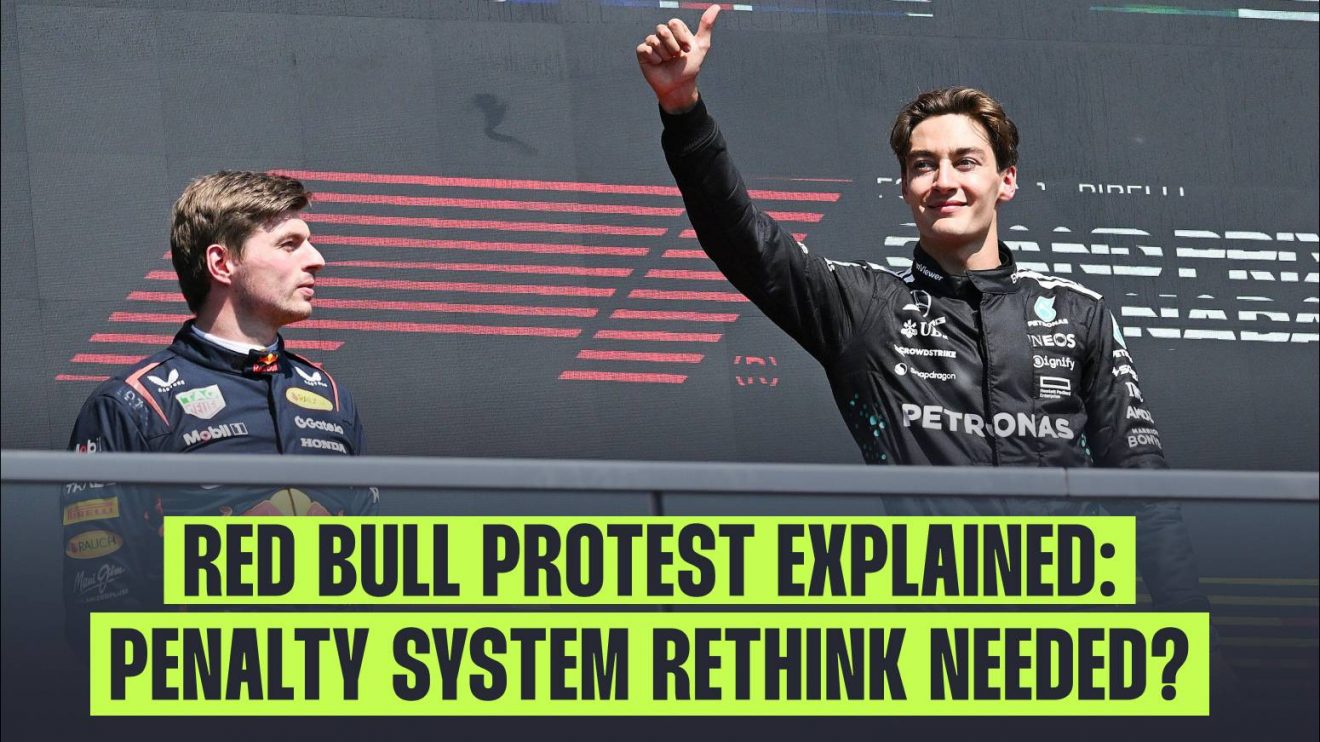
Red Bull's protest of Mercedes' George Russell triggered a lengthy delay in confirming the Canadian GP results.
Red Bull’s protest against George Russell meant the final results of the Canadian GP weren’t known until hours after the race.
George Russell’s win at the Circuit Gilles Villeneuve wasn’t confirmed until five hours and 38 minutes after the chequered flag, due to Red Bull lodging protests regarding Russell’s driving under the Safety Car in the closing stages.
Why did it take so long for the Canadian GP results to be formalised?
Less than half an hour after Mercedes’ George Russell crossed the line first in Montreal, the FIA issued its usual provisional race classification.
This classification is the first iteration of the results and assumes that everything is, on face value, above board – the cars are all legal, all in-race time penalties have been served, and there are no post-race concerns to deal with.
However, ‘provisional’ is very much the operative word and, while the fans switch off their TVs to continue their day or the circuit grounds clear out, the administrative process of signing off on that provisional classification begins – with no guarantee that seismic changes might not be made.
On the technical front, the scrutineers pore over the cars to ensure conformity with the various regulations, and, once satisfied, technical delegate Jo Bauer signs off that each competitor’s car has passed the multitude of checks and tests they are put through.
If there are no further post-race matters to deal with once this technical scrutineering has been cleared, the stewards can sign off on the final race classification that seals the results. In Canada, this took five hours and 38 minutes to arrive after the chequered flag, due to a multitude of issues the stewards had to take care of.
Drivers making post-race visits to the stewards’ offices have become increasingly regular in recent years, with potential transgressions often referred to the stewards for a proper post-race analysis.
This is a tricky balancing act. After all, in-race penalties make more sense so that matters are dealt with in full by the chequered flag but, on the flip side of that, a hurried decision made without the logic and intentions of the drivers involved being taken into account could be unfair.
There were several incidents that required the attention of the stewards following the chequered flag in Canada, and the regulations demand that these incidents are reviewed chronologically – meaning that lesser incidents such as investigating Esteban Ocon’s alleged erratic driving needed to be dealt with before the seven-car investigation for a Safety Car infringement after the chequered flag.
With the stewards settling in to deal with these matters, their workload was then added to by way of lodged protests from Red Bull against Mercedes’ George Russell for incidents behind the Safety Car.
These protests threatened the whole outcome of the race, representing the biggest interest to the fans who had just spent hours seeing Russell take a well-deserved victory, but the certainty of the result wasn’t confirmed until several hours later – a situation that several sources have indicated as being less than ideal.
The provisions of the International Sporting Code only allow competitors to lodge protests against the results of the provisional classification within a time limit of 30 minutes of the publishing of this document.
What was the process of dealing with Red Bull’s protest against George Russell?
Key insight into the process of hearing Red Bull’s protest against George Russell, and the considerations involved in the deliberations, have been provided to PlanetF1.com and sheds light on why the process to reach a conclusion can take so long – even with the desire to turn things around quickly.
With the five stewards already embroiled in the matters of writing up the documentation for any in-race penalties and issuing summons for any post-race investigations, the protests being lodged by Red Bull means the stewards also have to issue summons to both teams – the primary party (Red Bull), and the responding party (Mercedes).
This process sees the summons issued 30 minutes after the protest is lodged (which, in itself, wasn’t lodged until quite a while after the chequered flag) and gives the responding party time to prepare its defence – the primary party presumably already has its case pulled together before lodging the protest.
On top of that, media obligations for TV and written media are taken into account, with drivers being left alone to complete these obligations out of consideration for the timings of live TV and the on-site journalists, before heading off to any meetings with the stewards.
Once the hearing goes ahead, both parties (ie. Red Bull and Mercedes) present their respective cases together. As is often the case, telemetry and data may be provided to the stewards, and this telemetry requires verification for accuracy and clarity.
This particular hearing took some 45 minutes to conclude, with Red Bull and Mercedes presenting their cases.
After the cases have been put forward and the respective personnel depart, the stewards begin their deliberations. This can take anywhere from 30 minutes to an hour, deciding whether or not the protest is admissible under the regulations (as Red Bull’s was), and whether or not to uphold the protest (which Red Bull’s wasn’t).
If the stewards needed additional input to gain better understanding, the FIA’s sporting director Tim Malyon or technical director Jan Monchaux can weigh in, while the likes of Bauer or single-seater director Nikolas Tombazis may also be called upon for information that goes towards making decisions.
Unlike in a court of law, in which a verdict is announced with reasoning following later, the stewards issue their findings and the reasoning at the same time – this requires paperwork to be compiled and is aimed at stamping out conjecture and confusion as to why particular decisions have been made.
Another important factor that can contribute to delays is that, once a decision is made, the outcome is communicated to the relevant parties before the public. In this case, both Red Bull and Mercedes must have confirmed receipt of the stewards’ findings before the FIA makes it public.
If the representatives have boarded a plane and begun their trek home, or are otherwise uncontactable, then the stewards simply wait until this acknowledgment of receipt is received. While this didn’t happen in this particular instance, it can add considerable delays to an already lengthy process.
More on the FIA and F1’s governance
? FIA explained: What does it stand for and how does it govern F1?
? F1’s penalty system explained: How does a driver pick up a penalty from the FIA?
What could be done differently to streamline the process?
A big part of the long delay in confirming Russell’s victory stemmed from the regulation which states matters must be dealt with in chronological order, rather than in terms of priority.
This meant that, while the world waited to see if Russell or Verstappen would be given any possible penalties, the stewards had to deal with comparatively minor issues and paperwork first, such as Ocon’s alleged transgression, Ollie Bearman failing to follow the Race Director’s instructions on how to rejoin the track, the McLaren clash between Lando Norris and Oscar Piastri, and the seven-car post-race Safety Car incidents which resulted in warnings being issued.
Verdict after verdict was reached on these lesser incidents, and paperwork for each was issued, with uncertainty still remaining over the race winner as, finally, the stewards could tackle the issue of the protest, reach a conclusion, and draw up the paperwork.
It’s understood that there is now a desire to start dealing with post-race investigations in order of priority rather than chronologically, which would streamline the process considerably. This hasn’t come about as a result of Canada, specifically, although the length of the delay may just expedite the urgency of altering the process for efficiency.
While the final race classification in itself wouldn’t be any quicker in arriving, confirmation that Russell and Verstappen weren’t being punished would, at least, have confirmed the podium finishers and the most important race results considerably quicker.
Making the necessary regulatory changes to make this happen is understood to not be a point of contention amongst the teams, and there is a willingness to amend this particular foible of the regulations – something which may end up being put in front of the F1 Commission in the near future.
With only five stewards going through this process, an obvious solution is to simply boost the number of personnel involved, which would also allow for delegation of tasks – some personnel could be assigned to work on one matter, while others work on another transgression.
What usually happens at present is that one steward will pore through the rulebooks, while another – usually, but not always, the chair – takes charge of writing up the documents. These documents are then checked through by the FIA’s support department to ensure clarity and grammatical accuracy and, once all the boxes are ticked, are sent out to the parties involved.
Doing this for individual cases slows down the process, while an FIA spokesperson has pointed out that investment in resources and technology is constantly under review to ensure that the governing body has all the tools it needs to improve efficiency in this area.
What other solutions could make the stewards’ jobs easier?
One hypothetical solution to help speed things up considerably would be to separate transgressions by their rulebook.
If a car fails scrutineering, or there is an allegation on the grounds of the technical regulations, there is no quick and easy solution – the matter must be dealt with as appropriate in order to verify that the car raced was completely legal for the ruleset under which all competitors are expected to uphold and, if not, throw that car out of the results.
However, in the arena of sporting matters, such as track limits, distance behind the Safety Car, even questionable overtakes or on-track collisions – anything that falls under the Sporting Regulations – perhaps these shouldn’t be considered as relevant to the race in question.
Rather than applying penalties in retrospect, contributing to the uncertainty of the race result for hours, why not look ahead and apply penalties to the next race?
This would mean that once scrutineering is complete, the stewards can sign off on the final race classification and complete the result, and any post-race investigations can be heard as and when – even remotely – with an eye to consideration of penalties for the next round.
For instance, hypothetically, had Red Bull’s protest against Russell been upheld, the British driver would be allowed to keep his Canadian result but, perhaps, could be given a grid penalty for the following Grand Prix.
In other words, leave the results of any given race alone for sporting regulation matters but apply a penalty for the following race. It would ensure that there is considerable impetus to behave, considering the risks to the following weekend, and would streamline the post-race process considerably.
Read Next: Uncovered: Oscar Piastri’s incredible reaction to Norris clash in untelevised Canadian GP team radio


