Formula 1’s development race moves at a frenetic pace, which often means some of the best technical images are missed in the melee of a race weekend.
So, with a few weeks’ break until the next race, let’s delve into some of the best images of the season so far. And be warned, the intricate detail these images reveals could make them not safe for work!
Detail orientated
From front wings to sidepod inlets, all the way to brake ducts and everything in between, there’s not a surface on an F1 car that isn’t specifically tailored to a team’s design desires, all of which offer an incredibly interesting vista.
While much of the work we can see, it’s the nuance and the details hidden below the surface that paint the clearest picture of why one team performs better than another.
A rare glimpse of the underfloor and fence arrangement on the McLaren MCL39 shows the lack of uniformity in the surface geometry.
Sticking with the floor, here’s a shot of the underside of the Sauber C45, with much of that focus on the plank region.
A peek under the front brake drum on the Red Bull RB21, with the window in the fairing above the brake disc closed off on this occasion, whilst the caliper fairing is off, revealing its detail.
An overview of the front wing and nose assembly on the Racing Bulls VCARB02
A shot of the Aston Martin AMR25’s rear wing assembly without the upper flap in place or the DRS pod fairing reveals some of the internal design aspects that we might not otherwise see.
Overview of the rear wing on the Ferrari SF-25, with the notable detail being how the tip section is wrapped over the mainplane juncture.
The outboard section of Haas’ front wing features a winglet stack in the rearmost corner to aid in generating outwash.
A close up of the upturned section at the front of the edge wing assembly on the Alpine A525, which shows how the three vanes attached to it are angled to get the desired aerodynamic effect.
Looking back toward the front of the floor section on the Red Bull RB21 reveals the intricate geometries being employed.
A close up of the curved wingtip arrangement used at the endplate juncture on the McLaren MCL39’s front wing earlier in the season.
By comparison the renewed design introduced at the Canadian Grand Prix but not raced until Imola, features what McLaren described as ‘Mermaid tails’.
This top down view of the Aston Martin AMR25’s edge wing shows how upwardly swept the forward section is and how the vanes will have an impact on the airflow.
The ‘bib wing’ on the McLaren MCL39
The two inlets in the face of the Racing Bulls VCARB02’s sidepod
A look at the Mercedes power unit as it’s wheeled into the Aston Martin garage
A look at the details around the edge of the Red Bull upper flap and tip section with DRS open
A close up of some of the inboard front suspension elements on the Haas VF25
The inner pipework, channels and fairings used to deliver cool air to the various components of the McLaren MCL39’s front brake system.
A look at the detail in the outer portion of the Mercedes W16’s front wing
Side view of the Ferrari SF-25’s front wing endplate, with the main focus on how the flap connects to it in the lower half. Notably Ferrari also has a winglet above the flapped section at the rear, which results in a larger cutout in the endplate to allow the airflow the passage it requires to aid in outwash generation.
The secondary drum on the Red Bull RB21 has a number of vanes pressed into its surface to help direct the passage of the air as it moves between it and the outer drum normally fixed over it.
A top-down overview of the Williams FW47’s front wing
A look at how the Honda power unit and ancillaries are installed in the rear of the Racing Bulls VCARB02
The floor edge on the McLaren MCL39, which features an edge wing with an upswept forward section and gently tapering tail section.
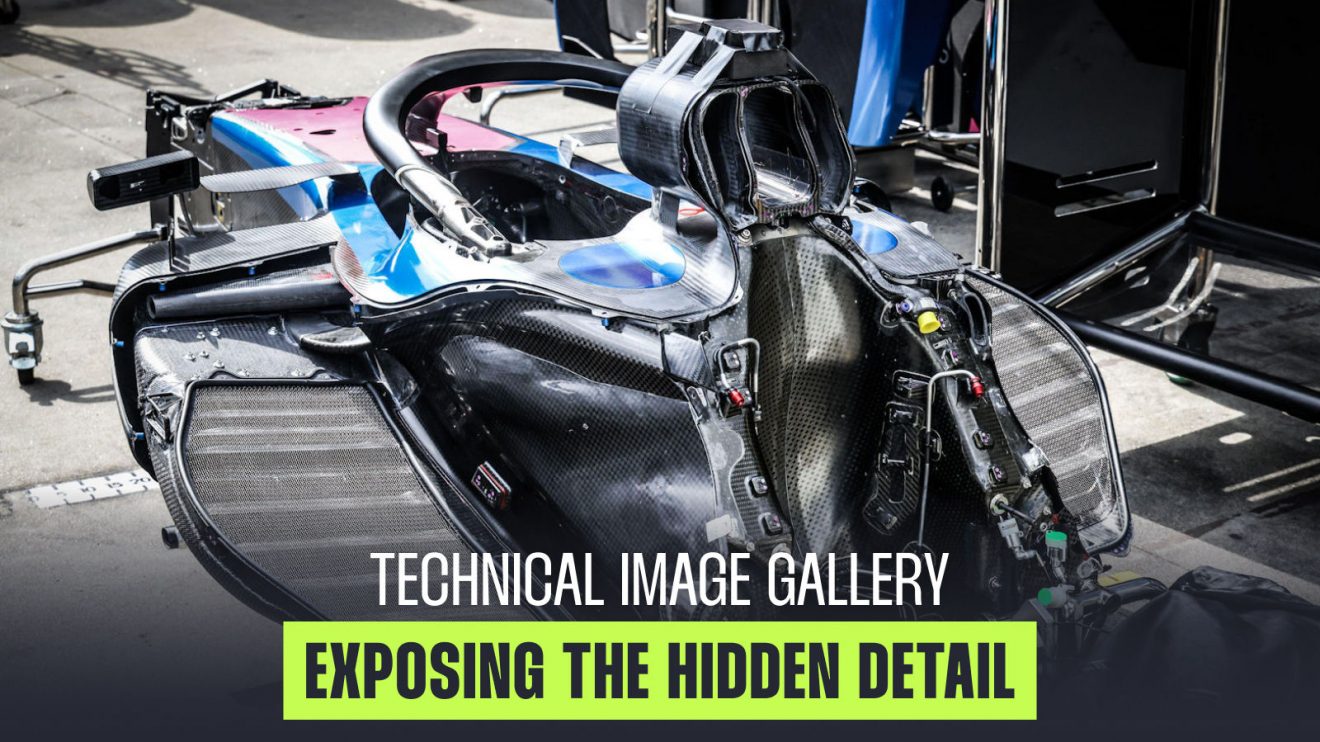
Alpine’s spare chassis was left out in the pitlane for the marshals to use for extrication practice, but this gives us a rare glimpse into how the chassis is laid out.
The rear corner of the McLaren MCL39, with focus on the rear brake duct winglet and the cutouts used and tabs applied to that surface.
A close up of the endplate and tip section juncture on the Mercedes W16, where designers have pulled the tip section down and over the rolled section of the endplate to allow for a larger cutout.
The fairings and pipework layout on the rear brake duct of the Sauber C45
A close up of some of the inboard front suspension elements on the Haas VF25
A look under the Ferrari SF-25 chassis during the build on a Thursday, reveals the bib damper being employed.
A look at the leading edge and floor fences on the Aston Martin AMR25, with their various geometries, which aren’t uniform as you might expect.
The internal duct, pipework and fairings used inside the rear brake duct on the McLaren MCL39.
An overview of the front suspension fairings on the Red Bull RB21, which now feature more winglet-styled sections at the chassis end.
Sauber’s lower downforce rear wing arrangement, which features a minimised mainplane and upper flap, whilst the upper corner of the tip section has also been trimmed extensively
Aston Martin has an inlet in the sidewall of the fairing around the halo’s rear leg in order to provide some refuge to the airflow passing by and reduce some of the inefficiencies that might otherwise be present.
The rear portion of Red Bull’s edge wing has been updated in recent races to feature a L-shaped that runs under the floor. It also features two vertical vanes, the innermost of which doubles as a support bracket.
A rare glimpse at the underside of the floor on the Sauber C45 reveals how much variety there is in the shape of the floor fences