

New McLaren rear wing spotted as FIA ramp up flexing investigations


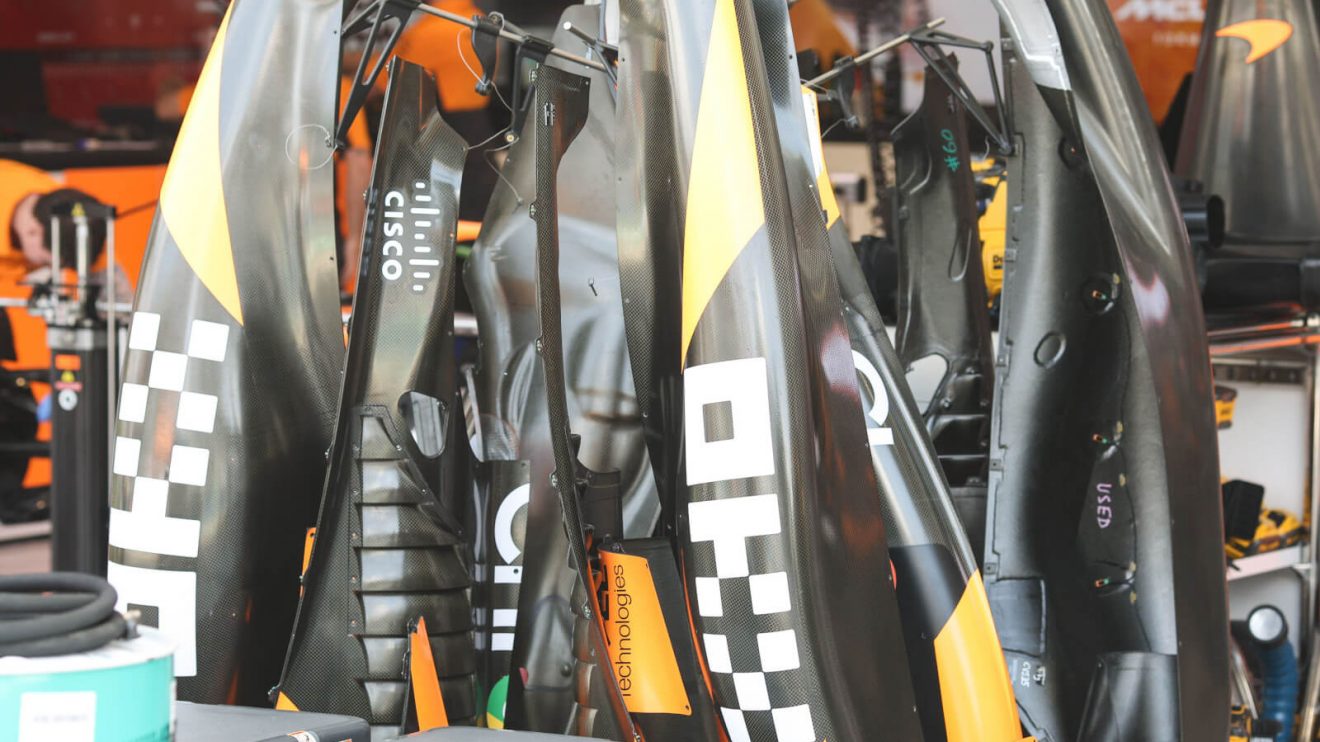
McLaren bodywork for the Brazilian GP
After two thrilling weekends in the Americas, Formula 1 heads to Brazil for the final stop on this latest triple header of the calendar. Known for its deep racing heritage, Brazil has given F1 some of its most legendary moments, with the Interlagos circuit consistently delivering high-stakes, unforgettable races.
The track’s unique layout and unpredictable weather keep teams and drivers on their toes, ready to adapt to every twist and turn. Let’s explore the specific challenges of this iconic circuit and see how the teams are preparing to face them.
All you need to know about Interlagos
The Autódromo José Carlos Pace, better known as Interlagos, is a 4.309 km track where drivers will tackle 71 laps on Sunday. The circuit requires utmost precision from both drivers and car setups due to its mix of long straight and tight corners. This place has seen some fantastic weekends over the years, especially in 2021. Overtaking here is generally easier than at many other tracks, and we can almost certainly expect a two-stop race, adding an extra layer of excitement.
One common thread across all three races in the American leg has been newly resurfaced tracks. In Austin and Mexico, only a few sections were repaved, while in Brazil, the entire track – including the pit lane – has been resurfaced.
This presents engineers with a challenging weekend, as the new surface introduces a lot of unknowns. Adding to the complexity, Brazil hosts a sprint weekend, meaning only one practice session before sprint qualifying. This limited time makes it harder for teams to gather all the data needed to fine-tune car balance to match the new asphalt.
Therefore, as we saw in Austin, the single practice and sprint race will be crucial for teams to collect as much information as possible to best prepare for Sunday. We can also expect lap times to improve significantly as the weekend progresses, thanks to the “rubbering-in” effect on the fresh surface.
To make things even more unpredictable, Pirelli has decided to bring softer tyres than last year, with the hard compound as C3, the medium as C4, and the softest as C5. Last year, nearly all drivers started the main race on softs, then switched to mediums, ending the race again on red-marked tyres.
And let’s not forget about the unpredictable weather, which can change in an instant over Brazil.
Brazilian Grand Prix: Aerodynamic setups for the weekend
Teams generally go for a mid-to-high downforce package to optimise grip on Interlagos’ twisty infield while maintaining stability through iconic corners like Senna’s S and Curva do Sol. However, balancing downforce with low drag is essential for high speeds on the long main straight.
Configuración alas traseras para Interlagos
Rear wing configurations for Interlagos#BrasilianGP pic.twitter.com/ipIK4M6Z8s
— Albert Fabrega (@AlbertFabrega) October 31, 2024
Y 4 más
And 4 more#f1 pic.twitter.com/1npBeiTN5W
— Albert Fabrega (@AlbertFabrega) October 31, 2024
From the images above, we can see that high-downforce setups are favoured by many teams, especially Aston Martin and Red Bull. Rear-end stability is crucial here, with the rear-right tyre taking the most strain, as Interlagos is an anti-clockwise track. Given all factors, keeping rear tyres within the optimal temperature range will likely be tougher than usual.
A team worth highlighting is McLaren, who brings a new rear wing to this race. We saw earlier upgrades from McLaren that brought solid gains, and these changes appear to be refinements to those updates.
The rear wing’s main plate now has a different central shape, with a “spoon” geometry that’s more pronounced. The DRS plane remains at a steep angle, enhancing top speed with the system open.
Another detail noticeable in the rear wing images are the load measurement points, used later by the FIA to check for wing flexing.
After the race, the FIA will use footage from the rear cameras to monitor any wing deflection against permitted limits. This isn’t new, but the number of load points has increased, now placed in pairs for better monitoring.
More on the Brazilian Grand Prix
?Meet the FIA stewards who will enforce rules at the Brazilian GP
?F1 AMA: We answered your questions ahead of the Brazilian Grand Prix
Brazilian GP: Who will be best suited to Interlagos?
In this exciting and unpredictable F1 season, it’s challenging to make firm predictions. One interesting fact is that the last four races have each had a different winner, something we haven’t seen in ages.
Ferrari currently looks like the team in the best form, although the MCL38 is still the car to beat on pure performance. When in clean air, Ferrari drivers manage to maintain an advantage on track, as we’ve seen in the last two races. However, the new surface and limited time for adjustments will shift the focus more onto each team’s engineers, who will have a crucial role this weekend. So, Ferrari and McLaren seem to be the top contenders for victory – unless we get a surprise.
Alongside them, we have Red Bull and Mercedes, both struggling with form. Red Bull still seems stronger with Max Verstappen at the wheel, extracting every ounce of performance from his car. These two teams were the only ones to win the main races in the last five weekends at this track.
All eyes will again be on Verstappen and Norris as they continue their championship battle. Their teammates, both lacking the expected form, will also play a critical role. What’s certain is that we’re in for a weekend full of excitement and action.
Read next: Five big questions we want answering at the Brazilian Grand Prix