

New McLaren ‘mini-DRS’ data reveals true impact on MCL38 performance


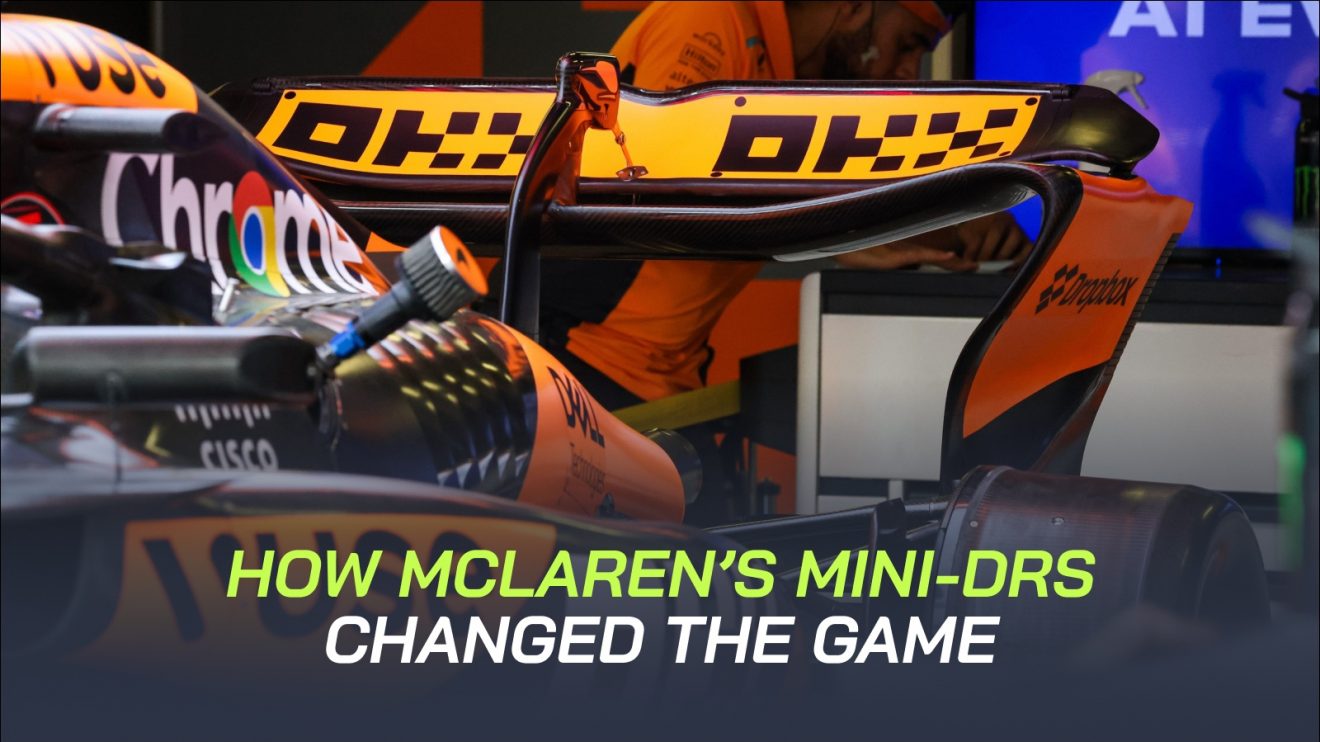
McLaren's Baku rear wing was a gamechanger but did not last long.
McLaren, and no other team, were able to take advantage of the ‘mini-DRS’ that set off alarm bells for the team’s rivals during the Azerbaijan GP.
Much has been said about the legality, illegality and true effect of McLaren’s low downforce rear wing, but was it really a game-changer or just an extra aid to the overall performance of the MCL38 package? And how much will it affect the performance of McLaren’s 2025 challenger?
Revealed: The true impact of McLaren’s mini-DRS rear wing
McLaren first introduced the controversial rear wing spec at the Belgian GP. In fact, in the car updates document for this race the team explained that the purpose of this spec was to use it recurrently at the following high-speed circuits like Italy, Azerbaijan and Las Vegas:
“In anticipation of high isochronal circuits, a less loaded Rear Wing assembly is introduced for this event, with the aim of reducing drag efficiently”.
And it is obvious that the ‘mini-DRS’ was a great help in reducing the drag induced on the MCL38. In fact, this has always been perhaps the biggest weakness of this car. Highly efficient in mid-high speed cornering, great traction on corner exit, but slightly down on straight line speed compared to Ferrari and Red Bull, for example.
During the Italian GP, the effect of the ‘mini DRS’ was less noticeable. Monza is a very low downforce circuit where all the teams are really looking for the minimum possible level of angle of attack to their wings, hence looking for the least ‘draggy’ compromise. Therefore, the bending of the upper flap of the leading edge of the rear wing is less noticeable in these cases.
In fact, it had no major impact in qualifying. Both with the DRS active and with the DRS inactive, the speed differences always remained within 5 km/h of Ferrari. The big question that is really hard to find an answer to is: were these top speeds achievable thanks to the ‘mini DRS’?

In the race, however, it is true that taking the average speeds of both Oscar Piastri and Charles Leclerc with DRS active and inactive, there are slight differences. Both reach the same top speed without DRS activated, but in top speed with DRS active Oscar Piastri had a better average speed.

Where the effect of this ‘mini DRS’ was really felt thanks to the increased flexing of the leading edge of the upper rear wing flap was in the Azerbaijan GP. Even more so in the race than in qualifying, which was precisely where the onboard cameras revealed the Papaya team’s ‘trick’.
Before the start of the weekend, it is worth noting that of the ‘Big Four’ teams, McLaren chose within the range of low downforce settings, the highest downforce to aid performance in Sector 2 and tyre management in the race. It was therefore to be expected that their top speeds would be the lowest.
But despite this, the striking thing about the data is that Oscar Piastri was quicker than Charles Leclerc and about the same as Sergio Pérez – with lowest downforce set-up – with the DRS closed. And as predicted, the slowest with the DRS open.
The latter was logical, but it is the former data that is truly revealing of the power the ‘mini DRS’ had during the Azerbaijan GP.

Obviously, the extra flex of the upper flap on the MCL38 allowed for this situation with the DRS closed, creating a lower drag-induced effect on his car. Not only in terms of top speed is this an advantage, but also in terms of set-up as it allowed McLaren to use a slightly more loaded wing and then compensate for the drag reduction on the straights due to the ‘mini DRS’.

Certainly, this was an advantage that Ferrari and Red Bull were quick to protest to the FIA. The international body with Nikolas Tombazis in charge of the technical regulations matters urged McLaren to modify this spec for future Grands Prix in order to avoid further controversy, something to which the Papaya team agreed despite complying with all the tests and scrutineering that came before.
In fact, after the Azerbaijan GP there was only one more circuit to visit with low downforce levels, like Belgium or Italy, in the remainder of the calendar.
In Las Vegas, it was the low temperatures that affected the overall performance of the MCL38 package and McLaren’s straight line performance was not greatly influenced by the loss of the ‘mini DRS’ due to the very low downforce characteristics, as it was the case in Italy, almost unnoticeable.

In contrast to Azerbaijan, both Ferrari and McLaren had the same average top speed without active DRS. And the Italian team’s car already made the difference with a higher top speed with active DRS.
Therefore, it is clear that the ‘mini DRS’ was an extra advantage in a very tight pack in the fight for victories in Belgium, Italy and especially, Azerbaijan.
Not just because it gave extra straight line speed directly, but because this extra speed allowed McLaren, especially in Baku, to use a higher downforce configuration without suffering major consequences in straight line speed.
However, this extra speed has not been the magic formula for McLaren’s strong performance. The overall car proved even after Azerbaijan to be a very competitive challenger as seen in Qatar or Abu Dhabi.
It was not a game-changer solution but rather a great resolution of the Papaya team’s engineers to extract a little extra performance. McLaren are not the only team to have played with the ‘flexi-wings’, but they have been the only ones able to raise eyebrows by taking it to a technical legal extreme.
So the big question is: will we see a weaker McLaren in 2025 after the ‘mini DRS’ ban? The answer is complicated because it will depend on the development of the new cars.
But at first, it is not unreasonable to think that at least on high-speed circuits they should suffer more than in 2024 if they keep the same aerodynamic concept as last season and drag remains their biggest concern.
Formula 1 has always been a sport defined by innovation and the relentless pursuit of performance, often operating in the murky waters of regulatory grey areas.
The “mini DRS” controversy highlights this dynamic perfectly. While it drew protests from Ferrari and Red Bull, it also showcased McLaren’s ingenuity in interpreting the rulebook to their advantage.
However, this debate also raises ethical questions about the balance between innovation and fairness. The FIA plays a critical role in maintaining parity, but overly strict regulation risks turning Formula 1 into a spec series, stifling the ingenuity that has long been its hallmark. McLaren’s “mini DRS” exemplifies this tension.
More data analysis from PlanetF1.com
Max Verstappen incident opens up major penalty debate for F1 2025 season
Fresh Lewis Hamilton data reveals huge advantage in final Mercedes race
Was it an unfair advantage, or a legitimate solution crafted within the constraints of the rulebook? While some see it as bending the rules, others view it as a testament to the team’s ability to extract performance in a highly competitive environment. Instead of vilifying such innovations, perhaps the focus should be on refining regulations to eliminate ambiguity while still encouraging creativity.
For 2025, however, the FIA is taking a firm stance to control this grey area by introducing stricter regulations around rear wing flexibility: “At all points along the span, the rear wing profiles must have a minimum gap of between 9.4mm and 13mm. This will apply when the DRS is not in the state of deployment and will be measured with a spherical gauge”.
As has been the trend already in the last few races of 2024, set-up configuration, track temperatures, balance and strategies may be the big keys for victories with little chance once again to border the legal limit of the regulations on the technical side ahead of next season.
Read next: Revealed: What F1 temperature data says about Mercedes and McLaren