

Revealed: How a 12th team could enter the F1 grid


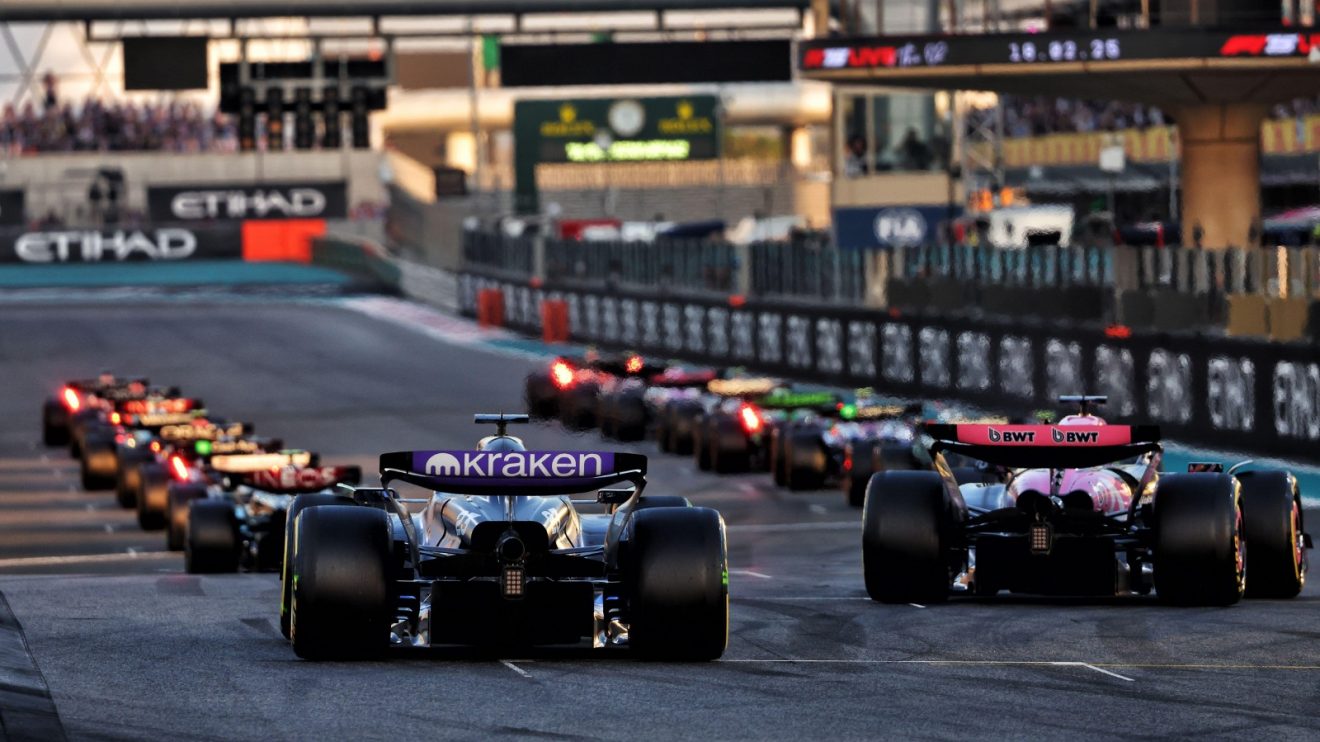
The F1 field pulls onto the grid for the start of the race.
While the F1 grid will expand to 11 teams next season, there is theoretically still room for one more.
Existing regulations make room for 12 teams on the grid, with Cadillac’s F1 2026 berth highlighting (and in some significant ways simplifying) the process a prospective operation must follow.
The key to admitting a 12th team onto the Formula 1 grid
Formula 1 is managed by two different bodies; the FIA and Formula One Management.
Their duties are largely separated into regulator (FIA) and commercial rights holder (FOM) though there is a degree of overlap and shared interests.
While it is FOM which organises where F1 will race each season, it is the FIA which writes and polices the regulations.
The pair are linked via the Concorde Agreement, a secretive document that details the roles and responsibilities of those involved in F1, including the teams.
Fundamentally, however, it is the FIA which sets the rules while FOM is then tasked with selling the resultant product.
That means it is the governing body which holds the key when it comes to admitting a new entity on the grid.
However, it is not simply a case of submitting a form and building a car.
Formula 1 is an open competition, not a franchise system despite the language often used.
The key difference is that, theoretically, anybody is able to compete provide they satisfy certain regulatory criteria.
In reality, with each team guaranteed a spot on the grid for the following year, it’s typically easier to buy out an operation than start from scratch.
There is, however, a process through which new teams can be admitted, just as Cadillac eventually was.
In the first instance, a prospective new team must register its interest via the FIA during a defined Expressions of Interest process.
There is no defined window as to when that might open, though when there is sufficient groundswell it can be triggered.
That was the case with what became Cadillac; it first registered its interest along with others including LkySunz, Hitech, and Rodin Carlin.
The Expressions of Interest is the first part of an intensive process which assesses each applicant on merit.
That includes having the underlying financial backing, expertise and experience, and access to facilities.
When last opened in early 2023, that process found only Andretti Global (as the project was then known) warranted progressing to the ‘next stage’, as the FIA termed it.
That process took a whole eight months, with the FIA only confirming Andretti had met its criteria in October, 2023.
Once that barrier is met, the governing body is effectively obliged to admit the team as there is no regulatory reason not to – a point that was made in court by FOM’s own legal counsel in 2001.
Separation of the regulatory and commercial
Who owns F1? All you need to know about Liberty Media and how F1 has changed since
Concorde Agreement explained: Who signs it, what it means and why it’s vital for F1
However, Cadillac’s experience proved rather bumpier courtesy of an added layer of complexity thanks to the Concorde Agreement.
There is now a requirement for all teams competing in Formula 1 to have signed the Concorde Agreement.
A change was made in the wake of Manor competing without agreeing terms with the sport’s commercial rights holder, then led by Bernie Ecclestone, in 2013.
It exposed a significant risk to the business as a critical element of the Concorde Agreement is the ability for the commercial rights holder to exploit a team’s image, which is essential for the television broadcast.
Signing the Concorde Agreement affords Formula One Management the rights to effectively operate while in return teams are entitled to prize money payments via a sliding scale, among other entitlements.
With that now a requirement, any new team must agree terms with the commercial rights holder before being allowed onto the grid.
That proved the stumbling block for the Andretti project, which was initially rejected by FOM.
It was a move that raised a number of critical questions and ultimately garnered the attentions of the United States Department of Justice, which launched an investigation.
It’s understood concern centred on the ability for the commercial rights holder to accept or reject entries, a regulatory power that appeared in conflict with a ruling of the European Union as far back as 2001.
Indeed, it’s generally accepted that it was the rejection of Andretti and the resultant DOJ investigation that saw Greg Maffei exit Liberty Media, the company which owns Formula One Management, after 18 years at the helm.
On November 13 last year, Maffei announced he would not continue in his role as Liberty’s CEO beyond the end of 2024.
On November 25 it was announced that an agreement of support had been inked between General Motors and Formula 1 to bring the Cadillac squad into the World Championship.
That was ultimately confirmed in March this year with the American operation poised to join the grid next season.
Cadillac’s plight was an anomaly, and arguably personal, with any new team not expected to face the same hurdles, with the Expressions of Interest opening the way for the FIA to assess on merit any prospective new entry to the grid.
Should it meet the governing body’s criteria, it will then be required to sign on to the all-new Concorde Agreement – part of which remain a work in progress – and pay an antidilution fee.
Unlike Cadillac, that process should be straight forward with the figure, though unlike before its fee antidilution fee is not set in stone and varies with the commercial health of FOM.
Read next: ‘Serious people’ backing ex-F1 boss for 12th team with car manufacturer on board