
Mexican GP conclusions: Big Norris chance, Verstappen illusion, new Hamilton document incoming


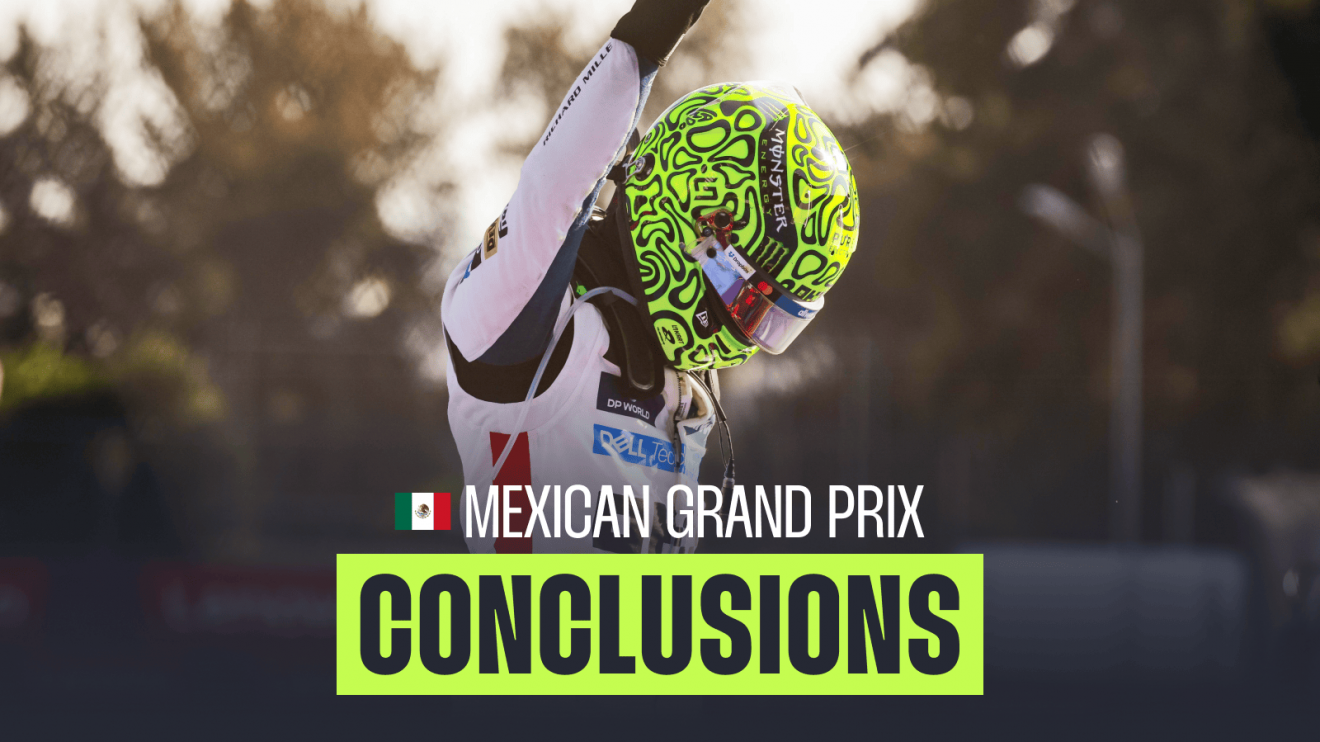
Will Lando Norris be able to handle the pressure of being title favourite?
McLaren driver Lando Norris claimed his sixth victory of the F1 2025 season in the Mexican Grand Prix at the Autodromo Hermanos Rodriguez.
Norris dominated from pole position to take the lead of the world championship from teammate Oscar Piastri for the first time since April, with Ferrari’s Charles Leclerc second and Max Verstappen third for Red Bull. Here are our conclusions from Mexico…
Lando Norris *should* win the F1 2025 title from here, but…
There exists a perception among some fans that the media tends to be unduly harsh on Lando Norris compared to other drivers.
And they have a point. It’s true. Hear that at the back? It. Is. True. No denying it here.
But why is that the case? That’s the important part.
And the answer is that it is because of weekends like this.
How can it be, after all, that a driver capable of such amazing highs can be so utterly uninspiring at other races?
Is this really the same Lando Norris who limped to a distant seventh place, seemingly oblivious to the opportunity presented to him by Oscar Piastri’s retirement, in Baku just five weeks ago?
Lando Norris vs Oscar Piastri: McLaren head-to-head scores for F1 2025
? F1 2025: Head-to-head qualifying statistics between team-mates
? F1 2025: Head-to-head race statistics between team-mates
How is it that this was his first victory in 84 days, stretching back to Hungary at the start of August?
Where has this Lando Norris been for the last three months?
And why doesn’t a driver as clearly gifted as this win – no, dominate – every week?
Therein lies the great frustration with Lando Norris.
That he doesn’t always do himself and his talent justice. That too often he sells himself short.
That he’d be capable of so much more if only he just got out of his own way from time to time.


Rarely has an athlete so obviously talented been riddled with such self-doubt. If only he had the personality and self-confidence of, say, Max Verstappen, he would be lethal.
That’s the only thing that’s really holding him back. And – yes, hands up – it makes him infuriating to watch at times.
If a driver of Max’s demeanour had just produced the kind of weekend Norris just did in Mexico, he would almost certainly be regarded as the overwhelming favourite for the 2025 title right now.
But because it’s Lando we’re talking about here, and because this is a driver with a suspect temperament who has only ever strung together two victories in succession (and even that owed much to Piastri’s penalty at Silverstone), well… honestly, who knows?
Put another way, can Norris be trusted over the remaining four races to replicate his Mexico performance level (or something close to it) enough times and hold his nerve to hit home the advantage this victory has given him?
It’s doable, certainly. But previous evidence, from both this year and last, suggests it would be quite unlike him.
How the F1 2025 title race has developed
? US GP conclusions: Verstappen’s big chance, more Piastri evidence, Ferrari culture clash
? Singapore GP conclusions: Norris corners Piastri, Russell’s big chance, double Red Bull exit?
More than once this season – notably after Monaco and Silverstone – people have confidently declared following a Norris victory that he has ‘the momentum’ in the title fight.
Only for him to blow it at the very next race and for those familiar frailties of his to resurface.
The complete elimination of doubt, that assurance that he will seize any and every opportunity presented to him, is not yet alive in Norris.
Yet with Piastri still in the midst of his late-season wobble, and Verstappen and Red Bull receiving a reality check in Mexico, the scale of the opportunity opening up before Norris now is undeniable.
All year long it has felt as though people have been waiting for Norris to finally click and for his peak performances – Zandvoort/Abu Dhabi 2024, Austria/Mexico 2025 – to become the norm.
Back in the lead of the championship for the first time since Bahrain, his retirement at Zandvoort reduced to a distant memory, he probably should win it from here.
But who can say with confidence that he will?
And how exactly will he react now he leads the points and he, not Oscar, has something to lose? It’s hard to know.
To repeat the point this column made after his win earlier this season in Monaco, another day when it seemed the clouds had finally parted: he has the talent and the pace to blow Piastri away and storm to the title.
The key question, as ever with Lando, is whether his mind will let him.
Max Verstappen has flattered the Red Bull RB21 since Monza
He couldn’t, could he?
Actually, maybe he can’t. Maybe this might be beyond him after all.
Maybe even the great Max Verstappen at his most inspired cannot coax a fifth straight championship out of this Red Bull.
And maybe, for all the talk of a technical breakthrough with the RB21 over recent races, the team is still a little too reliant on Verstappen for its own good almost 18 months after its initial slump started.
Certainly, the onboard footage of Verstappen in qualifying in Mexico – fighting to stop the rear from snapping every single time he went through the esses, ending up fifth on the grid and 0.5s down on Lando Norris’s lap for pole position – put his recent victories into a little more context.

If Monza really was what it looked like – a glorious flash of the Max and Red Bull of 2023 – Baku owed everything to Verstappen’s natural touch and feel in the slippery conditions of qualifying.
As noted by this column at the time, nobody out there is better equipped than Max to face the variables – the drizzle, the wind, the cold temperatures – that confronted the drivers that afternoon.
And once Verstappen secured pole with two midfield cars right behind him on the grid, and once the McLaren drivers both underperformed so dramatically, the door was left wide open for one of the most dominant wins of the season.
Austin, you say?
What, the weekend it seemed for all the world like Verstappen was coming quick at McLaren and there was nothing Norris and Oscar Piastri could do about it?
That one? A couple of overhanging questions from that race.
One: what if Norris and Piastri hadn’t collided at the start of the sprint and, denying the team crucial data, seemingly forced McLaren to take an ultra-safe setup choice at a notoriously bumpy circuit where disqualifications for ride-height issues have occurred previously?
And two: what if Norris hadn’t fallen behind Charles Leclerc at the start of the main race and condemned himself to running at the Ferrari’s pace almost throughout?
In other words, if Lando had given himself a free run at Max, could he have drilled home the McLaren’s famous advantage of thermal degradation on a hot Texas Sunday? Would Verstappen have stood a chance of containing him in that scenario?
A 31-second deficit to Norris in Mexico, another hot race with low grip, seemed to provide the answer.
The headline figure of three wins from the previous four races may have pointed to a late-season title charge by Verstappen.
Yet such a muted performance compared to the McLaren in Mexico, a circuit where the Red Bull has historically been a good car even when it was bad, has brought a bit of reality back to the conversation.
Maybe Max really will be powerless to prevent a McLaren championship double. Maybe he has been flattering the RB21 with his recent performances.
And maybe his title hopes are exactly what Norris’s were this time a year ago: an illusion.
Oscar Piastri’s struggles are not just psychological
When an athlete struggles as badly as Oscar Piastri has done over recent weeks, and at such a crucial point in the season, the temptation is to put it all down to psychology.
And with good reason too.
The overall talent level in sport is so uniformly high these days that it is very often the mental and emotional factors that decide outcomes.
Everyone is so annoyingly good and professional now that what were once considered the little things have ended up becoming decisive. Hence the invention of the very modern term ‘marginal gains’.
It is not necessarily about being the best or the most gifted, but about still being able to access all your skill and talent – or, at least, a greater proportion of it than your opponent can – even when under the most enormous pressure and scrutiny.
That, now more than ever, is how races and matches, championships and tournaments, are won in sport. It’s happening in every field and in every discipline.
So it is easy to look at Piastri’s results over the last couple of months and conclude that this is a classic case of a driver collapsing under pressure.
And undoubtedly some moments – the panic on the streets of Baku, the way he faded without trace after the first lap in Singapore, his careless switchback at the start of the sprint in Austin – fall under that banner.
But not all.
His significant pace deficit to Lando Norris over the last two weekends, culminating in a 0.588s gap in Mexico qualifying and a pair of measly fifth-place finishes?
That points to something more complex going on beneath the surface.
Something McLaren, at least, feels it understands.

Piastri arrived in Mexico confident that his struggles in Austin were related entirely to the unusual demands of the Circuit of the Americas, specifically the way the tyres are guaranteed to overheat no matter how they are nursed by the driver.
Only to met with the same root problem – a fundamental lack of grip, everyone struggling to a greater or lesser degree – here too.
The hard truth for Oscar? Norris is simply better equipped to deal with the challenges posed by low-grip conditions.
McLaren has hinted at it a couple of times over the last seven days, team principal Andrea Stella telling media including PlanetF1.com on Sunday in Austin that Piastri must “challenge the car and lean on the oversteer, understeer, locking” when grip is low and adding that “this is an area of his driving that he has an opportunity to improve.”
His comments after qualifying on Saturday in Mexico were along a similar theme.
“The fastest car is also a car that needs to be driven in a certain way,” Stella said. “Especially when you have conditions like here and to some extent in Austin with hot tarmac, sliding tyres.
“The way in which you generate lap time is a way that, I would say, comes relatively naturally for Lando and less naturally for Oscar.
“Lando is the driver of going on low grip, end of the stint when the tyres are quite worn, used, the grip is low.
“It’s where we see Lando [post] green sector, green sector, green sector.
“Oscar, instead, is more of a driver of high grip and that’s where he can exploit this incredible talent.”
The worst thing Piastri can do now is fall into the trap of pointing fingers at the car and the team, magicking up some unidentified problem with the chassis and believing the nonsense online that the cars in the McLaren garage are in some way unequal.
So many others – including some celebrated world champions – have headed down that path over the years and it never ends well.
The trick, instead, is to looks introspectively and remain self critical – what can I do about this? – accept that there are some things Norris currently does a bit better and work on those lingering weaknesses in his technique.
Piastri, humble and intelligent enough to recognise that, alluded to some progress in that area on Sunday night after experimenting with his driving style during the race.
That, you’ll often find, is the mark of the truly great drivers.
That’s how you know Oscar will be just fine, no matter how this season ends.
Ferrari’s poor communication is another Lewis Hamilton document in the making
Haven’t you heard? Lewis Hamilton is taking a hands-on approach to life at Ferrari.
So petrified is he by the thought of being remembered in the Maranello area alongside the likes of Fernando Alonso and Sebastian Vettel – established champions who failed to win the title with Ferrari – that he is leaving nothing to chance.
For someone who, at times unfairly, was perceived as the prized cog in an exceptionally well-oiled machine across his Mercedes career – a driver who arrived on Thursday, won on Sunday, then went away and did his own thing until the next race – it is quite a departure for Hamilton.
This, he says, is simply a reflection of his desire to make a success of his Ferrari career.
Yet it could just as easily be interpreted as a lack of trust in the people around him and the processes currently in place at Ferrari.
If you want a job done properly, do it yourself.
However good his intentions might be, that’s the message a driver risks conveying – even subconsciously – when he won’t let the team breathe unless he knows about it first.
The really interesting thing about Lewis’s new outlook?
It is one covered in the fingerprints of Vettel, who was engaged to the point of interference throughout his own Ferrari career and whom we know Hamilton consulted more than once before he linked up with the team at the start of this year.
It was at the Belgian Grand Prix in July that Hamilton first revealed the depth of his involvement with Ferrari away from the circuit and those ‘documents’ which have since become a running joke online.
The Hamilton Files supposedly cover not just changes to the car but working methods, communication between different departments at the factory and the execution of race weekends.
The first, Lewis revealed, was submitted after the first few races of the season. Then came two more in July.
And, if reports are to be believed, another arrived in the post not long after the Singapore Grand Prix, where he pointed publicly to Ferrari’s habit of sending both cars to the end of the pit lane in qualifying, and its impact on tyre preparation, as an area of weakness.
On the evidence of his penalty in Mexico, however, the message is not quite cutting through and the challenge of getting Ferrari to work harmoniously is the F1 equivalent of herding cats.
Regardless of whether Hamilton should have realised it himself – and there is a convincing argument that he should – there was a moment after he cut the track at Turns 4/5 to stay ahead of Max Verstappen for Riccardo Adami to give him a helping hand and inform him to give the position to the Red Bull.
As the sporting regulations dictated that he should have done, regardless of the flurry of questionable corner cuts committed by other drivers over the course of the race in Mexico.
It did not help, of course, that Oliver Bearman complicated matters by putting himself between Hamilton and Verstappen in the immediate aftermath of the incident in question.
Yet that Ferrari seemingly didn’t even suggest that Hamilton should slow his pace to at least negate the advantage he gained by taking to the grass – let alone give up the place – and put the decision in the hands of the stewards was yet more evidence that the relationship between driver and team isn’t quite gelling as it should after almost a full season of working together.
After returning with a fresh outlook at Zandvoort, Hamilton has achieved a level of competence – nothing more than that – this side of the summer break, making tentative progress but mainly just eradicating the complete disasters, especially in qualifying, that defined the first half of his season.
Having equalled the best result of his Ferrari career in Austin last weekend, it seemed he has been gradually building towards his first podium in red – a result that seemed within reach after he secured his highest starting position of the season with third on the grid.
And then just like that, with another piece of poor communication between cockpit and pit wall, it was gone.
A penalty. Again. Eighth. Again. Left to wonder what could have been. Again.
One step forward, two steps back. It was ever thus for Lewis Hamilton at Ferrari.
The team can expect another document from a Mr L. Hamilton to arrive through the letterbox between now and Brazil.
Oliver Bearman is reminiscent of Williams-era George Russell
How does a driver know when he has the edge over Esteban Ocon?
When Esteban starts dropping little hints, initially here and there, that dark forces are at work against him inside the team.
It happens everywhere he goes at some point and is partly why Alpine decided to release him ahead of the final race of last season after weeks of Ocon dropping hints that his car was in some way inferior to that of Pierre Gasly.
So it was interesting to hear to his reaction over team radio after the chequered flag at the United States Grand Prix last weekend.
Informed by his race engineer that he only managed P15 in Austin on a day Oliver Bearman finished ninth in the same car, Ocon replied: “What are you doing to me, guys, honestly?”
His delivery – in what, it should be stressed, was a very short snippet of team radio – seemed relaxed enough.
But give it a few more weeks.
As sure as night follows day, if the current trend continues – Mexico marked the fifth weekend in succession that Bearman has outqualified Ocon with the latter falling in Q3 three times – Esteban’s mask will slip a little bit more with each passing race.
It is to Bearman’s great credit that he has already poked and prodded Ocon, one of the more underrated drivers on the current grid, into that position.
His success in making his established and experienced teammate look positively average is not so different to what Gabriel Bortoleto, among the outstanding rookies of this season, has achieved against Nico Hulkenberg at Sauber.
Bearman won’t be in the running for any of those Rookie of the Year awards.
His poor disciplinary record – 10 penalty points, two away from a race ban – has put paid to that.
As has his terrible error of crashing in the pit lane under red flags at Silverstone, that single incident responsible for four of those points.
Yet his overall potential, it is increasingly clear, is as high as any of this year’s debutants.
Watch Bearman drive and you are transported back five years to the sight of an emerging George Russell in the Williams: always aggressive, always charging hard, not always tidy but very often effective.
Bearman’s reactive technique – reacting to whatever the car is doing at any given time rather than manipulating it with his inputs – sees him live on his reflexes on a very fine line and is what, like George, makes him prone to making mistakes.
Yet, as with Russell, it is also what makes him so irresistible over the course of a single lap.
Already, even before the end of his first full season, Ocon is struggling to contain Bearman.
Soon enough, as Oliver’s data banks expand ever more with experience, he won’t be able to live with him.
Read next: Lando Norris booed out of Mexico City GP stadium after crucial win