
Chief McLaren threat steps forward with Hungarian GP data uncovered


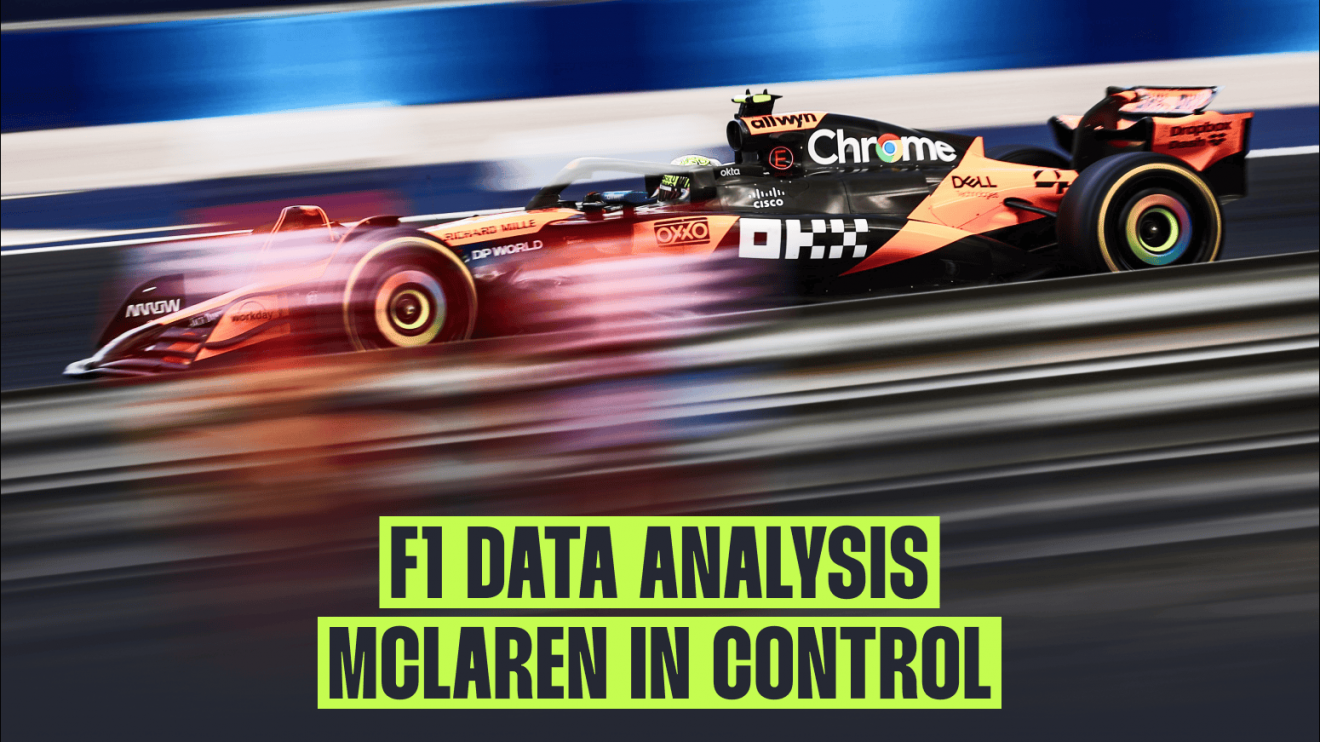
Lando Norris led McLaren's charge on Friday in Hungary
The first day on track at the Hungarian Grand Prix is done and McLaren finds itself convincingly on top — something we’ve grown accustomed to in F1 2025.
In both FP1 and FP2, Lando Norris set the fastest time with Oscar Piastri, the current championship leader, following closely in second.
F1 data analysis: McLaren too far ahead of the rest in Hungary?
But which of the two team-mates got off to the better start in the final race before the summer break? And is there anyone who can realistically threaten them?
The Hungaroring, by its very nature, plays directly into McLaren’s strengths.
It’s a slow track, dominated by medium and low-speed corners combined with high track temperatures — a perfect recipe for the MCL39 to exploit its two biggest advantages: superior tyre management and efficient high-downforce performance.
Even last year, when McLaren wasn’t yet in such a commanding position, it dominated in terms of race pace at this very circuit.
It looks like we’re set for a similar story this time around.
Oscar Piastri vs Lando Norris: McLaren head-to-head scores for F1 2025
? F1 2025: Head-to-head qualifying statistics between team-mates
? F1 2025: Head-to-head race statistics between team-mates
But the main storyline in the championship right now is the battle between the two McLaren drivers — Norris and Piastri.
Norris, who claimed pole position here last year, generally thrives on slower circuits with flowing low-speed corners.
His results in Monaco back this up, as do his performances in the first two practice sessions in Hungary.
In FP1, Piastri was only 0.019s behind, but in FP2 the gap extended to nearly 0.3s.
The main reason for this was the additional pace Norris found between sessions.
His FP2 time improved by 0.435s compared to FP1, while Piastri only gained 0.156s.
The Hungaroring is a track where lap times naturally improve throughout the weekend, so this margin could grow even further.

Norris seemed much more confident and stable, especially in Turn 1 and other medium-to-low-speed corners — the exact areas where McLaren stands out from the rest of the grid.
The MCL39’s low-speed stability is incredible, especially the amount of traction it extracts from the rear tyres when applying throttle.
During FP2, we saw Norris take a less-than-ideal line through some of the slower corners compared to Verstappen, but despite this the time gap between them remained very clear.
When we compare the fastest laps of the two McLaren drivers in FP2, we can clearly identify where the differences lie.

Right at the start of the lap, Norris exits Turn 1 better and creates a gap of about one tenth, which gradually disappears through Turns 4 and 5 thanks to Piastri’s superior driving in that sector.
Through the T6/T7 chicane, they’re nearly identical — but then we reach the part of the track that makes the biggest difference.
In the sequence of Turns 8, 9, and 10, Norris carries significantly more apex speed and gains around three tenths in this sector alone.
It’s a section of the track he enjoys and the added stability and confidence he has in the MCL39 here are clearly visible.
By the end of the lap, their gap remains relatively unchanged, leaving us with a clear picture of where Piastri is losing time.
Interestingly, in FP1 the situation was reversed — Norris was the one trailing slightly in this same section.
What about race pace?
In both qualifying and race pace simulations, Norris was once again ahead of his team-mate.
This time, the difference was smaller — Piastri was on average 0.136s per lap slower.
However, it’s important to note that Norris ran his long run on newer tyres and we also don’t know the fuel loads or engine modes each driver used.
Last year in Hungary, Norris had better pace during the race and that seems to be the case again.
Still, it’s difficult to draw concrete conclusions since there’s time left in the weekend for teams to improve.
We’ve already seen several times this year that Norris looks faster on Friday, only for Piastri to close the gap or reverse the order on Saturday.
As we’ve often said this season, the starting position will be absolutely crucial.
With the high temperatures in Hungary, keeping tyres, brakes, and engine temperatures under control is a tough task — and the last thing you want is to be stuck in dirty air.
If conditions remain dry and warm, clean air will be more important than ever.

Can anyone get close to McLaren?
Charles Leclerc and Ferrari appear to be the main contenders for third place.
At the moment, anything less than a one-two finish for McLaren would be considered a disappointment, meaning everyone else will be fighting for the final step on the podium.
The Italian team made a noticeable step forward in performance after its crucial upgrade introduced in Belgium.
Based on the current form of Red Bull and Mercedes, Ferrari is the only other team that can be seen as a serious challenger.
Nico Hulkenberg also did a solid job, finishing FP2 as the third-fastest driver in terms of race pace simulation.
When comparing the fast laps of Leclerc and Norris, we can see exactly where McLaren holds the advantage and where Ferrari’s weaknesses lie — namely, the slower corners.
The gap is most obvious in Turns 9 and 10 at the apex, but the SF-25 also lags in Turn 2 and the final corner.

Despite the positive progress, McLaren still looks like it is in a league of its own.
Unless something extraordinary happens on race day, neither Leclerc nor anyone else appears capable of dethroning McLaren this weekend.
Read next: How Williams are looking to stay one step ahead with new FW47 updates