

McLaren threw ‘papaya rules’ to the wind in Italian Grand Prix team orders call


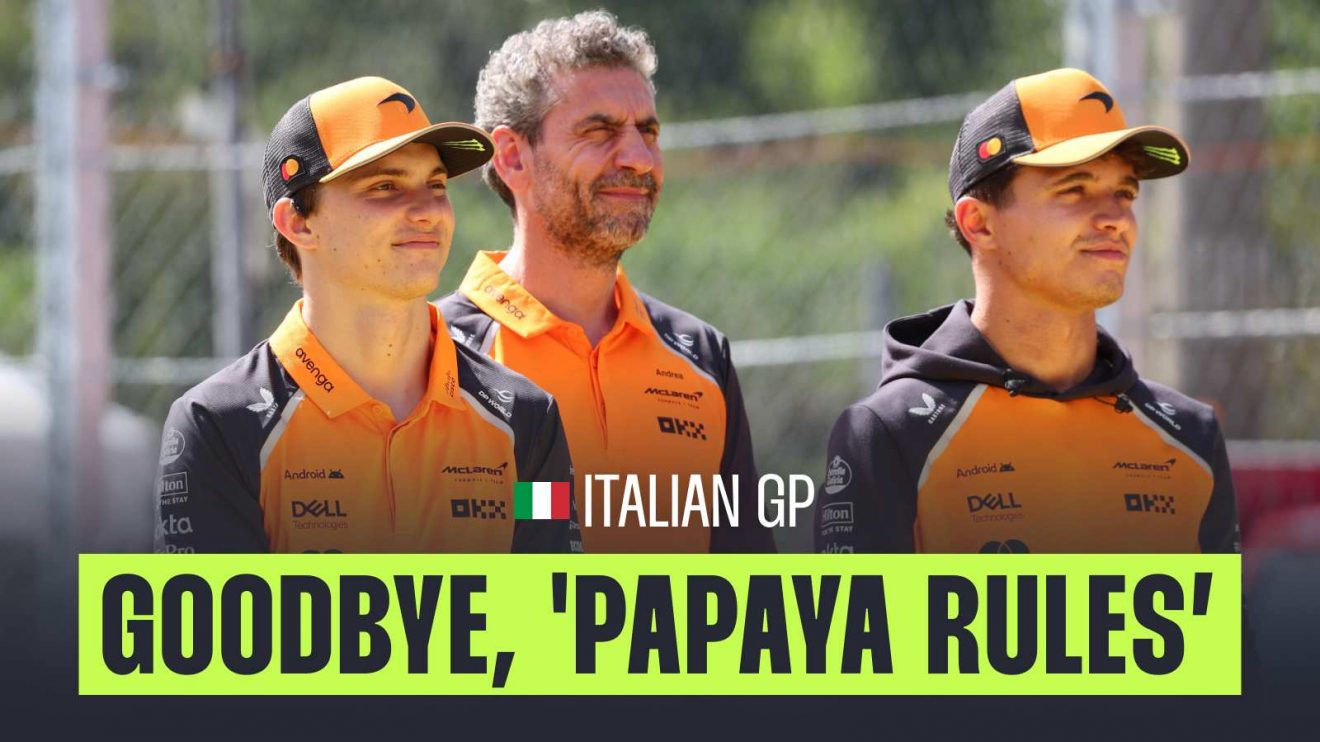
McLaren should not ask its drivers to shoulder the burden of a team's mistake.
McLaren has spent over a year talking about its “papaya rules” — or, the mandate that its drivers race fairly against one another, without interference from the team. It just threw its own mandate to the wind at the Italian Grand Prix.
Asking Oscar Piastri to cede position to Lando Norris because the latter driver had a slow pit stop undermines everything the team has worked so hard to establish in terms of hands-off fairness as the title battle hots up.
McLaren undermines its own ‘papaya rules’ in Italy
As McLaren found itself suddenly challenging for race wins during the F1 2024 season, it quickly became clear that drivers Lando Norris and Oscar Piastri were both incredibly talented competitors who were evolving into capable championship challengers. Coming into 2025, it was obvious those two would be doing battle for the title.
In an effort to keep racing fair and reduce the need to issue team orders, McLaren instituted something it calls “papaya rules‘, which team principal Andrea Stella defined as effectively requesting its drivers race one another cleanly and with the team’s greater good at the forefront of their minds.
“We need to make sure, especially being the car [is] so competitive, that we see the chequered flag and that we try and drive the race in synergy between our two drivers, rather than thinking that my main competitor is my teammate,” Stella explained.
“We try to stay away from this kind of mindset, because it’s not productive.”
The goal for the team is to avoid playing favourites, to avoid putting all its eggs in one driver’s basket, and to avoid any unnecessary contact.
That’s all well and good. But at the 2025 Italian Grand Prix, the team made a mockery of its own mandates by requesting Oscar Piastri cede position to Lando Norris.
More Italian Grand Prix analysis:
? How Max Verstappen stunned McLaren at Monza as key corner costs Lando Norris
? McLaren’s plan to annihilate rivals comes to life at Monza
The 53-lap Italian Grand Prix was a bit of a snooze fest sandwiched between a spectacular start and controversial end. Polesitter Max Verstappen held his lead at the start but had to give the position to Norris after he cut through the first chicane; he was able to pass again shortly after. Meanwhile, Piastri and Ferrari’s Charles Leclerc battled for third. Ultimately, the top four finished the same way they started.
The design of the MCL39 means the McLaren duo are able to nurse far more life out of their tyres than their competitors, which enabled Norris and Piastri to hold off on pitting for softs until the final 10 laps of the race.
Because Norris was second behind Verstappen, he was offered a say with regards to pit strategy: When he was told he’d pit first, he suggested that the team pit Piastri first. The team promised that this wouldn’t result in an undercut, and so Norris made the call to follow his teammate into the pits.
Indeed, race engineer Will Joseph radioed Norris to say, “Lando, we will box this lap onto the soft tyre.”
The driver replied, “Do you want to box the other car first?”
At that point, Will Joseph confirmed that the pit order had changed, saying, “Yep, we’ll do that. We’ll swap it ’round. Stay out.”
“Well, only if he doesn’t undercut,” came Norris’ reply.
“There will be no undercut,” he was assured.
Piastri had a blitzing 1.9-second stop, but when Norris followed, the left front tyre gun appeared to have an issue. When he finally exited the pits, he did so behind his teammate.
Then came the call from McLaren to Piastri: swap positions with Norris.
“Oscar, this is a bit like Hungary last year,” race engineer Tom Stallard explained. “We pitted in this order for team reasons. Please let Lando pass and you’re free to race.”
“I mean, we said that a slow pitstop was part of racing, so I don’t really get what’s changed here, but if you really want to do it, then I’ll do it,” came the reply from the Australian driver and championship leader.
But cede he did.
Italy 2025 is a different story than Hungary 2024
McLaren’s call back to the 2024 Hungarian Grand Prix likely had a strong effect, with the event being Piastri’s first-ever Formula 1 win. But Hungary 2024 is far different than Italy 2025.
There, Piastri had held a strong lead over the rest of the field when McLaren opted to call Norris into the pits first in order to cover off a challenge from Lewis Hamilton. That resulted in Norris undercutting Piastri and carving out a handy lead. The team had to ask the Briton to slow down and allow his teammate to pass.
In that instance, the team made a critical strategic error in its attempt to defend itself against a challenge from a competitor. It was an overall team mistake that impacted both drivers simultaneously; the error was only clear after both drivers had clean stops; and the team instituted the strategy without consulting its drivers.
But Italy 2025 is a much different story.
Yes, the team faced another shake-up in track position due to a pit stop, but the issue in this instance was not a defensive strategy but an error. Norris did not lose position in direct response to the team’s decision to pit Piastri first; he lost position because the front left tyre change was slow. And unfortunately for Norris, he made the decision to pit second.
McLaren’s orders in both instances represent an effort to correct a problem stemming from the team, but the critical difference in this Monza race was the fact that Norris had a choice.
No, it’s not his fault that the second pit stop proved to be the slower of the two. But it wasn’t Piastri’s fault, either — and the major issue with McLaren’s decision is that it has corrected its problem at the expense of the driver who did not have an issue, and who was not presented with the opportunity to decide when he pitted.
Bad luck happens. Slow stops happen. Incorrect strategies happen. It should not be the responsibility of the unaffected driver to right a team’s wrong in favour of their teammate — particularly not when both drivers are in active contention for the World Drivers’ Championship.
McLaren is singlehandedly attempting to balance the scales of justice in a sport that is inherently unfair.
Both drivers cannot share the championship. They cannot share race victories. They cannot be promised a result. Every time McLaren intervenes in the running order of its drivers on a race track, it casts a vote in favour of one driver, whether it believes it does or not. There is no making things fair; there is only manipulating an event to reflect an outcome you believed should happen, and that decision bears all the weight of the inequity the team is trying so desperately to avoid.
Rather than owning up to the fact that it made a mistake, McLaren is simply shrugging the burden of responsibility for its own errors onto the shoulders of its drivers.
Where does McLaren go from here?
McLaren now finds itself in an even more complex situation than the one it’s been in.
The team has two extremely capable young drivers who are both in active contention for their first championship and who have both committed to the team with “multi-year deals” that suggest the desire for a long-term partnership.
Speaking to media in the post-race FIA press conference, both drivers stressed the importance of preserving the “culture” of the team and of protecting the people who gave them the opportunity to compete at this level. It’s clear they’re willing to do what it takes to remain in good standing with the team.
But the team isn’t helping its drivers by trying to level a perpetually unequal playing field. It isn’t necessary to go so far as to prioritise one driver over another. It’s enough to simply stop asking its drivers to carry the burden of rectifying a team mistake.
Read next: Nico Rosberg predicts McLaren ‘talks’ after team orders take centre stage