

Max Verstappen the GOAT? Surprise Japanese GP pole hints at Senna-esque title tilt


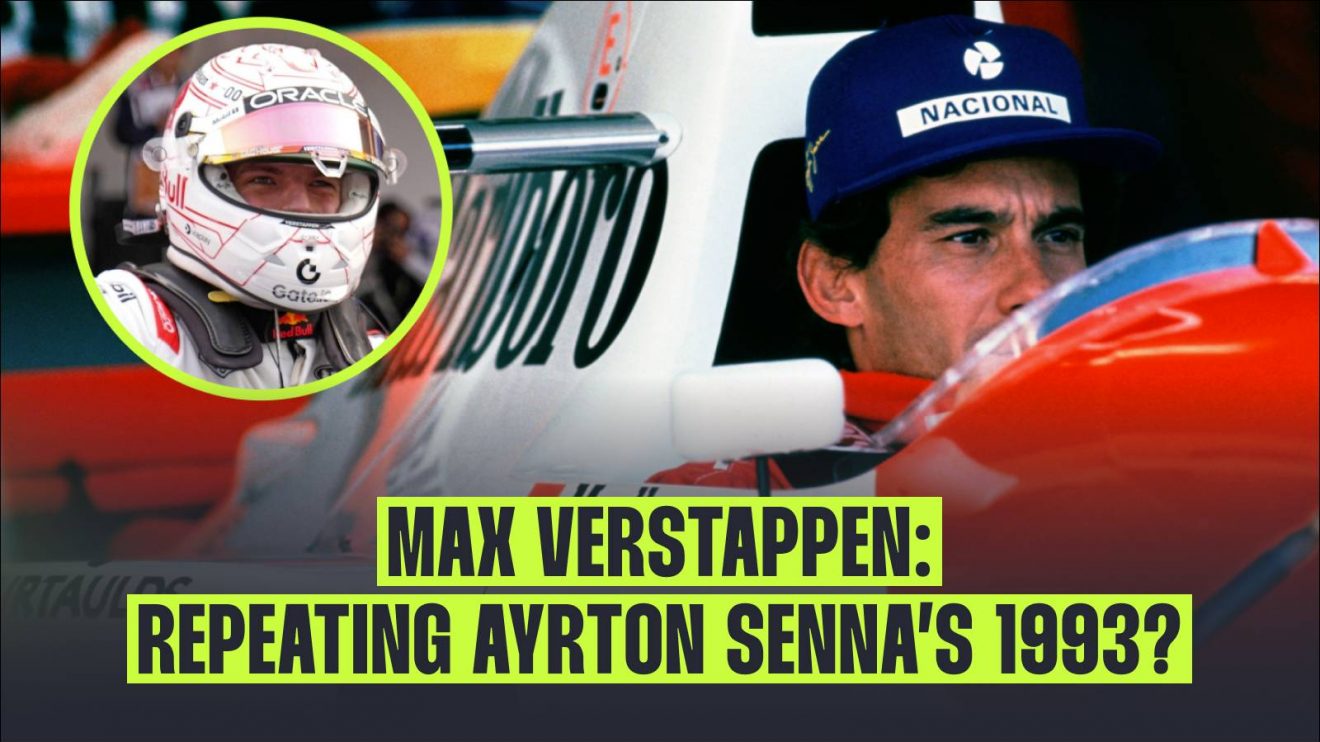
Is Max Verstappen about to set off on an Ayrton Senna-esque championship fight that could seal his place as the sport's GOAT?
Max Verstappen’s unlikely pole position at the Japanese Grand Prix against superior McLarens is reminiscent of Ayrton Senna’s feats in 1993.
Against the odds, Verstappen claimed pole position for the 2025 Japanese Grand Prix but, with the complexion of the season starting to take shape, the Dutch driver is up against it to claim another World Championship title.
Max Verstappen’s ‘insane’ pole position lap surprises even Red Bull
Verstappen has cultivated an image of invincibility in recent seasons, winning four titles on the bounce in a variety of different ways – first as the hunter and challenger to Lewis Hamilton’s crown in 2021, the slow start giving way to dominance against Charles Leclerc in 2022, the unprecedented crushing of all who lay in his path in 2023, and fending off Lando Norris as the McLaren man’s prey in 2024.
The vulnerability of 2024 was cushioned by Verstappen’s dominant start to last season before Red Bull lost its way and McLaren found incredible gains, but Verstappen has no such luxury this year.
Indeed, what has become evident from the first few weekends of this season is that Red Bull’s RB21 – in Verstappen’s hands, at least – is somewhere between the second and fourth-quickest team.
At least, that’s how it appears… without the frame of reference of a proven second driver performing well in the second car, it’s very difficult to gauge just how good – or bad – the RB21 really is. Handed over to lesser drivers than Verstappen, the picture becomes muddier still – the second RB21 has yet to make it into Q3 or the points.
Red Bull’s efforts over the winter on the development of the RB21 are well-publicised at this point – the goal was to row back on the ‘peakiness’ of the RB20 in a bid to widen the operating window of this year’s car, even if that meant coming with a net loss of outright potential.
In this regard, Red Bull appears to have been successful. Verstappen may not be 100 percent satisfied with the car yet (although he has been far more complimentary compared to last year), but it’s a car with which he can push on and keep towards the sharp end of the grid.
But, with that outright potential weakened, there’s no doubt that, at this early point of the season, the Red Bull is not the quickest car – a fact even rival teams seem willing to acknowledge.
And yet, despite this fact, it was Max Verstappen who took the unlikeliest of pole positions out of nowhere on Saturday at Suzuka. Having been half a second off in practice and more than a quarter of a second down through the first two parts of qualifying, the chessboard was set up for a McLaren intra-team battle for pole position at a circuit that plays directly to the strengths of the MCL39.
That was until Verstappen came out on top by the smallest of margins – just 0.012 clear of Norris, producing a more consistent lap than the others – evidenced as the Dutch driver didn’t manage to set a single fastest sector through his pole lap.
Leaving both McLaren drivers somewhat reeling as they paid tribute to Verstappen’s efforts, the lap, dubbed ‘insane’ by race engineer GianPiero Lambiase, was hailed by team boss Christian Horner as ‘one of his best-ever’. Quite the plaudits, and thoroughly deserved by the quadruple World Champion.
When it comes to discussions of who the greatest driver ever in Formula 1 is, Verstappen has continuously dragged himself further and further up the most intangible of leaderboards to vie with the likes of Ayrton Senna, Alain Prost, Niki Lauda, Michael Schumacher, and Lewis Hamilton for that unofficial title.
This is largely a topic that the name atop anyone’s list comes down to personal biases and the nostalgic factor, with Senna frequently atop such lists. Not only did the Brazilian match or beat Prost when in comparable equipment over multiple years, but his premature death added a layer of mystique to his legend.
But it was arguably the 1993 season that sealed Senna’s contention for the title of GOAT in Formula 1, despite only finishing as runner-up in that year’s championship.
Ayrton Senna takes on Williams in underpowered McLaren MP4/8
Rewinding back three decades, Senna was given an incredible car for the 1993 F1 season, with the Neil Oatley-designed MP4/8 a hugely advanced and sophisticated chassis that was created to try hauling in the ingenious Adrian Newey and Patrick Head-designed Williams FW14B evolution, the FW15C.
Featuring a wide range of incredible technologies for chassis and suspension control, the issue for McLaren was that – not for the first time – Honda had elected to pull out of Formula 1. It took until November 1992 to find a replacement, with McLaren forced to go down the customer route as Ron Dennis signed a contract with Ford to receive the HB V8.
Design work had been well underway for months at this point, meaning McLaren had had to design the chassis without full knowledge of what engine would be in the back.
The 3.5-litre V8 was a competent motor, but, having been a works team with Honda and TAG Porsche, the new Ford power unit was a little down on power. Not only that, but in a deal which would be illegal under the supply rules of today, Ford would only supply an engine specification that was one behind that of Benetton in its B193.
The MP4/8 may have been a great car, but it was underequipped compared to the Williams-Renault package and heading into the season, it was clear that the combination of Alain Prost and new teammate Damon Hill would be very difficult to beat.
Senna duly set about maximising his results throughout the season, finishing second to Prost in South Africa before winning at home in Brazil as the French driver crashed out. Weeks later, Senna produced perhaps the most famous first lap in F1 history at Donington Park as he climbed from fifth to the lead – including overtaking Prost – in the space of a single lap.
This set the tone for the year as a whole. Prost won all bar one of the next seven races, with Senna getting a little boost in Monaco where his engine horsepower deficit was not as crippling. Senna himself then went eight races without a podium as his title challenge faded, before bouncing back with wins in Japan and Australia to finish the year.
It had been a season of maximising results against superior machinery, which Senna managed with aplomb. Finishing second and beating Hill, Senna’s efforts had been monumental, and his 73-point tally was enough to score McLaren, single-handedly, second place in the Constructors’ Championship.
This was because teammate Michael Andretti failed to impress at all upon his switch to Formula 1 from IndyCar and scored just seven points in 13 race weekends. It took the promotion of test driver and future double World Champion Mika Hakkinen before Senna got some backup, as he found out to his surprise when the Finn out-qualified him for the first time of asking at the Portuguese Grand Prix.
Despite being beaten by the dominant Prost/Williams combination, 1993 underlined Senna’s status as being not only the most impressive driver of the season, but showed what he could do with a car that wasn’t as fast as the Williams.
This is where Verstappen finds himself at this point in time. The McLaren MCL39 is clearly the quicker car but, through a mixture of Verstappen’s dogged determination and talent, he showed up to shock Norris and Piastri at a track where driver talent can make up for small car deficiencies.
Not only that but like Senna, Verstappen finds himself fighting the battle one-handed, with Red Bull not able to get their second car into contention at this point – although there have been flashes of potential from Yuki Tsunoda through his first weekend.
Of course, there are some differences. Senna’s 1993 season was hamstrung by an engine power deficit, not the car, meaning that the gap to Williams was broadly insurmountable. That is not the case for Red Bull, whose RB21 is powered by a very competitive Honda engine and has the potential to develop the car into the measure of the McLaren – or even exceed it, if the team gets things right.
But, while Senna only really had to worry about the Williams drivers and the attentions of the young challenger at Benetton, Michael Schumacher, Verstappen has to contend with a much closer field of competitive teams and a more consistent quality of rival drivers.
What Verstappen did by taking pole position out of nowhere at Suzuka was underline to all his rivals in a quicker car that he is going to continue to be inevitable through this season, even if it appears he is out of contention.
While Red Bull slots drivers into the second car in a bid to find someone who clicks, Verstappen keeps showing up at race weekends and putting his car where, in theory, it doesn’t yet appear to belong.
If McLaren’s pace advantage is as great as speculation has suggested, future successes for Verstappen are only likely to come on days where he over-delivers and McLaren’s drivers don’t get it together, as was the case on Saturday at Suzuka. Like for Senna in 1993, defeat still seems the likelier path given the apparent superiority of Verstappen’s rivals.
But, if Verstappen can do what Senna did and keep the pressure up, snatch victories, and keep himself in contention for the title as long as he can, then it might yet end up being his greatest season yet.
Read Next: Data reveals key Verstappen driving style differences to Norris after shock Suzuka pole


