

Data reveals why Max Verstappen’s Hungary strategy actually made a lot of sense


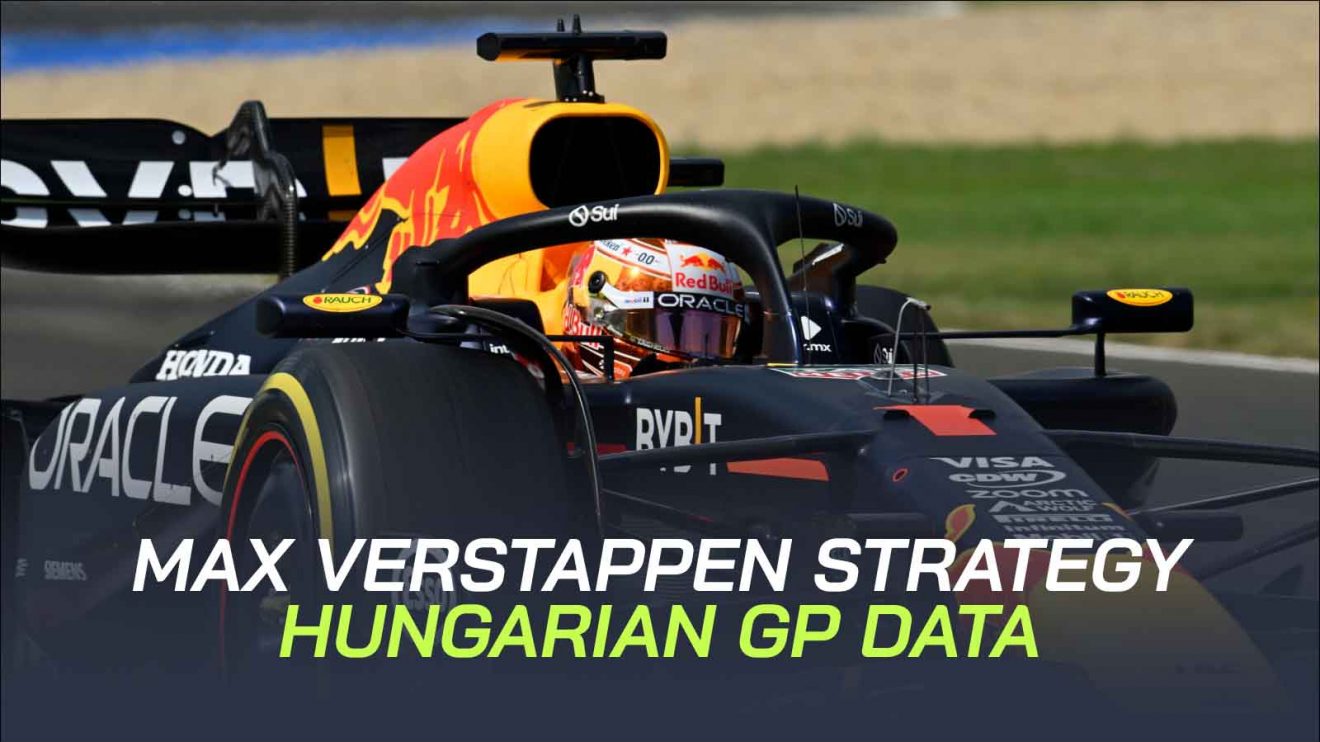
Max Verstappen called his strategy into question in Hungary, but we've run the numbers behind it.
Max Verstappen finished the Hungarian Grand Prix in fifth place. The Dutch driver was far from happy with Red Bull’s pit wall decisions, which allowed Lewis Hamilton to undercut him twice and Charles Leclerc in the final stint.
However, despite Verstappen’s obvious complaints over the radio, the team’s strategy made far more sense than it might first appear. What Red Bull didn’t know was that Lewis Hamilton’s defence would be able to stop their plans for victory and eventually, the podium.
Max Verstappen strategy analysed after Hungarian Grand Prix complaints
Max Verstappen started the race from P3 with a controversial manoeuvre. At Turn 1, with Oscar Piastri and Lando Norris side-by-side, the three-time World Champion was forced off track. However, in the absence of a gravel trap, Verstappen took advantage to continue with the throttle down to overtake Norris for P2.
On lap 4, he had to give the McLaren driver the position back. Piastri was the big beneficiary in this action as he forced both drivers on the outside to take the lead.
From here on, Verstappen could not keep up with the McLaren pace. By lap 10, Norris had already opened a two-second gap over the Dutchman and Lewis Hamilton was chasing him closely at just over a second. Even so, the Mercedes driver was unable to enter the DRS zone to attack him on track, but he was able to launch an undercut attack in the pits.


On lap 16, when Hamilton was +1.2s behind Verstappen, Mercedes went for the undercut on the Red Bull driver. At this point, Max was four seconds behind Norris in P2. Why didn’t Red Bull stop Max Verstappen a lap later to cover the podium position?
The answer has a very elaborate logic and makes a lot more sense than it seems. For a start, we should bear in mind that on the other side of the garage, Sergio Perez had started the race on the hard tyre, and the Mexican’s pace was looking very promising compared to that of George Russell, who was also being held up in traffic by Valtteri Bottas.
But once Bottas made his stop also on lap 16, as did Hamilton, Perez did not get off the back of the W15 with Russell at that point in clean air. Therefore, Red Bull had promising pace data on the hard tyre.
On the other hand, we also have to remember that of the top teams, only Red Bull and Ferrari had a second set of medium tyres to use at the end of the race in full attack mode.

More of the fallout from a dramatic Hungarian Grand Prix weekend
? Hungarian GP conclusions: McLaren team orders, Piastri rise, Red Bull’s Perez failure
? Hungarian Grand Prix driver ratings: Max Verstappen hit with worst score after Hungary nightmare
Therefore, the idea of Red Bull’s pit wall in the first third of the race was very clear after a bad first stint almost three tenths per lap worse than McLaren in race pace and high degradation: to have a tyre life advantage with the hard tyre, push to recover the time lost to Hamilton and McLaren, stretch the tyre life again with the hard compound and put on the new medium tyre, fresher and with fewer laps at the end of the race to catch Norris and Piastri for the win.


Verstappen extended his first stint until lap 21 and came out in virtual fifth position – Charles Leclerc copied his strategy – behind Hamilton by seven seconds. But with a tyre five laps fresher and with a very promising pace thanks to Sergio Perez’s data on the hards.

Therefore, Verstappen with a tyre 3-4 laps fresher than both McLarens was also in a position to close the gap to them. If Verstappen managed to overtake Hamilton on track within 2-3 laps maximum, he would have approximately another 11-12 laps in clean air to close on Norris and Piastri and cut more than a second to put himself in a more favourable position than at the end of the first stint.

In short, the idea of not taking cover from Hamilton’s undercut at the first pit stop was the right one, as it gave them a chance to fight for the win and keep the P3 position virtually assured. However, overtaking the Mercedes driver proved an impossible task for Verstappen. Even when it looked like he had it made on lap 35, the Dutchman made a mistake by going wide at turn 2.
In this situation, and losing time behind Hamilton despite evidently having more pace, the gap to McLaren increased to +11.5s on lap 41. At this point Mercedes stopped Hamilton again to cover for a possible early undercut from Verstappen, whose chances of victory and P2 vanished in those 6-7 laps behind the W15 of the seven-time World Champion.
And in that battle in which both lost time with the front runners, they also lost time with another new rival who joined the action. Charles Leclerc, who had copied Verstappen’s strategy, got onto the back of the Dutchman’s RB20 and this time copied Hamilton, but to undercut Verstappen in that three-way battle.
And here again came another dilemma for Red Bull: extend the life of the hard tyre knowing that it was going to be difficult to overtake Hamilton on track, as happened before, and this time with an extra time loss of having to overtake Leclerc too and all backmarkers, or risk suffering badly on the medium tyre at the end of the race against Hamilton’s hard tyre?
In other words: overtaking Hamilton on track later in the race or having to defend against Hamilton numerous laps before the end of the race, assuming an early overtake on him with the medium tyre. Both scenarios were not ideal.
The truth is that both options were difficult choices for Red Bull, who ultimately chose the former. In my opinion, they chose the right one according to the race plan they set up. Because by extending the stint and staying out on track in virtual P1, in case of a safety car or red flag, they also had a favourable position to take the win.
Max Verstappen stopped for the last time on lap 49, and came out in P5 +6s behind Charles Leclerc and +7.2s behind Lewis Hamilton with 20 laps to go and with a tyre nine laps fresher than both.
The Red Bull driver overtook Leclerc on lap 57 for P4 and only had to cut two seconds off Lewis Hamilton to move into the overtaking zone with 13 laps to go before the end of the race.

Verstappen entered Hamilton’s DRS zone on lap 61 and this time, angry with the team for what he believed was an over-optimistic strategy, his patience disappeared. Two laps later, he impacted with Hamilton at Turn 1 after a dive bomb that saw him make contact with the Mercedes driver’s right-front tyre.
Verstappen lost position again to Leclerc and his podium chances vanished completely. His P5 finish was therefore not a mistake by Red Bull, despite his multiple complaints on the radio to race engineer Gianpiero Lambiase.
Had he completed the overtake on Hamilton on lap 35 without going wide at the long Turn 2 and had he been more patient at the end of the race to overtake Lewis with nine laps to go, the podium was his – but hindsight is a wonderful thing.
He had a difficult race to run, with a sub-optimal but correct strategy that made him work harder than usual and, ultimately, Verstappen was not patient enough with this scenario.
It is true that overtaking in Hungary is a very difficult task and even more so against a specialist of this track like Hamilton, but with the skill Verstappen is showing this season and the tyre advantage over the Mercedes driver, a move was possible.

So all in all, Red Bull’s strategy made a lot of sense at least after their first pitstop. They never stopped thinking about the possibility of taking the win by giving themselves opportunities to take advantage of their tyre selection and tyre life and taking into account that a safety car period would have given them a great chance for the win by staying out in P1 without missing the opportunity of keeping their podium chances alive.
For the final stint, we could say they were too ambitious relying purely on Verstappen and their pace, which was not optimal to overtake Hamilton on the track, but stopping on lap 40 or 41 to make an undercut or to cover from Hamilton’s last pitstop would have meant Verstappen should have completed 30 laps on the medium tyre against Lewis with the hard.
Only Fernando Alonso, Lance Stroll and Charles Leclerc could complete more than 30 laps on the medium tyre. In fact, if it wasn’t for Verstappen’s crash, Leclerc would have been attacked by Carlos Sainz at the end of the race for P5. So covering from Hamilton’s and Leclerc’s stops was also a very difficult call for Red Bull.
It is arguable that Verstappen had the podium in his hand. It is one of the few races in a long time that the Max Verstappen of his early years in F1 has shown up: too little patience and risky moves with many laps to go still.
In terms of championship points, with a conservative strategy as Verstappen wanted, he would not have made any major gains. Should he have covered both undercuts to secure P3, but without giving himself further options Verstappen would have scored 15 points.
On the other hand, with the strategy selected by Red Bull P3 was still possible and at the worst he would have finished P4 with 12 points and also, by extending tyre life and in virtual P1, he would have had a chance of taking the win with a safety car or red flag.
Read next: Revealed: Every word exchanged between furious Max Verstappen and Gianpiero Lambiase


