

Telemetry reveals the truth behind Max Verstappen qualifying lap


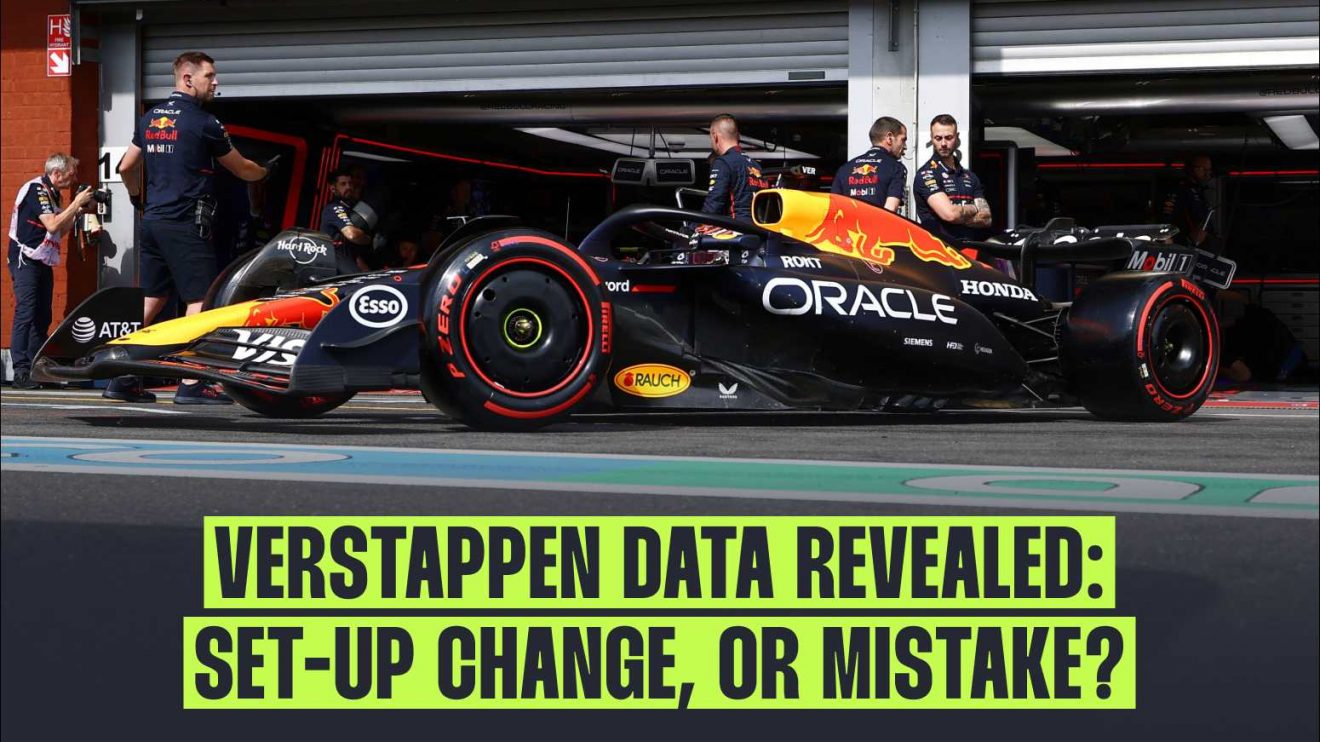
Did a set-up change or a driver mistake leave Max Verstappen qualifying P4 for the Belgian Grand Prix?
After a strong start to Saturday with a brilliant Sprint race victory, Max Verstappen made a costly mistake in Turn 1 that denied him a top-three position; he’ll start P4 for the Belgian Grand Prix.
But how much of an impact did that early error have on his lap — and how much came down to the rear wing change Red Bull made just before the session? The telemetry gives us answers.
Did Red Bull make the right Belgian Grand Prix set-up call?
With the sprint format in place this weekend, teams had a valuable chance to learn from the early sessions of the mini race and make setup changes ahead of Sunday.
According to the rules, no adjustments to setup or aero components are allowed between Sprint Qualifying and the Sprint Race, but after that, there’s a brief window before parc fermé is re-established for Grand Prix qualifying.
Learning from their struggles in the wet at Silverstone, Red Bull’s engineers decided to switch Verstappen to a higher-downforce rear wing ahead of qualifying, anticipating rain on Sunday.
Back in Britain, the team had opted for a low-downforce rear wing that helped in qualifying, where the reigning champion took pole. During the race, though, it cost them dearly as it made the RB21 more challenging to handle in the wet. Verstappen struggled for grip, spun after the safety car restart, and was off the pace for much of the race.
This time, Red Bull sought to avoid a repeat. Early laps with the new rear wing on RB21 in Q1 and Q2 looked promising. Verstappen, again, appeared the only true challenger to the two McLarens, especially in Sector 2, where his lap times improved significantly. The slight drop in top speed wasn’t overly detrimental.
More Belgian Grand Prix analysis:
? Ferrari unveil highly anticipated ride-height solution at Spa
? Tech analysis: Red Bull throw kitchen sink at RB21 in bid to catch McLaren
But trouble arose on his first Q3 push lap — the time wasn’t where it should have been. Over the radio, Verstappen reported a general lack of grip and seemed confused by the sudden loss of performance.
The same issues persisted in his final Q3 run.
After the session, Verstappen explained that from the very start of his lap, he struggled with severe wheelspin and couldn’t transfer power cleanly to the track. Not long after, a significant mistake in Turn 1 cost him valuable time.


Spa is a track where a small mistake in Turn 1 has a knock-on effect through Eau Rouge and all the way down the Kemmel Straight. That’s exactly what happened — telemetry shows Piastri reaching higher speeds earlier on Kemmel, which is rare even after Verstappen was running a higher-downforce rear wing.
The Turn 1 error cost him around 0.15 seconds, but the real time loss came in Turns 5 and 6 — precisely where Verstappen mentioned struggling for grip. McLaren, by contrast, looked planted and quick through this section all weekend.
From there, Verstappen and Lando Norris were more or less even, until the final chicane, where the Dutch driver managed a slightly better exit. But it wasn’t enough to claw back the lost ground.
Could Verstappen have challenged for the front row — or even pole — without that T1 mistake? In truth, no. While the error was costly, the underlying issues were already visible in his earlier Q3 lap. It’s also worth noting that most drivers struggled to improve in Q3 — it just stood out more for Red Bull.
The “ideal lap” data shows Verstappen’s ceiling was probably P3 — still notably behind both McLaren drivers.

Was the rear wing change the wrong call?
Max Verstappen’s best lap in Sprint Qualifying was a 1:40.987. In Grand Prix qualifying, his best was a 1:40.903 — a slight improvement, but nothing dramatic.
That’s typical for Spa. It’s a circuit where different aero setups can produce similar lap times thanks to its layout. Sector 1 rewards low drag and top speed while Sector 2 demands maximum downforce.

Looking at Verstappen’s telemetry from Sprint Qualifying versus Grand Prix qualifying confirms this. Notice the ~0.4s gap in Sector 1 — the Kemmel Straight speed difference is clear. But as we move through Sectors 2 and 3, that gap slowly vanishes.
Sector 2 starts with Turns 5 and 6, and here the white delta line clearly shows how the higher-downforce RB21 gains back time corner by corner. Interestingly, Verstappen was able to take Turn 10 flat out on Saturday, something he couldn’t manage on Friday.
Another notable gain came in Turn 14, where the loaded rear wing allowed for a much higher apex speed — and he carried that advantage all the way down the next straight.
In short, the wing change was the right call. It may not look like much now, but it’s likely to pay off on Sunday. With a high chance of rain, the added downforce could be a crucial advantage.
So what can we expect from Verstappen on race day? It’s hard to say. He’s expected to have the pace to clear Leclerc, but catching the McLarens may prove a step too far. Right now, Norris and Piastri look simply too fast.
But then again — this is Spa, nothing is ever certain, and all the cards are still very much on the table.
Read next: Winners and losers from the 2025 Belgian Grand Prix qualifying