

Lewis Hamilton telemetry data exposes critical Ferrari issues in Saudi Arabia


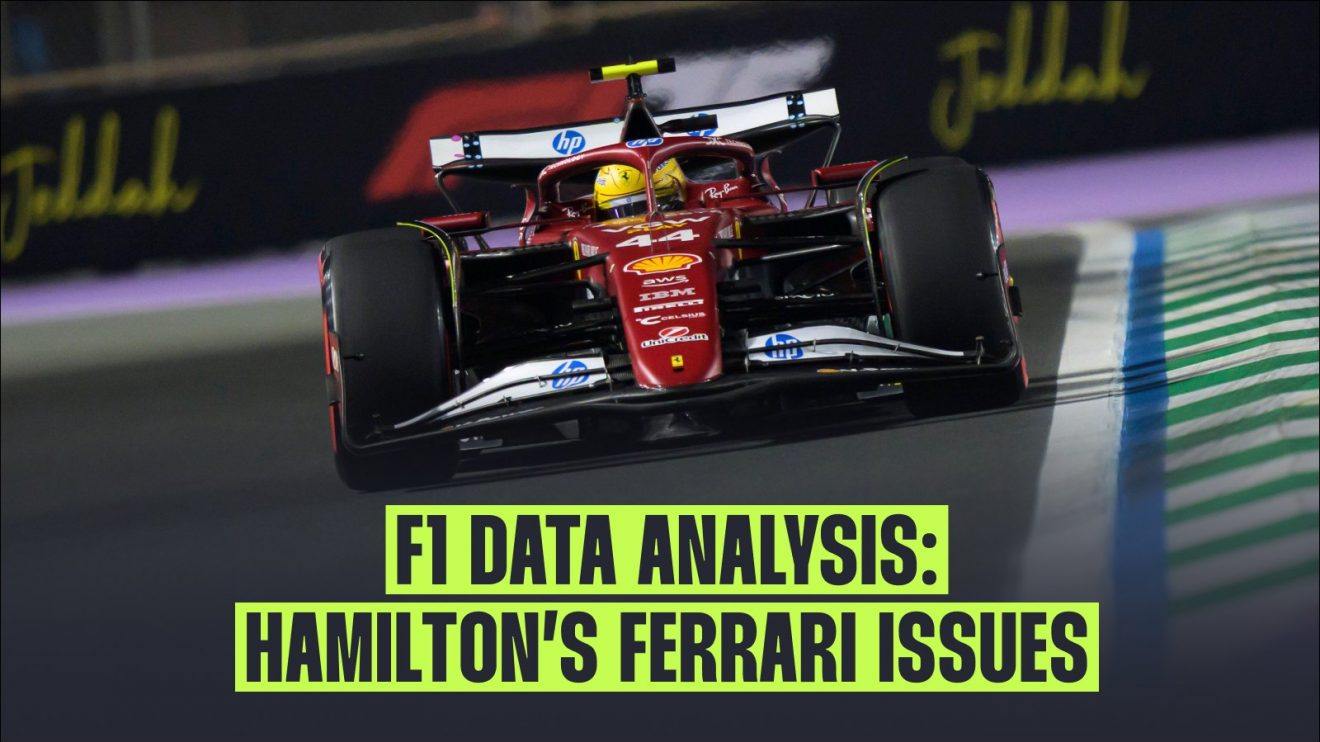
Lewis Hamilton struggled again to find speed in his Ferrari.
Another qualifying session is behind us and it was another underwhelming result for seven-time world champion Lewis Hamilton.
It seems Hamilton is still adjusting to the Ferrari, and that process is taking longer than many expected. But what does the telemetry say? Where exactly is he lacking confidence, and why?
Is the problem Lewis Hamilton or Ferrari?
The answer is: both. His team-mate, Charles Leclerc, widely regarded as one of the best qualifiers on the grid, offers us a perfect point of reference. Leclerc is a driver who consistently extracts the maximum from his Ferrari, a car he knows inside and out.
Leclerc finished qualifying in P4, around 0.4s behind Verstappen’s pole time – a notable gap, but not dramatic given the length of the Jeddah circuit. In contrast, Hamilton ended up 0.907s off pole – a massive gap by Formula 1 standards.
This means there was a difference of over half a second between the two Ferrari drivers, so where exactly is Hamilton losing time?

Sector analysis shows that Hamilton was significantly slower in Sector 1 and Sector 3, while he and Leclerc were closely matched in Sector 2. It’s also worth noting that Hamilton didn’t improve in Q3, his final lap wasn’t his best, making him one of the few drivers who failed to go quicker in the final shootout.

Looking at the speed trace from their fastest laps, it becomes even clearer how much Hamilton struggled in Sector 1. Leclerc showed much greater confidence through Turns 4, 5, 8, and 9 carrying more speed and taking a more aggressive racing line, gaining a decisive advantage over his team-mate. Another critical problem area for Hamilton was Turn 13.
But why is Hamilton struggling so much?
One theory centres around engine braking – something that is notably different in the SF-25 compared to the Mercedes. A different engine braking setup requires a change in braking style and pedal feel in order to fully exploit the car’s potential. As the data shows, Hamilton struggled the most in areas where precise braking is essential.
Comparing Lewis Hamilton to the front of the grid
If we compare Hamilton’s telemetry to Max Verstappen’s, the pole sitter, the challenges become even more apparent.

Hamilton lost the most time right at the start of the lap – in Turns 1 and 2 and it appears the Ferrari struggled to get the front tyres into the ideal temperature window, which hurt Hamilton particularly in the early corners. This resulted in understeer and a more cautious racing line.
Further into the lap, particularly through Turns 7, 8 and 10, Hamilton was noticeably lighter on the throttle, at points where Verstappen was fully committed. By the end of Sector 1, the gap was already close to half a second and realistically, Hamilton had no way to recover it.

More data analysis from PlanetF1.com
What the data reveals about Lando Norris’ costly Saudi Arabian GP qualifying crash
The Max Verstappen ‘bonus’ found in McLaren battle data analysis
When it comes to fast corners and straights, the Ferrari remains competitive. But in slow-speed corners, the SF-25 continues to struggle, and that’s where Hamilton’s lack of confidence in the car becomes most visible.
What’s next for Ferrari? The team’s engineers are fully aware that there’s still a performance gap compared to the other top teams even after the significant floor upgrade, which brought gains, but perhaps not as much as expected.
It remains to be seen whether Ferrari can use strategy to turn things around and bring home valuable points. The Italian team currently sits fourth in the Constructors’ Championship – despite having, arguably, the strongest driver pairing on the grid right now.
Read next: Winners and losers from the 2025 Saudi Arabian Grand Prix qualifying