
How Lando Norris turned strategic gamble into Hungarian GP victory


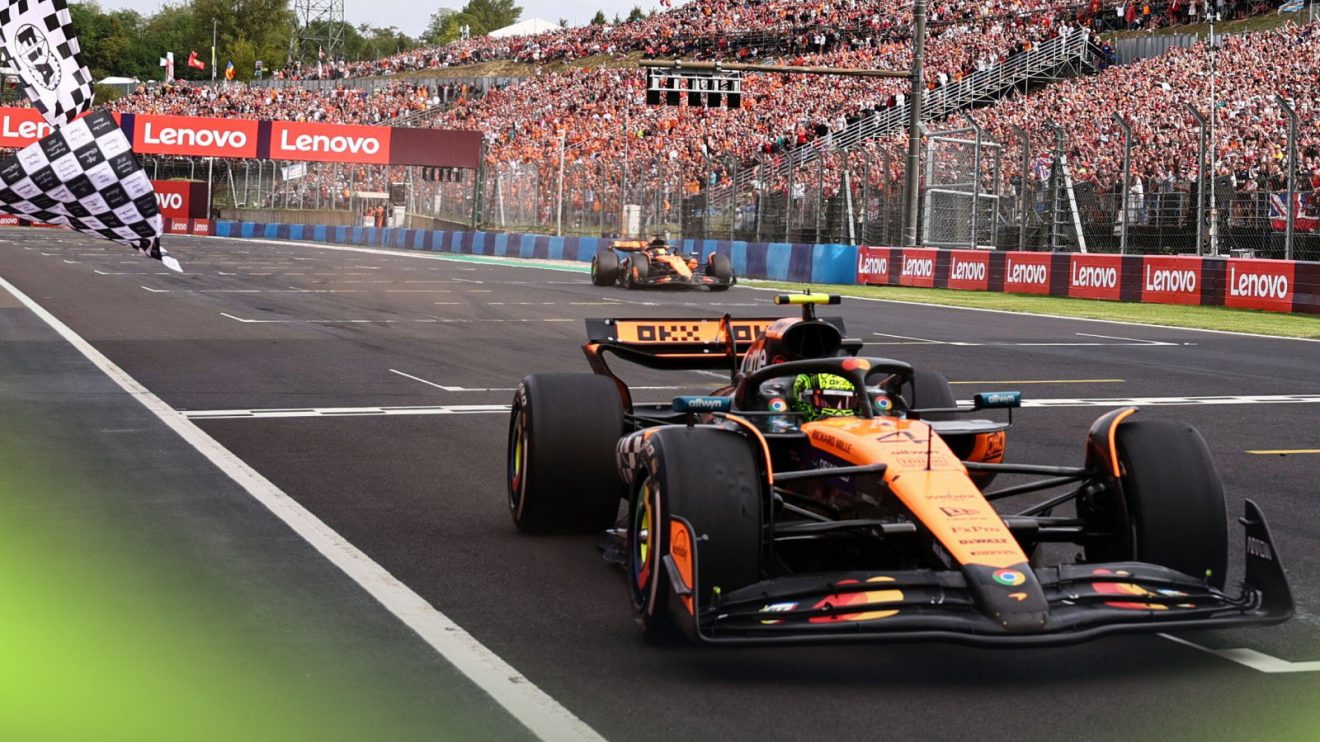
Lando Norris used strategy to win the Hungarian GP from team-mate Oscar Piastri.
After a phenomenal strategic duel at the Hungarian Grand Prix, Lando Norris emerged victorious, securing McLaren’s fourth consecutive one-two finish alongside Oscar Piastri.
The Briton achieved it by making one fewer pit stop — so let’s dive into the details using telemetry data to understand how he pulled it off.
Lando Norris closes the championship gap with strategy gamble
Following Charles Leclerc’s unexpected pole position in mixed conditions, it was clear we were in for a strategic showdown. The Hungaroring is a circuit where overtaking is difficult — but not impossible — making race strategy even more critical in the overall outcome.
What we also knew was that McLaren held a clear edge over the rest of the field in terms of race pace, tyre management, and the ability to fully exploit clean air — which has become more valuable than ever. On a short and congested track like the Hungaroring, where traffic is almost always present, strategy becomes king.
Both Norris and Piastri started on medium compound tyres. Based on recent races here, a two-stop strategy has generally been quicker, and it’s likely that both McLaren drivers were initially prepared for such a plan.
On the opening lap, Norris reminded us of his struggles from last season, where he often lost positions off the line. Piastri focused his efforts on defending against Lando, putting pole-sitter Charles Leclerc on the backburner — and it worked. What’s more, Norris soon found himself behind both George Russell and Fernando Alonso, compromising his early stint. It took him two laps to clear Alonso, but he remained stuck behind Russell until Lap 20, when the Mercedes driver finally pitted.
More Hungarian Grand Prix reaction:
? Charles Leclerc backtracks on Ferrari radio rant as true cause of problems revealed
? Marko declares F1 2025 title ‘impossible’ after latest Red Bull defeat
By then, McLaren made a crucial call: Norris would attempt a one-stop strategy. At that moment, he was trailing Piastri by five seconds and Leclerc by seven seconds.
It’s impossible to know whether McLaren would’ve made the same call if Norris had kept his original third place starting position. But in the end, switching to a one-stopper was absolutely the right decision.
After Russell and Leclerc pitted on Lap 19 and 20 respectively, Norris found himself in clean air — and he made the most of it. His laps during the remainder of that first stint were surgically precise.

The timing of the pit stop was also perfect. After coordinating with his race engineer, Norris waited just long enough for both Leclerc and Piastri — who were catching up — to close in, and only then dove into the pits. This way, he avoided being overtaken on track and preserved his clean air advantage.
After a fantastic stop of just 1.9 seconds, Norris rejoined 8.5 seconds behind Russell — but crucially, with a clear track ahead. Once again, Lando was in control of his own pace, unbothered by other cars.
The only lap where Norris had to follow another car in his second stint came on Lap 43, when he briefly got stuck behind a slower Russell. That single lap alone cost him over a second. Fortunately, Russell pitted at the end of that lap, freeing up the track again.
Had Russell stayed out even one lap longer, Norris might have lost crucial time — and his chance at victory could have slipped away.

Just how valuable clean air really is can best be illustrated by the following fact: during his second stint, which lasted 27 laps, Oscar Piastri spent nearly the entire time running in very close proximity to Leclerc ahead of him.
In contrast, Norris’s second stint lasted 39 laps, a full 12 laps longer than his team-mate’s. Despite this, he averaged a full second per lap faster than Piastri. That’s a stunning statistic — and it tells us everything about how Lando won this race.


It wasn’t until Piastri made his second stop and finally cleared Leclerc — who, we later learned, had a technical issue — that he was able to show his full pace. In the closing laps, Oscar was extremely fast, but simply ran out of time to pass his team-mate.
Could Oscar Piastri have won with a different strategy?
Looking back with the benefit of hindsight, it’s easy to say yes — the one-stop was clearly superior. But at the time, things weren’t so simple.
Piastri made his first pit stop on Lap 19, trying to undercut Leclerc. The Ferrari driver pitted just one lap later and managed to retain track position. With that failed attempt, Piastri got stuck behind Leclerc for a long period — and that essentially ruined his race.
There wasn’t a clear opening later in the race for Oscar to pit and rejoin in a stronger position. Given the options available to him and his team at the time, they did the best they could.
For his second stop, Piastri opted to stay out longer than Leclerc. This gave him clean air and helped prepare the tyres for an easier overtake — which ultimately worked. But by then, it was too late to reel Norris back in.
In the end, with a bit of luck and a perfectly executed strategy, Norris took a well-earned victory. His precise driving avoided a repeat of the Belgian GP result, and he closed the championship gap.
The difference is now just nine points, and the second half of the season promises to be thrilling.
Read next: Winners and losers from the 2025 Hungarian Grand Prix