

Japanese GP data shows signs of life for Mercedes W15, Aston Martin catch the eye


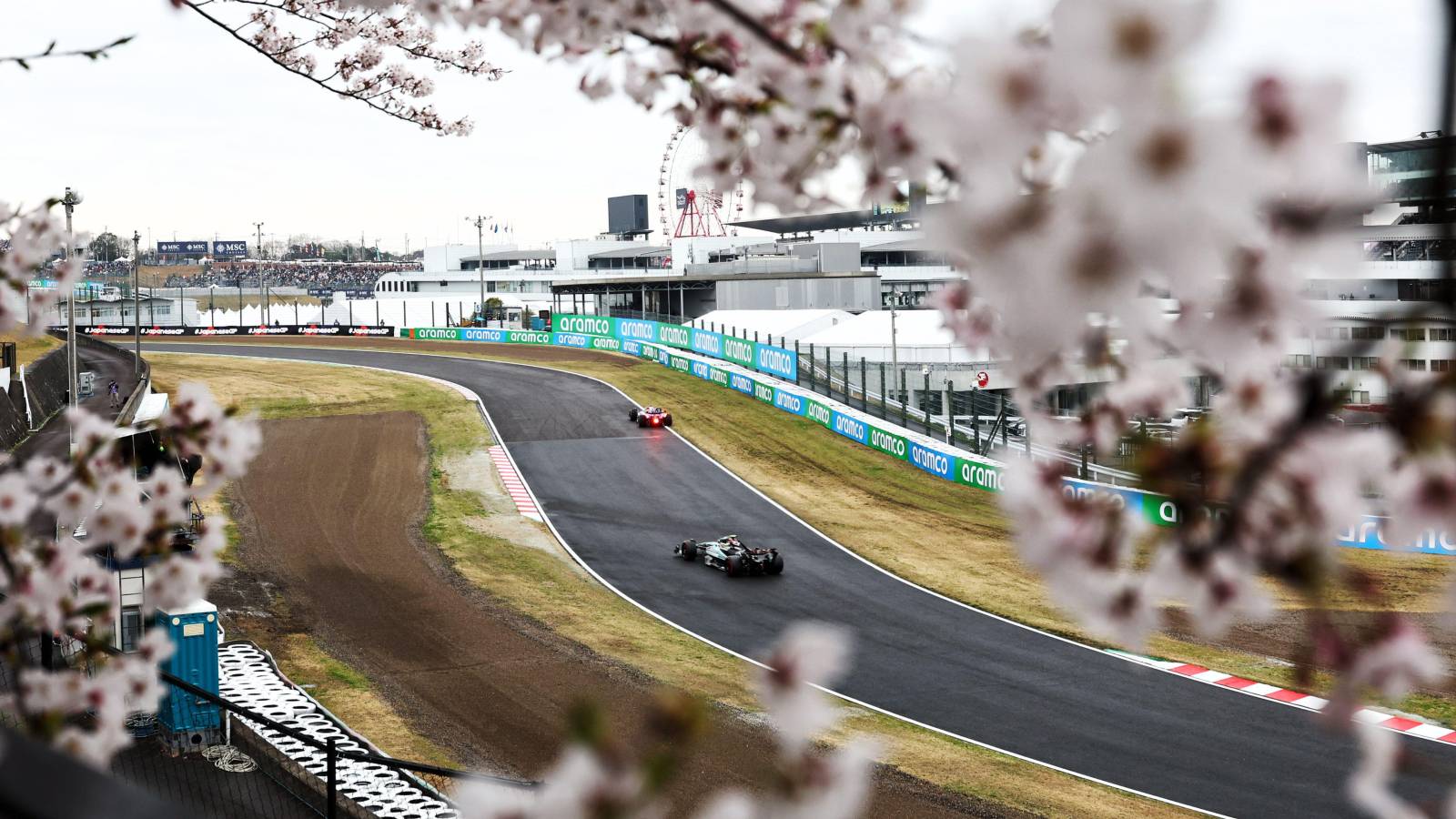
Mercedes driver Lewis Hamilton through the blossom
The cars are on the Suzuka Circuit, and after the first two free practices, we can see how the teams have adapted to this track.
With the help of telemetry data, we can analyse certain characteristics of the teams and drivers, which might reveal their true performance.
How the teams prepared for Suzuka
Suzuka is a track that demands a significant amount of downforce and grip. A large number of fast corners can drastically affect your time if you haven’t chosen the right aerodynamic package for your car. Additionally, it’s necessary to keep an eye on the tyres, which degrade rapidly, despite using the hardest Pirelli C1, C2, and C3 compounds.
It’s also worth noting that Suzuka has only one DRS zone, which is a significant difference compared to the four zones from the previous race weekend.
This means that teams with slightly higher drag can lose a lot of time, which engineers must consider when determining the aero package. Nevertheless, we can expect high-loaded aero packages at Suzuka.
La configuración de alas traseras para Suzuka
Suzuka rear wing configuration #f1 #JapaneseGP pic.twitter.com/EytLgHbRXR
— Albert Fabrega (@AlbertFabrega) April 4, 2024
We can see different designs of rear wings from the current top four teams on the grid. There are some obvious differences, especially with Red Bull and Ferrari opting for the least loaded variant compared to other teams.
It’s well known that Red Bull has the most efficient car in terms of aerodynamics, and their main source of downforce is a well-designed underbody that works well with other components.
Therefore, such a rear wing design isn’t surprising, considering there’s only one DRS zone. In comparison to the last race, many teams had more loaded rear wings than usual, solely due to the high number of DRS zones that would make a difference.
On the other hand, we have Mercedes and McLaren opting for a more loaded variant, with McLaren’s upper flap of the rear wing looking very aggressive.
McLaren is a team struggling with tracks requiring high levels of downforce, which explains this move. On the other hand, we can recall last year’s Suzuka visit where McLaren was the second-fastest team. If they have high maximum speeds, we can expect a strong performance from them on Sunday.
Y 4 más
And 4 more#f1 #JapaneseGP pic.twitter.com/wDBxMyScne
— Albert Fabrega (@AlbertFabrega) April 4, 2024
When it comes to other teams, Aston Martin is definitely the one to watch. The new upgrade could be a good step forward in challenging the top teams.
Similar to McLaren, both Aston Martin and Sauber have opted for a high-loaded rear wing. Aston Martin is in a similar situation as McLaren, facing issues with generating a high level of downforce.
We can also recall the last race where Aston Martin arguably had the most loaded rear wing.
FP1 telemetry data analysis
Although we had a very unusual FP2 in Suzuka where many drivers didn’t even set their times, we will take some interesting data from FP1 and analyse it. It’s worth noting that analysis of this type should always be taken with a pinch of salt because we don’t know all the information that the teams know.

In the image above, we can see the maximum speeds achieved by drivers during their fastest laps in FP1.
At first glance, it’s clear that Haas took the first place with a significant difference compared to the rest. Immediately after them are the Red Bull drivers as well as other teams, with very little difference between them.
At the bottom is Alpine, who has been in catastrophic form since the beginning of the season, and their progress isn’t visible yet. It’s important to keep in mind that we don’t know exactly how much fuel each driver had during their fastest lap or their engine maps.

In the next table, we can see the best sectors by teams, also in the first free practice. Although Red Bull took the first place in all three sectors, we can notice that the delta times are very small for Aston Martin in the first sector, while Mercedes was the best in the third.
The first sector is characterised by fast “S” corners where Aston Martin’s high-loaded wing comes into play and provides sufficient grip, while such corners don’t suit Mercedes.
Mercedes will try to find their advantage in the third, as well as the second sector. Their car is more suited to slower corners like the sixteenth and seventeenth corners in the final sector.
What is characteristic of this year’s race in Japan is the earlier timing. Compared to September last year, some differences in track temperature are already visible, which will definitely affect the choice of tyres for the race.
So far, the soft compounds have performed quite well in the free practices, primarily due to the low track temperatures. Therefore, it won’t be surprising to see soft tyres even in the race on Sunday.
Read next – Japanese GP data: What we learned from practice at Suzuka
