

The Italian Grand Prix proves race duration isn’t the key to making F1 exciting


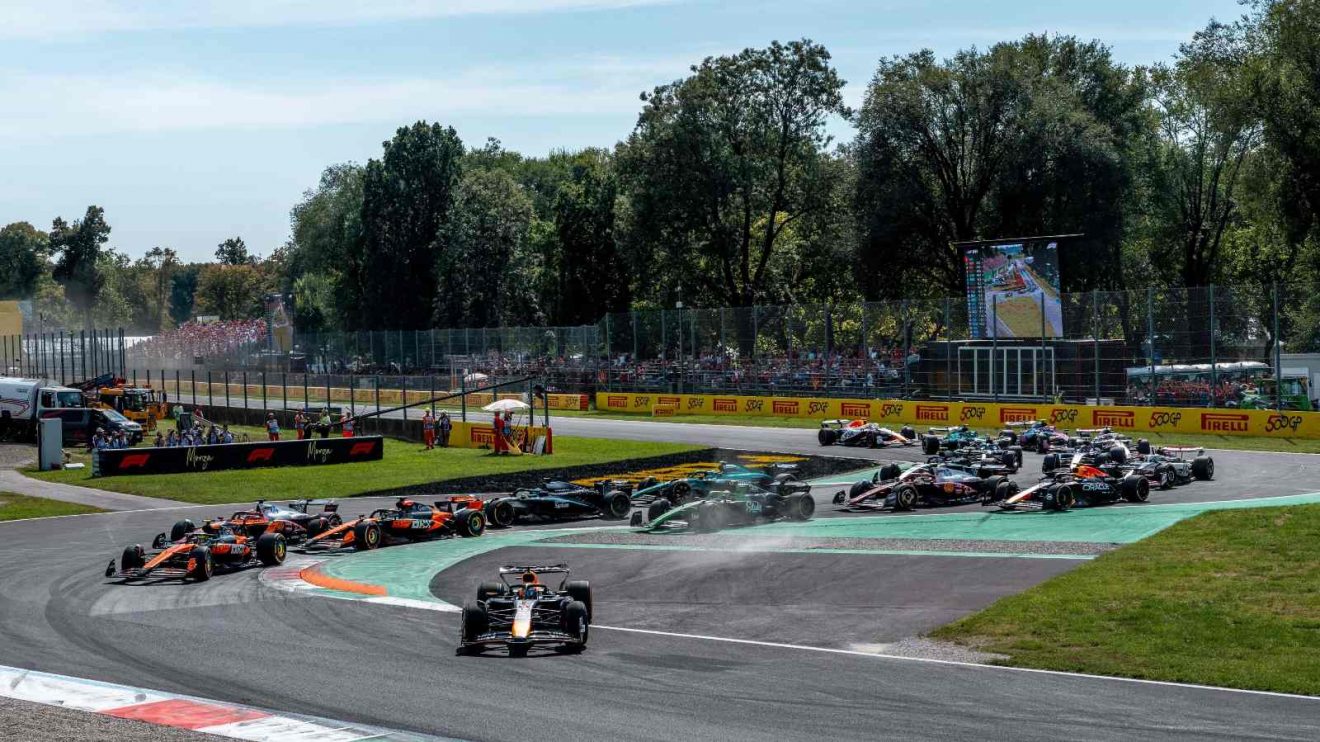
The start of the Italian Grand Prix contained most of the race's action.
Around the world, countless sports are looking for new ways to attract younger audiences, with many pundits arguing that shorter attention spans should necessitate the addition of things like pitch clocks for the MLB. But in Formula 1, race duration should not be a consideration.
But the 2025 Italian Grand Prix — the shortest fully completed event in F1 history — proves that duration has absolutely no bearing on race quality. The problem is much, much deeper.
Italian Grand Prix: Short race, short on action
The first four laps of the 2025 Italian Grand Prix were chock full of drama. Polesitter Max Verstappen held his line into the first chicane, leaving the McLaren of Lando Norris to take a trip into the grass on the front straight. Verstappen then cut the chicane, forcing him to give the position back, all while Oscar Piastri and Charles Leclerc did battle for the final podium position.
The subsequent 46 laps? Far from compelling. The final three provided some drama, thanks wholly to a McLaren pit stop problem.
The high-speed nature of the Monza circuit saw the field string out within a handful of laps, and a lack of safety cars saw the race wrap up in just over an hour.
As Formula 1 continues to evolve with an eye to appealing to younger audiences, some onlookers have wondered if shorter races could be a consequence. And while F1 is clear that it is not looking at shortening its grand prix, the 2025 race in Italy has proved why that would be a fruitless path.
More Italian Grand Prix analysis:
? How Max Verstappen stunned McLaren at Monza as key corner costs Lando Norris
? McLaren’s plan to annihilate rivals comes to life at Monza
Are shorter races key to greater fan interest?
In the buildup to the Italian Grand Prix, Formula 1 CEO Stefano Domenicali sat down with a select handful of journalists to discuss some of the big ideas being considered for the future of the sport. All are currently just suggestions, but they hint at a future where grand prix weekends could look dramatically different than they do today.
Domenicali’s arguments largely hinged on what younger fanbases want, arguing that F1’s growth in the youth market means the sport must change to continue appealing to them.
“Promoters and fans want action,” said Domenicali. “And now that they’ve started to understand it’s possible: our surveys show the vast majority of the audience wants the drivers to fight for a result.”
He added that modern events “may be a bit too long for younger audiences,” and that “highlights do very well” because “there’s a large segment that only wants to see the key moments.”
Many onlookers have interpreted these statements to mean that shorter races could be in the future, though F1 has offered no indication that that would be a possibility.
However, these are similar arguments that were used to introduce the pitch clock to Major League Baseball. The logic dictates that younger fans require shorter sporting events that are packed with ever more action.
Domenicali’s statements hinge on the fact that F1 is always paying close attention to the way fans respond to and interact with the sport…
…But shorter races shouldn’t enter the conversation
And the Italian Grand Prix has proved that.
In fact, almost every sprint race has proved that, too.
The length of a race has far less to do with the quality of the event than almost every other factor: Car size and weight, wheelbase length, aerodynamic performance, racing regulations, circuit construction, and so much more.
But developing a technical regulatory set and a slew of sporting regulations that enable hard battling without compromising the integrity of F1’s innovative heritage is far easier said than done. It’s far simpler to play with the event format.
The Italian Grand Prix lasted for just over 70 minutes, and its excitement was confined to the very start and very end of the event. That would have almost certainly been the case had the race been three hours, or if it had lasted for 20 minutes. The distance was not the problem, and race duration should not be a consideration in addressing problems of dwindling interest midway through an event.
The slippery slope of spectacle
Formula 1 may cite MotoGP as its inspiration for bolstering its weekends with more, shorter events, but it would do well to look across the pond for a far better example of what happens when a racing series prioritizes spectacle over substance: NASCAR.
The stock car series has increasingly degraded its racing product in an effort to attract more interest.
In an attempt to inject life into a series being dominated by one driver, the Cup Series introduced an elimination-style Playoff system that determines the overall series champion based on the best in-race performance of the last four drivers standing come the season finale. The best driver is no longer guaranteed to win the title.
When that failed to bring in more fans, the Cup Series introduced “stages.” Effectively, each event is subdivided into three sections by two mandatory caution periods, which necessitates a restart that generates more on-track action.
And when stages didn’t necessarily result in a green-flag finish, NASCAR introduced “overtime,” where, if a race is yellow-flagged before the white flag, the grid re-racks and restarts for a two-lap shootout. They’ll do it again and again and again, until the field takes the white flag.
These changes added nothing to the quality of the NASCAR championship. They were designed to cause drama, because drama makes for a compelling highlight reel.
Evolution is critical for any sport, but Formula 1 is already more popular than it’s ever been before. Fans are responding to what currently exists; they aren’t tuning in on Sunday because they believe the existing product needs a spectacular overhaul. And when they’re asking for changes, they’re not asking for the racing to feel cheapened by gimmicks.
Read next: McLaren threw ‘papaya rules’ to the wind in Italian Grand Prix team orders call