

IndyCar is in dire need of a rulebook overhaul after Gateway restart drama


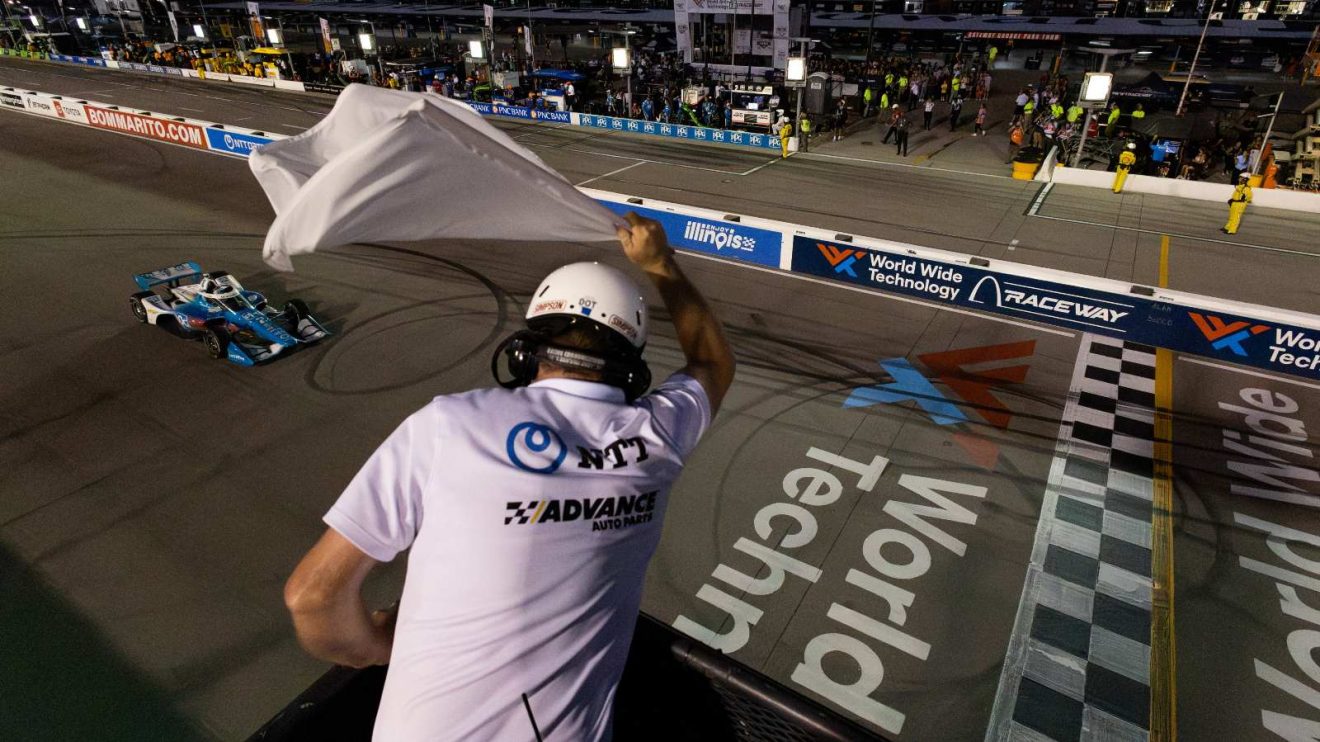
Josef Newgarden takes the white flag at Gateway after a controversial restart.
As the red flag waved for a multi-car restart crash at Gateway, IndyCar pundits struggled to figure out who was at fault. Was it Josef Newgarden? Did he slow the field far too drastically; did he accelerate and then slow down? Or should we blame Alexander Rossi for getting on the gas too aggressively before the leader had restarted?
Much of the argument circled around what should happen, but what is technically allowed — a clear sign that IndyCar is in need of a rulebook revamp.
IndyCar needs more definitive rules
With under 10 laps remaining in the Bommarito Automotive Group 500 at Gateway, Team Penske’s Josef Newgarden paced the field to a green-flag restart… slowly.
Newgarden had just usurped teammate Scott McLaughlin for the lead after his No. 2 crew put together a stunningly quick four-tire pit stop, and it was clear the American racer was interested getting a strong start. But as he brought the field through Turns 3 and 4, Newgarden didn’t pick up the pace.
He didn’t have to; IndyCar’s rulebook states that the leader of the pack is in charge of the pace. It also states that Newgarden must maintain a steady pace and not decelerate. But Newgarden could hit the gas any time he wanted to — and he wanted to wait.
The full chain of events after that remains a little unclear. Newgarden’s teammate Scott McLaughlin seemed to tuck his rear wing right under the No. 2’s attenuator before slowing down. Colton Herta seemed to accelerate, then reign it in once it was clear the field wasn’t starting.
Will Power launched forward, then slowed. And finally, Alexander Rossi just gunned it, seemingly under the belief that the field had gone green. When he rode up the rear end of Power’s Penske machine, he realized that, actually, it hadn’t.
All this in a matter of seconds — but in the ensuing red-flag period, IndyCar on NBC commentators James Hinchcliffe and Townsend Bell couldn’t agree on who was at fault in the whole fiasco. They also couldn’t really articulate exactly what the rules said.
That’s the problem.
More conclusions from IndyCar at Gateway:
? IndyCar Gateway Conclusions: Oval racing is Indy’s greatest party trick
? IndyCar Gateway driver ratings: An imperfect race for winner Josef Newgarden
IndyCar’s rulebook is a 103-page document detailing procedures for everything from testing violations to engineering specifications. But the rules dictating restarts — as with many other rules — feature ample gray area.
Article 7.7.1.3 states that after the pace car turns off its lights, “The leader is required to maintain the pace lap speed until reaching the restart zone designated by INDYCAR when the leader shall accelerate smoothly back to racing speed and the Green condition will then be declared.”
And that’s largely it.
For road and street courses, IndyCar race directors will designate a specific restart zone, but no such thing exists on ovals.
Formula 1’s rules, by contrast, are much more robust:
Article 55.15 of the FIA’s Sporting Regulations reads that, after the safety car is announced to be coming to the pit lane, “the first car in line behind the safety car may dictate the pace and, if necessary, fall more than ten (10) car lengths behind it.
“In order to avoid the likelihood of accidents before the safety car returns to the pits, from the point at which the lights on the car are turned out drivers must proceed at a pace which involves no erratic acceleration or braking nor any other manoeuvre which is likely to endanger other drivers or impede the restart.
“As the safety car is approaching the pit entry road the SC boards will be withdrawn and, other than on the last lap of the sprint session or the race, as the leader approaches the Line the yellow flags will be withdrawn and a green flag and/or green light panel will be displayed at the Line.”
While both articles include a certain amount of gray area, F1’s rules get right to the point — making it far easier for onlookers to determine if restart rules were broken.
In IndyCar’s case at Gateway, it also seems as if one specific rule was not followed, specifically regarding that IndyCar will only declare Green conditions after the leader has accelerated to racing speed.
Newgarden did not accelerate to racing speed before the green was declared. The green flag appeared to be waved before he had actually officially restarted the race — thus creating an impression that he must have accelerated and then decelerated. IndyCar has confirmed data does not show that Newgarden decelerated at any time in the restart procedure.
Making this whole situation even more challenging is the fact that the nuance of many racing procedures during a weekend are announced during a pre-race Competition Meeting. Specific rules may apply to one event and not another, and its up to drivers and team personnel to be able to recall those rules in the heat of a race situation.
The simplest solution, then, is to develop a more robust rulebook.
Part of the magic of American motorsport is that it isn’t dictated by a deeply prescriptive rulebook, that there is more freedom and wiggle room. But when that freedom comes at the cost of multiple wrecked cars and massive championship implications, freedom loses its luster.
The onus now shifts away from the drivers and onto IndyCar. The series is often admittedly diligent about updating the regulations as need dictates — but the restart debacle at Gateway is a clear sign that we need a more robust overhaul. It’s time to be proactive, not reactive.
Read next: IndyCar charters: What we know about the document delivered to teams at Gateway