

The trick up Mario Andretti’s sleeve to gain advantage over F1 rivals


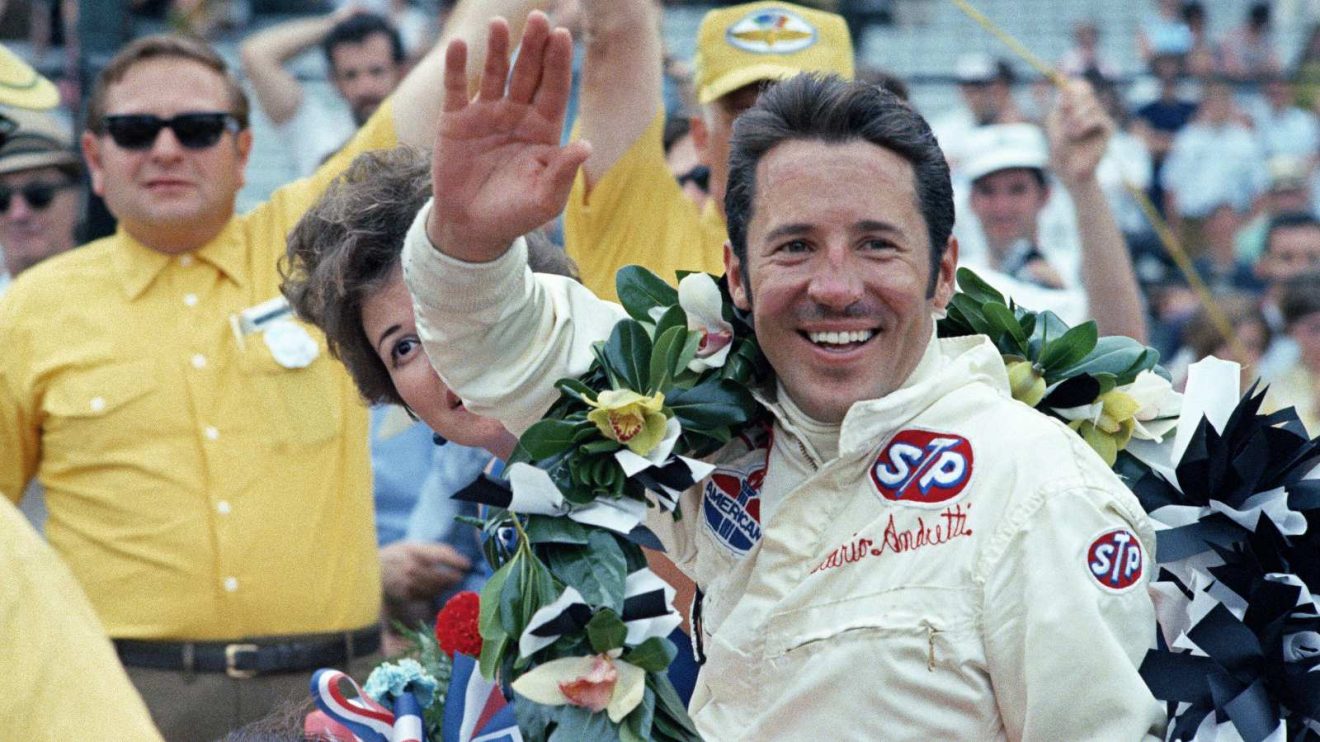
Mario Andretti celebrates winning the 1969 Indianapolis 500.
“Wait until it’s wet.” When Mario Andretti joined Formula 1, his competitors couldn’t believe that this former oval racer would be able to transfer his skillset to a wet race track — after all, oval racing is too dangerous under wet conditions.
But the Italian-American racer had a trick up his sleeve, one that practically guaranteed him success on a wet track. That’s because Mario Andretti was a master on the dirt.
Mario Andretti: From dirt ovals to Formula 1
By the time the Andretti family emigrated from a conflict-torn Italy to the United States, teenaged twins Mario and Aldo had already fallen in love with motorsport. They’d witnessed the Italian Grand Prix at Monza and the stunning Mille Miglia, and when they settled in Pennsylvania, they wanted nothing more than to get behind the wheel.
But racing in the US looked much different than what they were used to at home. Rather than competing on sprawling, open roads or permanent, state-of-the-art facilities, most of the local competition was done on small dirt oval tracks.
Undaunted, Mario and Also got their hands on a 1948 Hudson and began taking it to those local tracks — particularly Nazareth Speedway. It didn’t take long before the twins were traveling to other nearby tracks, and, eventually, for Mario to begin pursuing a dedicated career in USAC in the mid 1960s.
Things quickly took off from there, with Mario Andretti progressing into open-wheel racing, winning the Indianapolis 500 and Daytona 500, and taking on one-off drives in Formula 1.
More on Cadillac F1:
? Cadillac F1: Everything you need to know about the new 11th team
? Revealed: The six-stage Cadillac F1 blueprint ahead of huge 2026 entry
But it wasn’t until the mid-1970s that Andretti truly began to pursue a Formula 1 career in earnest — much to the skepticism of some of his competitors.
“In my days, especially when I went to Europe full-time, the chat was, ‘Wait until it’s wet,” Andretti explained to PlanetF1.com in a recent exclusive interview.
But while other drivers may have found it challenging to compete in rainy conditions, Andretti was confident in his skills.
“I was not afraid of the wet,” he explained. “I felt I was as competitive as anyone, and I learned that from oval racing on the dirt, believe it or not.
“One thing you do learn [on a dirt oval] is car control.
“I felt that it really helped me deal with wet conditions on road courses, because what’s similar is that almost every lap, conditions change, and you’re looking for grip.”
Rather than being a detriment to Andretti’s successes in F1, his background in dirt oval racing actually helped him better understand what it took to race in challenging conditions.
And it worked: In 1976, during his first truly full season in the sport, Andretti took victory at the season finale, the Japanese Grand Prix, during dire conditions.
Remember, that was the race that would decide the championship for either James Hunt or Niki Lauda, and captivated television audiences spurred organizers to set the race off in or formidable monsoon. So poor was the weather that Lauda willingly retired from the race; he refused to risk his life in conditions that he deemed to be too dangerous.
Hunt took the ’76 WDC that year by finishing fourth — but crowning the top step of the podium was one Mario Andretti, flaunting his dirt oval skills for the whole world to see.
Read next: Mario Andretti speaks out after new Cadillac F1 role confirmed