

Five signs of Formula 1 excess condemned to the history books


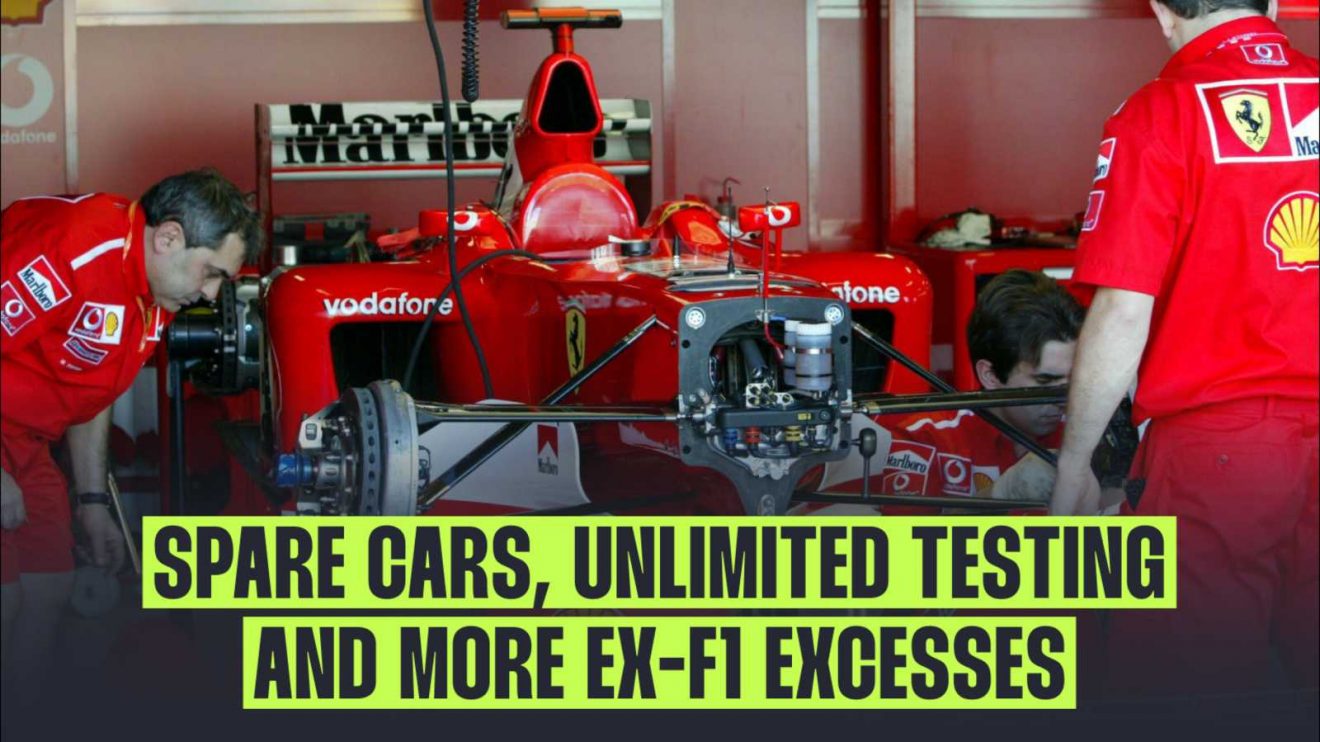
Drivers having a spare car at race weekends used to be the norm, along with other aspects in the pre-cost cap era.
Formula 1 has long been known as a high-spending sport, so much so that a cost cap has only been introduced for teams in recent years, but it remains an incredibly expensive sport in which to run.
Given the cost cap restrictions now in place, some aspects which used to be a fixture of the paddock are now unlikely to be revived, with teams beginning to not just minimise losses but, in some cases, turn a profit. Here’s a list of just a few:
Five signs of F1 excess we’re unlikely to see again
1: Unlimited testing mileage
There was a time in Formula 1 when the role of ‘test driver’ would be almost as busy as the race drivers themselves, with testing previously unlimited as teams and drivers fine-tuned their cars relentlessly.
Michael Schumacher was famously hard-working in his time at Ferrari, putting in hours upon hours behind the wheel at the team’s in-house test track, Fiorano, and was known for the incredibly high level of detail which he would be able to provide the engineers at the Scuderia as they built up a title-winning dynasty in the early 2000s.
Unlimited testing was outlawed in 2009, with teams limited to official running and often running their race drivers from then on, with the present day allowing for more testing through the Testing of a Previous Car [TPC] programme, with cars having to be at least two years old.
Current drivers are limited to 1,000km of testing across four days in TPC running, while these outings are also a valuable proving ground for young drivers and reserves to either show their potential or keep race-sharp, in the event of a late call-up.
Drivers can also take part in filming days, though these are strictly limited to two days and up to 200km in each.
Needless to say, however, budgets could quickly expand when the amount of testing was higher in the sport.
Pre-season testing is limited for the teams and drivers to all run at the same circuit at once, though the number of test days is increasing in 2026 to allow teams time to get to grips with the upcoming sweeping regulation changes in Formula 1.
2: Unlimited upgrade spending
A significant part of Formula 1’s unlimited testing period was the ability to test new parts on track, to provide immediate reference points against what came beforehand – sometimes in multiple versions, depending on the team’s budget.
With the budget cap now limiting teams in how much they can spend, they have to be precise in which areas and by how much they attempt to upgrade their cars.
Much of the previous on-track testing has now been replaced by simulator work, with teams able to closely replicate cars in their previous and updated conditions based on the parameters offered by new parts.
At race weekends, once upgrades are brought to the track, teams and drivers will use the free practice sessions available to assess the viability of new upgrades, having been tested virtually at their factory.
More on Formula 1’s rules and regulations
? Explained: How the budget cap rules are enforced by the FIA
? Explained: The 2026 engine regulations set to seriously shake up Formula 1
3: Qualifying engines and tyres
The 1980s was an important decade in the context of Formula 1, not only for the intense driver battles on track, but for the technical innovation.
Every constructor was looking to make the quickest turbocharged engines possible, with power output reaching well over 1000bhp at the time.
These engines were both extremely fast and, quite often, unreliable, so it was not uncommon to see multiple engine-related retirements per race at the time.
With spending unregulated in what was perhaps the era with the most excess in Formula 1, fresh engines would be used for qualifying for the teams with the means to do so, built for the maximum possible power over the course of one lap, to then be replaced for the race by a fresh one.
Given the need for maximum power over a qualifying lap, qualifying engines would be run at the full potential of what was available, which sometimes equated to several hundred more horsepower under a driver’s right foot, with less power available in race trim as drivers looked to complete the full distance.
The same principle would apply to tyres, with suppliers Michelin and Goodyear looking to maximise their potential on Saturdays by introducing ultra-soft, incredibly grippy qualifying tyres that, again, would be designed for peak performance over a single lap, but would not be seen again over the weekend.
Even though the power units and tyres of today are strictly regulated, the drivers and teams often opt to start on medium tyres for races, meaning the current soft tyres could even be seen as the ‘qualifying tyre’ equivalent of the present day in Formula 1.
4: Spare cars
If drivers had a crash that was irreparable at short notice, spare cars (also known as T-cars), were once the accepted norm in Formula 1.
Not only would the teams have the expense of constructing the two cars they were bringing to the circuit race by race, quite often, a third car was kept in reserve, just in case.
Teams used to be allowed to bring as many chassis to a race weekend as they wished, though each car had to go through FIA scrutineering in order to compete for the weekend.
Most teams with the requisite parts brought a third car, though Ferrari was known in years gone by to even bring a fourth car with them.
In 2008, however, the practice was banned and teams now have to survive on the two chassis they bring to a race weekend.
Spare cars would be allowed to be used in races, too, provided a collision took place in the first two laps, with a subsequent red flag period and confirmation from the FIA technical delegate that the original car for the race could not be repaired for a restart.
There have been times where drivers have been caught out by the lack of spare cars, such as Charles Leclerc being unable to start the Monaco Grand Prix from pole in 2021 after Ferrari could not fix crash damage from the previous day in time for the start.
The end of this practice was also bad news for Daniel Ricciardo and Alex Albon at the 2024 Japanese Grand Prix, with the pair having collided on the opening lap in the early corners. Without a spare chassis, though, they could not take the restart of the race after the red flag that followed their incident.
5: Unlimited engine/power unit supply
Engines were ever-evolving in Formula 1 throughout history, and it has only really been in the 21st century where one eye has been on keeping costs comparatively down.
As alluded to before, not only were certain engines used specifically with qualifying in mind, the continuous development of the teams would see updated specifications brought whenever possible to try and gain a competitive advantage.
In their time at McLaren, Alain Prost and Ayrton Senna would famously draw lots to choose their Honda engines to ensure fairness, with each unit never guaranteeing the exact same power output.
Engine formula rules have long been prescribed in a certain form, but the quantity of engines to use was not.
That changed in 2009, when the first use of an engine limit would come into play, with eight units available to drivers over the course of the season.
The beginning of the turbo hybrid era tightened these regulations further, with the teams prescribed a certain number of each key element of a power unit over the course of a season, with 10-place grid penalties handed to those who go beyond the prescribed limit for the campaign.
Read next: F1 2027 driver line-up: Which drivers are already confirmed for the 2027 grid?