

F1 uncovered: Under the skin of the Racing Bulls VCARB02


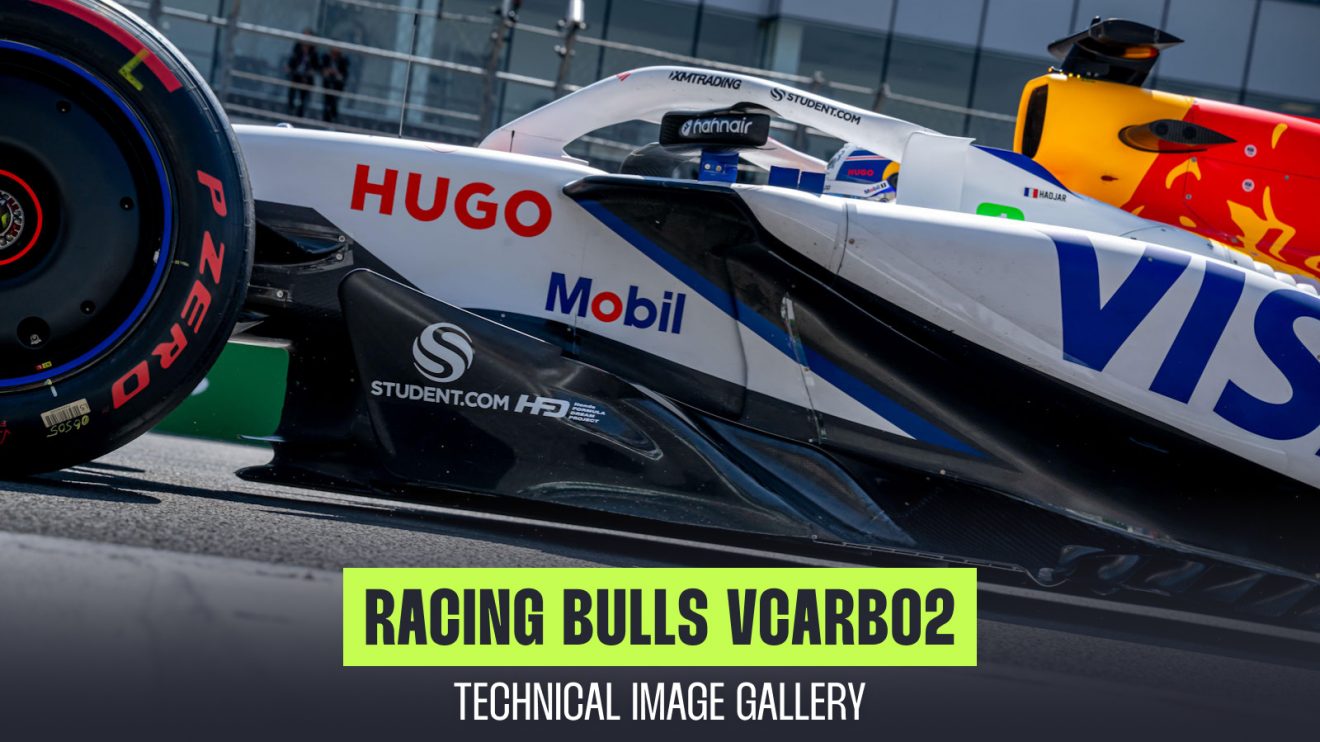
Operating under yet another name in 2025, the sister Red Bull team continued to deliver a solid car for their young protégé’s.
Retaining the car’s naming lineage, the VCARB02 clearly had good bones, for which performance was added to throughout the course of the season.
Beneath the covers

An unusual view of the Racing Bulls VCARB02, with the floor and bodywork yet to be installed.

The forward, upswept, section of the edge wing on the VCARB02 remains one of the more interesting, owing to the amount of detail on display, including the C-shaped floor cutout upon which it resides and the vane mounted on its back edge, let alone the varied shape and pitch of the various vanes on the lower surface.

Another look at the VCARB02’s edge wing, this time with green flo-viz painted on it, as the team looked for correlation between their work done in CFD and wind tunnel and the real world counterpart.
Want more PlanetF1.com coverage? Add us as a preferred source on Google to your favourites list for news you can trust.

The disc and caliper fairing detail which exists underneath the plain outer drum on the VCARB02’s front brake assembly.

The bulkhead, steering assembly and brake master cylinder arrangement on the Racing Bulls VCARB02.

Racing Bulls made a change to their endplate and flap juncture at the __ Grand Prix, adding a horizontal spar between the surfaces in order to alter how outwash is generated by those surfaces.

A comparison showing the two different front wing specifications from the VCARB02.

An overview of the VCARB02, which shows a number of the details on the car, including the fences protruding out from under the floor, the edge wing and floor geometry and the channel in the upper surface of the sidepod, especially just ahead of where the airflow moves into the coke bottle region.

A great shot of the VCARB02’s rear end without the bodywork in place, showing how the Honda powerunit is installed and the rear suspension arrangement.

Another look at the powerunit installation, noting the saddle cooler sat astride the powerunit, a design feature the team have used for a long time now and has since been copied by many of their rivals.

Racing Bulls made changes to their rear brake duct winglet array at the Canadian Grand Prix, with a different profile used in the lower cutout.

A close up of the rear brake duct fence, with the various winglets mounted between the inner face and tyre’s sidewall to help direct flow into the assembly. Also note the shape of the lower lead arm of the rear wishbone, which also sits close to the downsloping sidepod bodywork.

A close up of the rear wing endplate and tip section juncture, showing how the latter sits inboard and behind the rolled profile.

A mechanic uses a probe to measure the gap between the mainplane and top flap on the VCARB02’s rear wing to ensure it’s compliant with the regulations.

An overview of the VCARB02’s rear wing arrangement, with a notable anhedral profile used on the upper flap and tip sections trailing edge.

A close up of the outer floor fence and P-shaped sidepod inlet, which on the VCARB02 is lent backwards, top-to-bottom, on the horizontal section.

Racing Bulls made changes to their sidepod at the Emilia Romagna Grand Prix, with a rather significant shape change made to the G-Line (green line in the comparison).
Read next: F1 2026 engine ‘loophole’ claims: What’s really going on?</strong>