

F1 uncovered: How Mercedes made up lost ground to win in Singapore


McLaren may have tied up the Constructors’ Championship with six races remaining but, in recent races we’ve seen a resurgence from its rivals.
Both Red Bull and Mercedes have made use of a stage in the season where there won’t be any more significant leaps in performance and are using their engineering nous and much smaller, car balancing updates to improve the performance of their respective machinery.
Progress is not linear
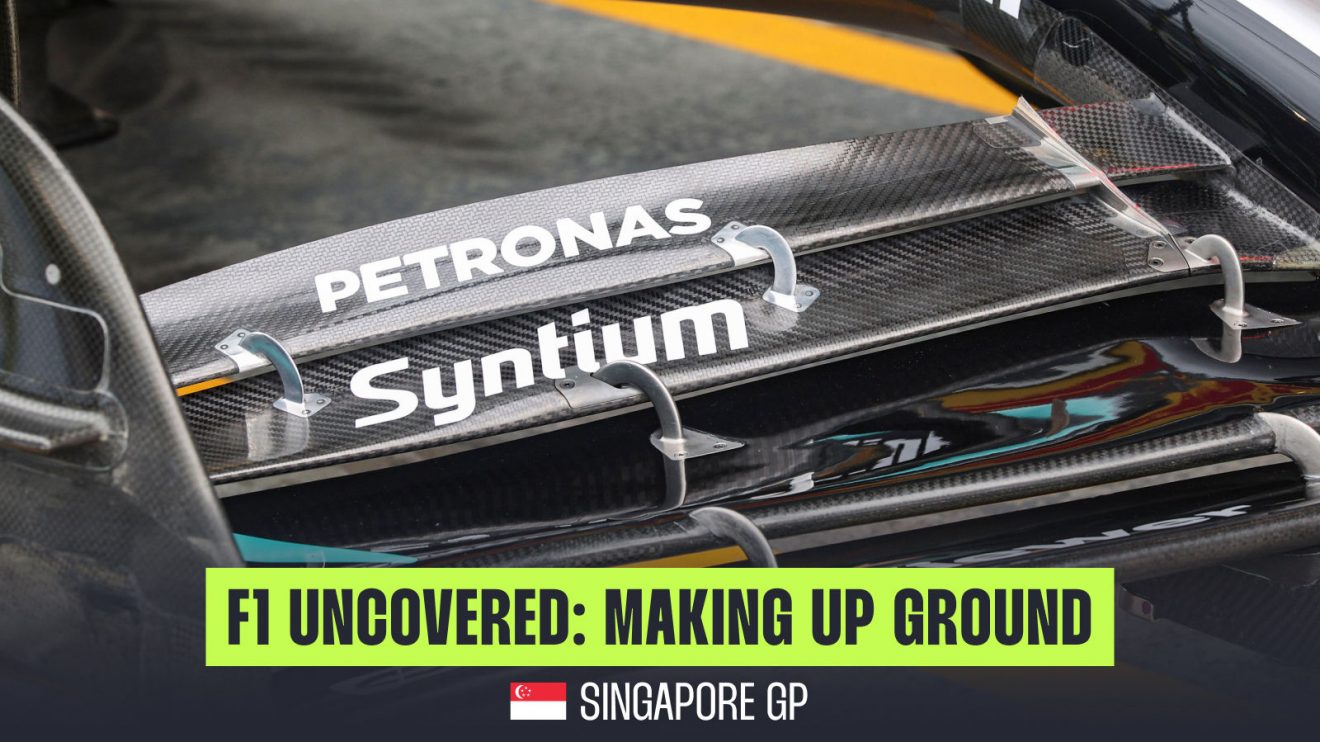
George Russell’s victory for Mercedes came off the back of yet another of these small updates that have trickled through for them over the course of the last few races, with Mercedes having announced front wing updates for the W16 at the last three events.
The latest, for Singapore, appears to be another solution introduced within this new family of designs that’s been reprofiled to reduce load compared with its predecessor in that downforce range.

The subtle geometrical readjustments that have been made between these solutions and those that came before them are about rebalancing the W16 in line with the choices made in terms of their beam wing and rear wing solutions for a given circuit.
Comparing the new solution in Singapore, with the one used in Hungary we can see how the difference in the shape of the upper flap, not only from the perspective of the trailing edge geometry (dotted line) but also in how much camber is applied across their chord (green arrow), with the older specification using a Gurney flap to make up that difference.
More on F1’s technical developments
? F1 uncovered: How Red Bull has reinvigorated the RB21
? F1 uncovered: The challenges faced by F1 teams in 2026
The other, more hidden detail in these updates is how Mercedes has responded to the more stringent front wing flexing tests at the Spanish Grand Prix earlier in the season.
It appears from onboard footage that Mercedes has recovered some of it losses in this respect, whilst still adhering to the increased load and deflection tests, just as some of its other rivals appear to have achieved too.
However, we must also be mindful that Mercedes has also had to take a few steps backwards in its development trajectory to move forward once again too, having reverted to the rear suspension arrangement at the Hungarian Grand Prix that it started the season with, abandoning the newer variant first seen in Imola.
This, as we know, has been a key component with this generation of machinery, as the rebalancing effect that can be achieved helps to mitigate some of the inherent traits posed by the ‘ground effect’ regulations.
Read next: Susie Wolff issues fresh update on FIA legal case after conflict of interest investigation