
F1 uncovered: Hidden details from the Azerbaijan GP exposed


The Azerbaijan Grand Prix comes hot on the heels of the Italian Grand Prix, putting two races on the lower end of the downforce spectrum next to one another, but while the teams are happy to trim as much drag as possible at Monza, there has to be a little more consideration when it comes to the tight and twisty middle sector in Baku.
Join us as we delve into the technical details that were on display at the Azebaijan Grand Prix.
Azerbaijan Grand Prix: Digging into the details…

A look at the Red Bull RB21 while it’s being prepared for action. With the rear brake ducts outer drum still removed we’re able to see how the designers are channelling the air and heat within the assembly. Also note the coating that’s applied to the inner drum to alter how the heat transfers between the various components and layers that make up the assembly.

A side view of the low downforce rear wing installed on the Mercedes W16, with the upper flap having a Gurney flap applied to the trailing edge.

A look at the front brake duct arrangement on the McLaren MCL39 prior to the remainder of the pipework, ducting and fairings being applied. Also note the floor fences are visible in the background.

The inner fairings that surround the caliper and disc on the Racing Bulls VCARB02 help to control the transfer of heat to the wheel rim and tyre.

A close up of some of the inboard suspension elements on the Mercedes W16, including the heave element, which uses a Belleville spring arrangement.

A look at the bib section on the Alpine A525 and the spring arrangement that connects it to the underside of the chassis.

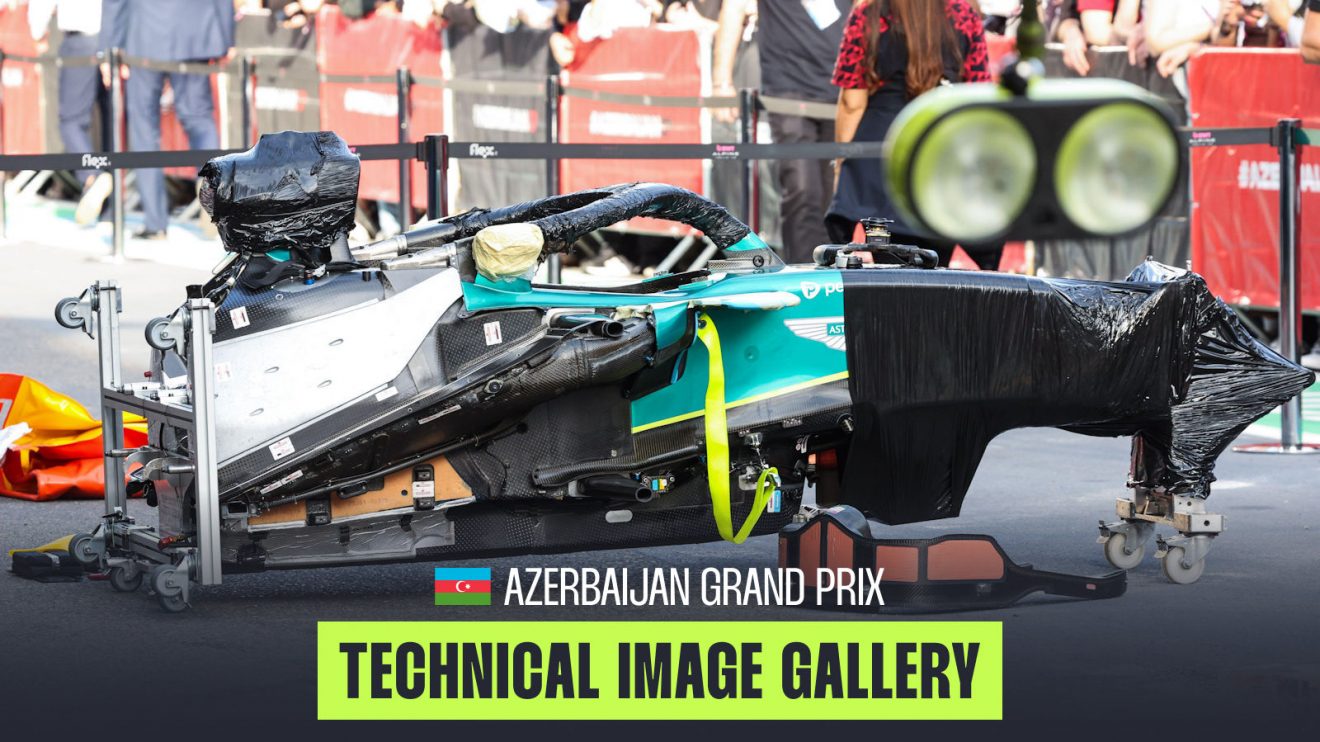
The Aston Martin AMR25 bare chassis in the pitlane reveals numerous details, including the destination for the air captured by the halo intake that sits around the rear leg of the safety structure (inset). The channel expands outwards and sits on the side of the chassis beside the fuel cell and acts as a firewall for the heat being rejected from the radiators that run alongside within the sidepod.

A look at the winglet-shaped front suspension fairings near the chassis on the Racing Bulls VCARB02

A look at the Mercedes front brake duct without the drum fairings in place offers insight into how the brake caliper is cooled.

The Racing Bulls VCARB02 without the sidepod and engine cover bodywork in place provides a view of the saddle cooler mounted above the powerunit, while the two-piece sidepod inlet sits in the foreground of the image.

The interior brake drum on the Sauber C43 shows how the designers are moving some of the air around the assembly to help control temperature exchange between the brakes and wheel rim/tyre.

A close up of the rear end of the Racing Bulls VCARB02, including a great view of the rear brake duct winglet arrays, both the one mounted on the side of the outlet and the one beneath.

The forward section of floor, including the outer fence on the Mercedes W16. Also note the wing-shaped front suspension fairing solution being employed.

The low downforce rear wing assembly on the A525 features a minimal mainplane design, devoid of the usual spoon-shaped appearance that has characterized designs of this regulation phase.

The rear brake duct winglets on the Red Bull RB21, with the main step ladder arrangement at the base, whilst another array sits above and another pair are mounted on the side of the outlet.

Further back on the Mercedes W16’s floor edge there’s the upturned edge wing, which features a number of vanes to help control how the airflow is extracted.

The Ferrari SF-25 with flo-viz applied to the rear wing as the team ascertain whether the trimmed variant is performing as anticipated.

The low downforce rear wing assembly on the McLaren MCL39 features a minimal frontal section, as the elements take up much less of the allowable box region than is permissible.

The DRS actuator mechanism is exposed on the Alpine A525’s rear wing

Ferrari’s trimmed lower downforce rear wing assembly, which has several chunks taken out of the upper flap’s trailing edge in order to reduce drag from the normal arrangement’s baseline.
Read next: Bernie Ecclestone responds to $82m F1 lawsuit after ‘unacceptable’ Massa claim