

F1 tyres explained: All the technical info and key Pirelli compounds


Pirelli has been the sole F1 tyre supplier since 2011.
F1 tyres play a critical role in how a team completes its Grand Prix weekend, with Pirelli having been Formula 1’s sole tyre supplier since 2011.
There were significant changes made to Formula 1 tyres in 2022, when Pirelli changed their construction from 13-inch to 18-inch wheels. This came after thousands of miles of testing, more than 5000 hours of simulations and cycling through more than 70 prototypes to create their current compounds.
F1 tyres: Which compounds are in use?
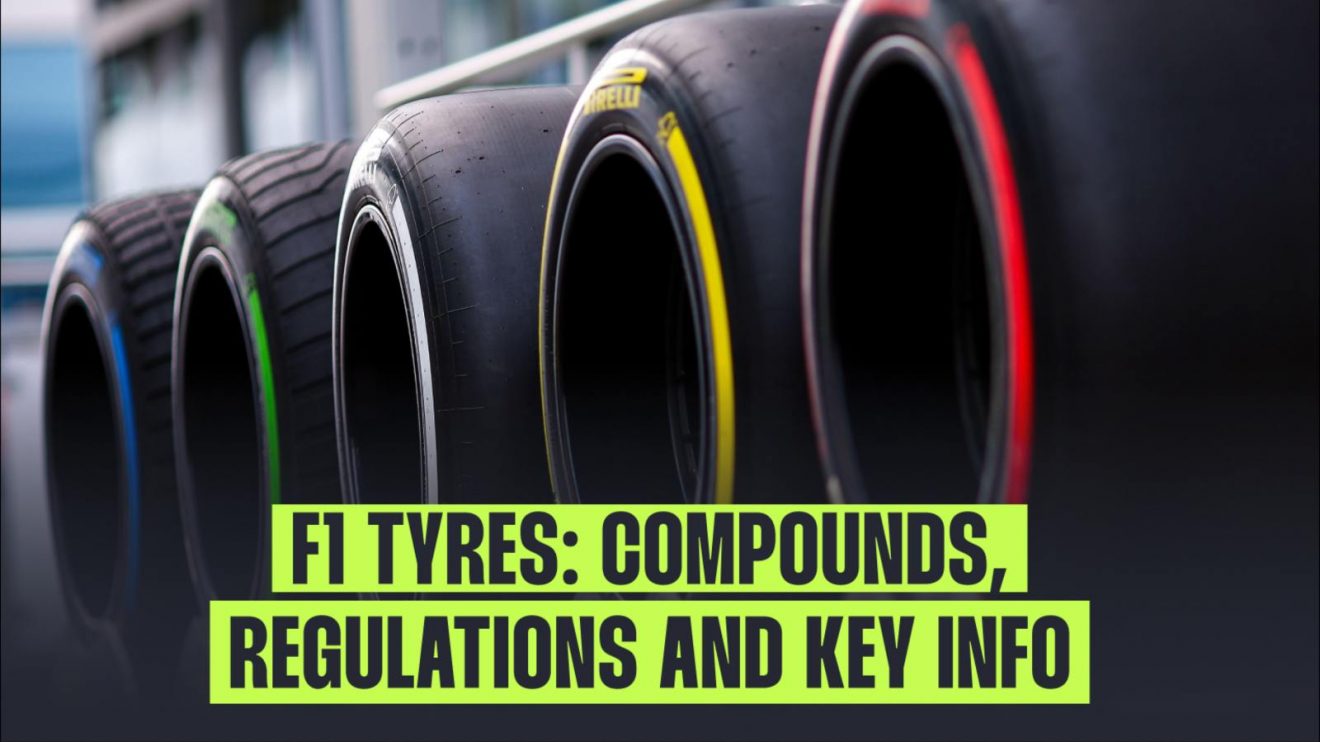
As of the 2025 season, Pirelli will have six dry tyre compounds to choose from, selecting three for each race weekend. The range going from the C1 tyre, which is the hardest, to the new C6, the softest.
At every race weekend, Pirelli will nominate three of its compounds to go to each race, based on the circuit and its predicted levels of degradation, often opting for their softest compounds at street circuits such as Monaco and Singapore, and their hardest at high-wear circuits like Suzuka and Silverstone.
Having previously used a C1-C5 range, an all-new C6 compound was tested in Mexico City and Abu Dhabi in 2024 for use on some of the calendar’s low-wear circuits, with the compound then approved for use in 2025.
At each race weekend, the selected F1 tyres are then marked into three categories:
Soft (red): The quickest tyre over one lap, but the least durable – best for qualifying.
Medium (yellow): The ‘in-between’ tyre which balances speed and durability, often favourable in the first stint of a race.
Hard (white): The most durable of the three available compounds, though providing the least grip for single-lap pace – best for race strategy options.
Then, there are also two wet-weather tyre options available at every race weekend, and the softness of their compound does not change all year:
Intermediate (green): Partially grooved with tread to clear minor standing water and navigate a slippery track surface.
Wet (blue): Marked with deeper tread to work in the toughest, wettest driving conditions.
What are the basic rules surrounding F1 tyres at race weekends?
Once Pirelli confirms its choices of tyre compound, teams choose up to 13 sets of slick tyres for use on a race weekend, though this drops down to 12 on a Sprint weekend.
During a dry race, drivers must use at least two different dry compounds – effectively forcing at least one pit stop from each driver through the course of the race. This rule is not in force in Sprints or wet conditions, however, where pit stops are non-mandatory.
The teams must return two sets after each free practice session, too – leaving seven available in total for qualifying and the race, one of which being a set of soft tyres they must keep to one side for use in Q3, should they make it that far.
Those who make it to Q3 must then return that set of soft tyres, leaving six sets for the race, while the bottom 10 qualifiers will have that fresh set of softs available for the race, if they choose to use them.
Four sets of intermediates and three sets of wets are also available for use for each driver at every race weekend.
Tyres are not allowed to be shared between drivers either, meaning teams are not allowed to take unused fresh tyres from one driver to give to another tactically.
PlanetF1.com recommends
? Lewis Hamilton car collection: Take a closer look at his incredible private garage
? F1 team principals: How long has each team boss been in charge?
F1 tyres: What are tyre blankets and how do they work?
Tyre blankets are used over the top of F1 tyres while they are in the garage or on the grid to keep them warm for when the drivers go out on track, meaning they can get into their correct operating window more quickly and thus perform almost to their optimum potential from the off.
After dropping from a 100°C (212°F) blanket temperature to 70°C (158°F), F1 had planned on dropping it further to 50°C (122°F) in 2023, but teams and drivers pushed back against the idea on safety grounds.
As a compromise, however, teams will be allowed to heat their tyres to a maximum of 70°C again, but only for up to two hours ahead of a session instead of the previous three, in order to save energy.
Can drivers use two different tyre compounds at the same time?
No, F1 drivers cannot use two different tyre compounds at the same time.
All four tyres must be the same compound, and each set must be kept as a set – meaning drivers would not be allowed to mix and match four fresh soft tyres, for example.
How do teams decide tyre strategy?
Tyre strategy can vary wildly from circuit to circuit, and teams rely on data from previous years as well as each free practice session to decide upon the optimum tyre strategy.
Teams will look at each compound and its predicted degradation over distance to put together a strategy, with some circuits and compounds inflicting higher tyre wear than others.
This is why some circuits call for a one-stop strategy, with others requiring two stops or more to complete a race distance in the fastest time.
How do teams decide which tyres to bring to a race?
Teams are allocated their tyres ahead of each race weekend by Pirelli, with each driver given the same selection of tyres.
For a standard Grand Prix, drivers are given two sets of hard tyres, three sets of mediums and eight sets of softs. One set of softs is reserved for use in Q3, should the driver make it that far in qualifying.
On Sprint weekends, drivers are handed two sets of hard tyres, four sets of mediums and six sets of softs. In Sprint qualifying, medium tyres are mandated in SQ1 and SQ2, with a switch to softs in SQ3.
At every race weekend, drivers have access to three sets of full wet tyres, and six sets of intermediates, should the weather require their usage.
What does blistering, scrubbing, marbles and graining mean?
Blistering: When a tyre overheats in a certain place, rubber can deform and break away from the body of the tyre, leaving what is known as a ‘blister’ behind.
Graining: The term for when tyres are placed under enough stress that tiny parts of rubber are displaced in ‘grains’, making it akin to driving on top of ball bearings from a driver’s perspective.
Marbles: Pieces of discarded rubber that fly off worn tyres during races.
Scrubbing: There are two definitions of tyre scrubbing, the first of which is when a tyre is unable to grip the surface properly when turning, which creates a ‘scrubbing’ effect as the tyre moves laterally, often caused by tyres being at too low a temperature. Secondly, teams can ‘scrub’ a barely-used set of tyres by using heat to scrape a small layer of rubber from the surface of the tyre. This in turn increases the performance of the tyre by the driver exiting the pits on what is effectively the second layer of fresh rubber.
What happens when a tyre locks up?
A lock-up occurs when at least one tyre gets caught on the track surface, often under heavy braking.
As a result, the affected tyre effectively drags along the track surface, not rotating under the driver releases the brake.
This in turn causes what’s known as a ‘flat spot’, where one area of rubber wears heavily as it skids along the surface. This means the affected portion of rubber wears heavily in one place, causing the tyre to lose its roundness.
How are F1 tyres changing again in the F1 2026 season?
With massive regulation changes incoming in Formula 1 for 2026, Pirelli will be altering their tyre construction once again.
Pirelli will be keeping their 18-inch wheel construction, but the tyres will be reduced in width to aid towards Formula 1’s goal of smaller, lighter cars.
As a result, front tyres will reduce by 25mm in width and rear tyres by 30mm.
Pirelli is conducting tests throughout the 2025 season in modified ‘mule cars’, which have been adjusted to simulate the downforce levels brought in by the new F1 2026 machines.
Read next: F1 qualifying format: What is the current system used in Formula 1?
