
F1 team valuations surge as Ferrari tops billion-dollar boom


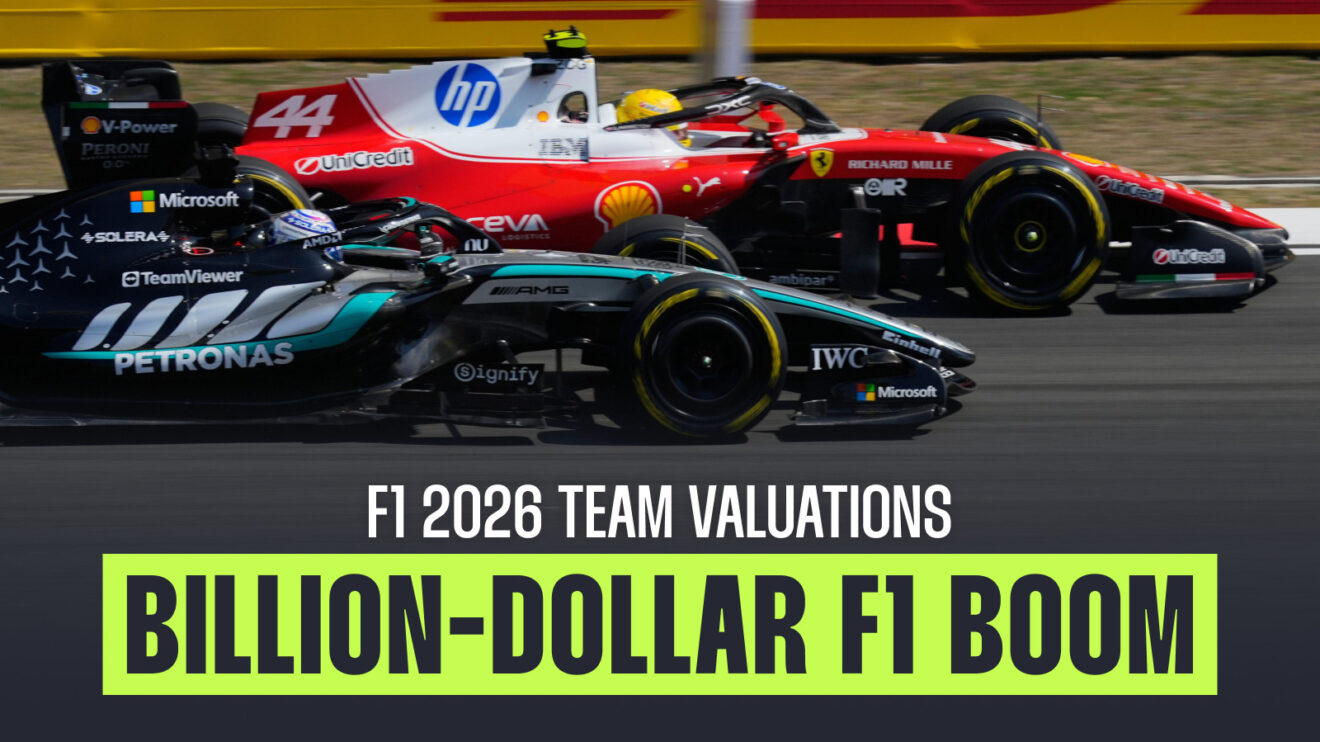
F1 team valuations continue to soar as they approach the $10bn mark.
The value of Formula 1 teams continues to rise as interest in the world championship remains at an all-time high.
The financial landscape has changed dramatically in recent years, with teams that once traded for a ceremonial dollar now worth billions.
Ferrari leads F1’s multibillion-dollar valuation surge
Want more PlanetF1.com coverage? Add us as a preferred source on Google for news you can trust.
Driving that rise is a combination of factors ranging from regulations to event promotion, broader economic growth, and the health of the sport itself.
Much of the sport’s success in recent years has been attributed to Drive to Survive, the Netflix series coinciding with a boom in popularity.
However, that is too simplistic an explanation.
The Netflix effect is welcome, but to an extent accidental; neither Formula One Management nor the teams could realistically have predicted such growth of the back of it.
Launching in 2019, it arrived at a time when conversations were well underway over what became the 2021 Concorde Agreement.
The Concorde Agreement links all the key players in the sport together, outlining the roles and responsibilities of each.
The 2021 Agreement was the first Liberty Media negotiated after acquiring the commercial rights from CVC in 2017.
Key within it was a dramatic equalisation and simplification of prize money payments to better support teams at the back end of the grid.
That immediately put more money in most teams’ pockets, and coincided with the introduction of a cost cap.
Those two elements combined to create a more stable financial landscape, affording teams a degree of certainty when it comes to both income and expenses, elements that had been lacking previously.
What has followed has been a relative explosion in values across the board, with some teams enjoying a ten-fold increase in their valuation.
Analysis of the sport suggests there is strong growth to come, with F1 under commercialised in key markets – especially the United States.
The Dallas Cowboys NFL team, for instance, has been valued by Forbes at $9 billion, almost $2 billion higher than what Ferrari is worth.
In Europe, the Real Madrid football club is on par with the Mercedes at $6.6 billion, with NBA teams valued similarly.
A key difference is that the NFL, NBA, and Primera League are all domestic competitions; while they might hold international appeal (especially the US-sports), their core audience is typically one major market.
By comparison, F1 has the potential to reach every market more naturally, a point that affords it the potential to have team values surge well beyond what is seen in the United States.
As the overall awareness and interest in F1 grows, so too does its commercial appeal globally. That in turn brings in new commercial partners, often at a higher tier given their broader outlook versus more domestic or regional sports.
It creates a positive cycle that drives value, helping the teams to soar towards previously unthinkable levels.
The net result is a growing F1 should now directly translate into financially healthy teams with values rising towards the $10 billion mark, based on PlanetF1.com’s own calculations and market estimations.
To reach these figures, several factors have been taken into account, including enterprise value calculations (as of the most recently available accounts), recent transactions, third-party reports, and estimates from multiple informed parties.
Ferrari | 2026: $7.1bn | 2020: $2bn
Arguably the most recognisable brand in world motorsport, it’s position in F1 is formally recognised by its peers with additional consideration in the Concorde Agreement prize money payments.
It has strong brand equity with Ferrari branching out from a luxury sportscar manufacturer into a lifestyle brand with merchandise and licensing activities boosting its financial performance and increasing its accessibility.
With estimated revenue streams of over $720 million, prize money that routinely surpasses $100 million, and sponsorship income thought to be around $300 million, it produces an operating profit of about $150 million.
Mercedes | 2026: $6.4bn | 2020: $1.8bn
The sale of a recent slice in one of the holding companies has helped firm a valuation of over $6 billion for the Mercedes F1 team.
The team is owned by a combination of Mercedes-Benz AG, Jim Ratcliffe (Ineos), and an investment group led by Toto Wolff, all of which own a third share.
The Mercedes F1 team is one of the most profitable sports teams on the planet with an operating income of around $227 million.
The Mercedes brand is a key element of the team’s value; the prestigious name is powerful when it comes to sponsorship. Coupled with a strong and successful F1 pedigree, and it leads to an enormous $6.4 billion valuation – a significant result for an organisation that was sold for a symbolic pound to Ross Brawn in 2009.
Not included in this valuation is Mercedes HPP, the power unit division, which is owned entirely by Mercedes-Benz AG.
McLaren | 2026: $5.2bn | 2020: $740m
From financial crisis to powerhouse, McLaren’s financial transformation over the past five years has been extraordinary.
Investment from MSP Capital injected much needed capital as the broader McLaren Group faced financial hurdles, giving the F1 operation the freedom it needed to continue developing to maintain its on-track performance during the pandemic.
Financial controls in F1 arrived at the perfect time for McLaren and coupled with the prize money payments, saw the team quickly reverse its fortunes.
That generated more than $700 million in revenue in 2024, the most recent annual accounts available, up from just shy of $580 million the year before. In 2024, it posted almost $73 million in net profit.
An important element of McLaren Racing is that the business doesn’t just encapsulate its F1 team, but also its IndyCar and other racing activities.
Red Bull Racing | 2026: $4.9bn | 2020: $1.2bn
In 2004, Red Bull acquired what was Jaguar Racing for just £1 and has since seen that investment grow into one of the largest teams in pit lane.
That growth is driven by on-track success that has seen it entitled to larger percentages of prize money, beyond what the cost cap is set at, driving strong annual revenues.
It has a diversified sponsorship roster with global names beyond its own brand, with the Oracle deal thought to be the largest single sponsorship contract in F1 history.
Now boasting Red Bull Powertrains developed power units, it’s important to note that Red Bull Racing’s $4.9 billion does not include that element of the business, despite common ownership and a hand-in-glove relationship.
Aston Martin | 2026: $3.3bn | 2020: $450m (Racing Point)
Significant investment has been made into the Silverstone operation over recent years to the point it is hardly recognisable from the team Eddie Jordan founded in 1991.
Its expansive factory is an asset, and it has agreed a commercial deal with the Aston Martin road car company to use its name in perpetuity. That’s an important step as it resolves some of the uncertainty surrounding its future given ongoing speculation Aston Martin Lagonda could be sold – it currently enjoys common ownership with the F1 organisation that carries its name.
It had 2024 revenues of around $370 million, placing it firmly within the mid-tier of F1 teams and highlighting the growth potential from the organisation, though it remained a loss-making entity in its most recently filed accounts.
Williams | 2026: $2.7bn | 2020: $180m
Dorilton Capital’s acquisition in Williams coincided with a steep upturn in the value of teams. But far from being a passive owner, it has injected hundreds of millions of pounds into the organisation.
That has shown itself on the balance sheet as a deficit, despite revenue having increased. It is part of a deliberate investment plan for the organisation as it looks to address years of under-investment.
For the moment, the goal is to return the team to a more consistently competitive position over its outfight financial performance. This process is helped by the team’s rising value outpacing its costs.
Alpine | 2026: $2.6bn | $500m (Renault)
Arguably the most undervalued team on the market, Alpine is owned by Renault Group and represents the manufacturer’s factory-backed F1 effort.
Its comparatively modest valuation reflects commercial under performance, largely owing to the struggles the organisation has faced on track.
There has been external investment in the operation though that has been passive rather than helped drive the operation forward, a point that looks set to force a change in ownership for the 24 percent currently held by Otro Capital.
Several bids are known to have been submitted, including one from Mercedes that values the operation at $2.1 billion. New York Mets owner Steve Cohen has also been linked with a bid, valuing the team at $2.6 billion, while ex-Red Bull Boss Christian Horner has also been linked with the Enstone-based operation.
Audi | 2026: $2.6bn | 2020: $300m (Sauber)
In a stronger position owing to Audi’s acquisition of the team, the organisation is now underpinned by the broader Volkswagen Group.
At its Hinwil base there has been significant investment in modernising and upgrading the facility, with the F1 team in many respects a means of brand positioning (together with technology transfer) for the road car operation.
Its value to the German company therefore extends beyond revenue or profit levels, with the underlying value of the organisation rising as a result of the wave carrying all teams forward over any specific investment of effort.
Racing Bulls | 2026: $2.4bn | $350m (AlphaTauri)
A strategic link with Red Bull Racing helps bolster Racing Bulls’ valuation, which would otherwise not justify a $2.4 billion figure on revenue alone.
The operation benefits from its integration with Red Bull, one of the sport’s most successful commercial operations, together with investment within the team itself in recent years.
It has strong branding courtesy of Visa and Cash App, again, benefitting from its relationship with its sister team.
Haas | 2026: $1.9bn | 2020: $280m
A somewhat unique business model and comparatively light footprint in comparisons to its rivals, Haas’ valuation owes much to the increase in the market.
It generates around $150 million in revenue through a mixture of sponsorship and prize money payments; enough to cover the cost cap element of the sport and produce an operating profit of $9 million (in 2024).
Gene Haas remains the sole owner of the squad despite a relationship with Toyota that some have suggested may deepen in time to the point it could become a financial partner – or more.
Cadillac | 2026: $1.6bn
The all-new organisation’s valuation is a reflection on what a place on the F1 grid is worth – and goes some way to explain why there is much interest in getting involved.
There has been significant outlay by TWG to get the organisation to this point, including one-off costs of some $500 million in anti-dilution payments purely for the privilege of joining the group.
With an instant entitlement to prize money, the valuation of the organisation is likely to rise sharply as revenue increases following its inaugural season of racing.
Want to be the first to know exclusive information from the F1 paddock? Join our broadcast channel on WhatsApp to get the scoop on the latest developments from our team of accredited journalists.
You can also subscribe to the PlanetF1 YouTube channel for exclusive features, hear from our paddock journalists with stories from the heart of Formula 1 and much more!
Read Next: Williams under pressure as Hill warns of ‘tough road ahead’ in F1 2026