

Uncovered: How teams are exploiting the flexi-wing gap effect


The flexibility of components in F1, especially elements on the front and rear wing, has been a battleground for decades, with the battle lines between the teams and governing body constantly being redrawn in order to redress the balance.
The latest controversy, regarding rear wing deflection, has seen the FIA issue a new Technical Directive that will be enforced from the Chinese Grand Prix onwards.
F1 flexi-wings: Not quite a tale as old as time
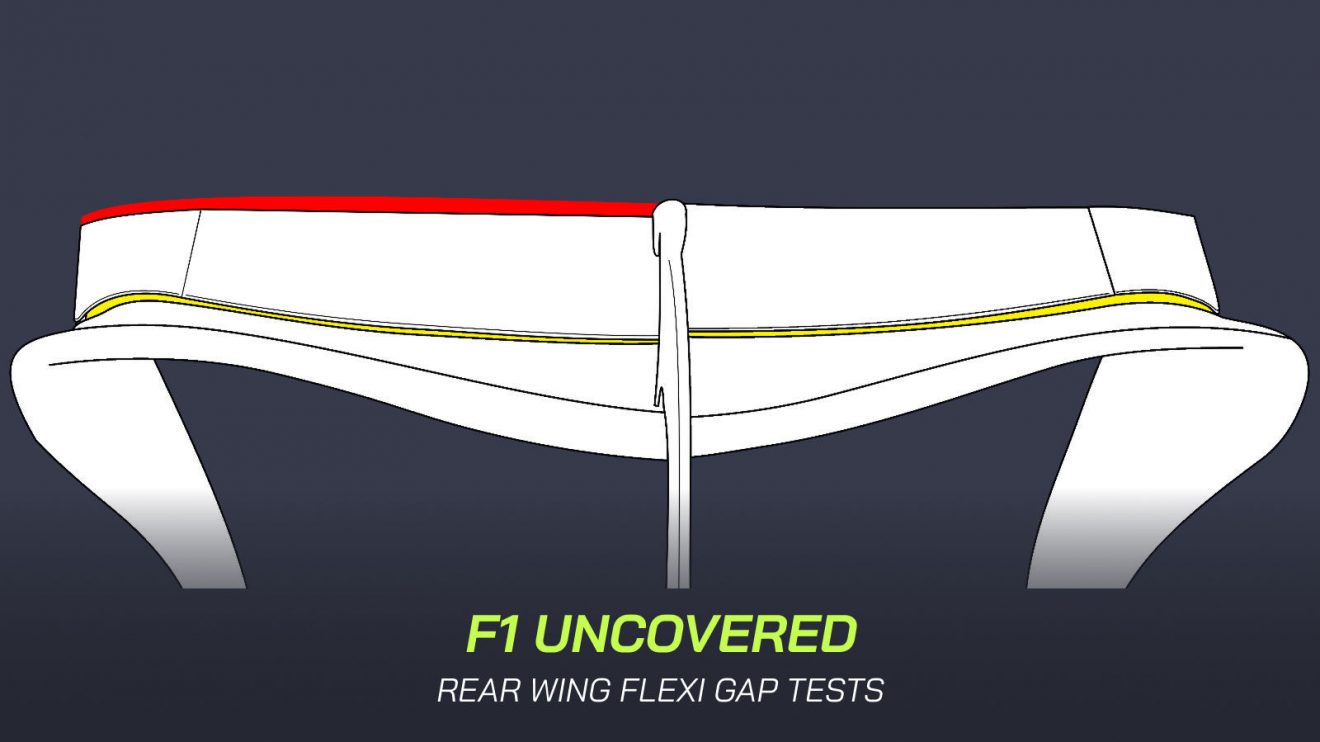
Whereas the governing body has previously pursued the overall deformation of the assembly, they have shifted their attention to the slot gap on this occasion. For those unfamiliar with the term, this is the gap between the mainplane and upper flap and tip section (yellow highlight).
This is not to be confused with the DRS slot gap, which is also referred to on occasion and explains the gap between those two elements when DRS is active.
It’s believed that teams have been manipulating the size of this gap in order to gain a straight line speed advantage, with downforce and drag being reduced at a point when the loads being imparted should see them rising.
This follows in the wake of the furore over McLaren’s ‘mini-DRS’ solution that was outlawed shortly after the Azerbaijan Grand Prix last season.
In that instance the upper flap was clearly lifted out of its usual bed in order to increase the size of the slot gap around it and provide a performance boost.
An agreement was struck between McLaren and the FIA over the discontinuity of that wing for the remainder of the season, whilst the regulations have been redrafted for this season in a bid to prevent any recurrence.
However, even with a limited amount of rear-facing footage being available during pre-season testing, suspicions had grown over a new version of this trick being employed, to which the FIA reacted and requested, by Technical Directive, that teams be prepared to have a hi-res camera fitted to their car at the Australian Grand Prix.
Similar to how the FIA conducted tests on the front wing between the Belgian and Singapore Grand Prix in 2024, target dots placed in specific areas on the wing flaps are used as a reference in the footage to see how much deflection is occurring.

The camera, a Mobius Maxi, is 4k @30FPS rather than the 720p unit usually installed on the car, which is then upscaled to 1080p for the broadcast. This obviously affords the governing body more clarity on the wing’s behavior when the car is in motion, whilst removing some of the artefacts that might be present in the regular footage too.
Furthermore, the footage remains on an SD card, that’s carefully managed by the FIA, rather than being held on the internal recording device, which captures footage from all the cameras around the car and is offloaded after a session, as only one camera can send footage wirelessly from the car at a time.
F1 flexi-wings: The FIA are clamping down
Following analysis of the footage captured during Free Practice at the Australian Grand Prix, the FIA have reacted with immediate effect, issuing a Technical Directive (TD055A), that alters the distance that’s permitted between the mainplane, upper flap and tip section when a 750N load is applied to the forward most section of the wing profile inboard of 525mm from the centreline.
At the Australian Grand Prix, the first time this test had been conducted, as Article 3.5.17 was inserted into the Technical Regulations for 2025, there was a 2mm allowance. However, given their findings, the FIA have decided that there will be an allowance of 0.75mm at the Chinese Grand Prix, reducing to 0.5mm from the Japanese Grand Prix onwards.
This is set to be enshrined within the Technical Regulations once approved by the WMSC on 24.03.25, making the Technical Directive obsolete thereafter.
F1 flexi-wings: Not a one-dimensional problem

One of the problems with trying to prevent teams from exploiting this flexi-gap effect is that it’s not just this behaviour that’s in play either, with the teams also pushing the limits of how the rear wing assembly deforms in general.
Of course, the governing body have made extensive efforts down the years to limit how much flexion the teams have at their disposal, with the rearward rotation of the entire assembly at the top of that list in recent times, given it too can help to reduce downforce and drag.
It’s clear from the rear-facing footage that this is still an avenue that’s being pursued, with a considerable compression of the assembly noticeable (red highlight indicates how much lower one team’s rear wing’s trailing edge is when loaded versus static).
Interestingly, this alters the position of the slot gap relative to the camera and of course, the airflow (yellow highlight). This will, in-turn, present the airflow to the trailing edge of the mainplane and leading edge of the upper flap and tip section differently to how it might ordinarily be received.
Knowing this and designing the surfaces with this in mind, might be why there’s question marks over the non-linear deformation of the slot gap in order to take full advantage of the behaviour.
F1 flexi-wings: Will the new TD change anything?
Clearly there’s an expectation, both in and outside the sport, that one team in particular will take a swan dive in performance following the announcement, but that’s rarely been the case in the past when Technical Directives have been used to intervene in these sorts of matters.
In some instances we’ve seen a performance drop-off across the entire grid, as everyone adjusts to meet the new requirements, whereas on other occasions it hasn’t really altered anything and teams have continued to enjoy the fruits of their labour.
Furthermore, even though the FIA have added an additional test this season and already modified its parameters, there’s nothing to say that it will prevent the teams from continuing to take advantage of the effect that they’re looking to regulate.
Regardless of the incoming changes, the governing body will likely still capture footage during Free Practice going forward and monitor any deformation that’s occurring, with an eye on adding or modifying the load/deflection/slot gap tests to help curtail this practice during the season, should it still be occurring.
Read next: The Williams and Sauber technical solutions that could catch rival eyes