

Disqualified George Russell joins very exclusive club after deleted Belgian GP win


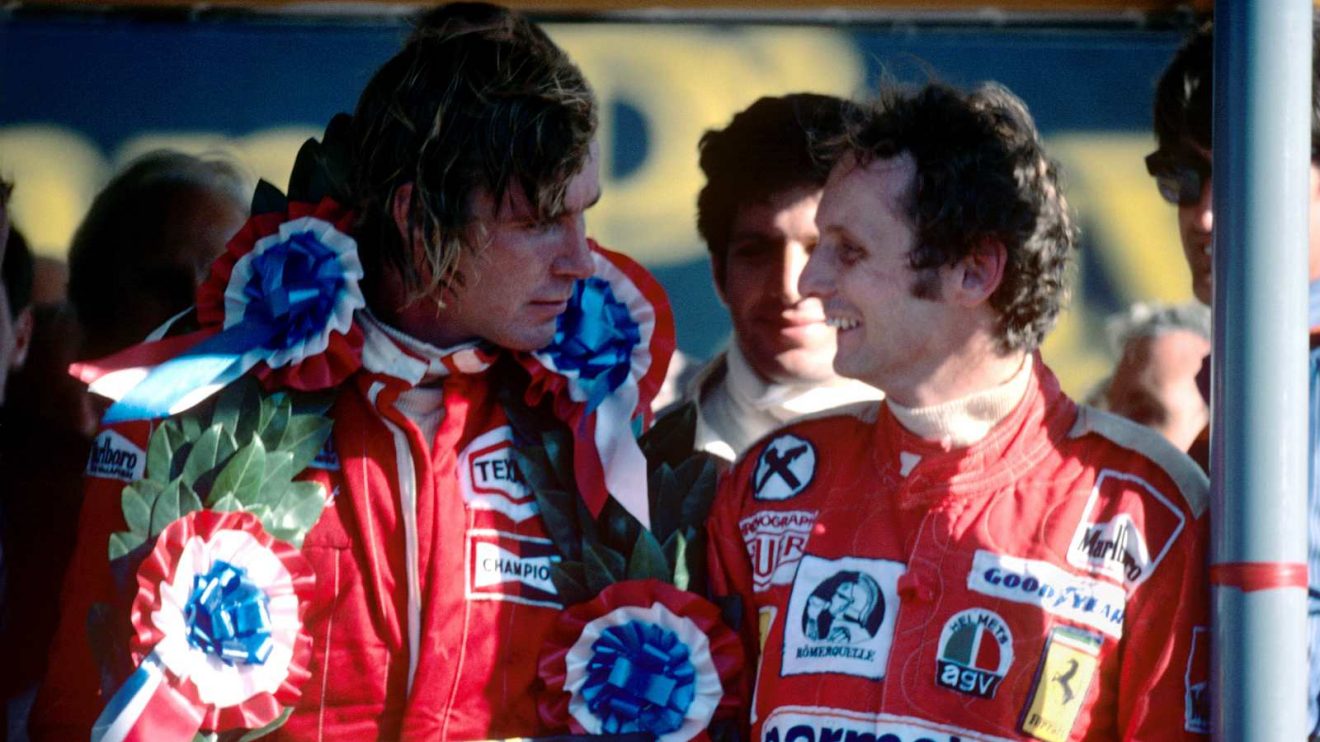
James Hunt was disqualified from the 1976 British Grand Prix.
George Russell has made headlines after his victory at the 2024 Belgian Grand Prix was stripped from him due to a disqualification — but he’s in good company.
Only a handful of Formula 1 drivers have ever been disqualified from a race after winning it. And the lucky omen is every single one of those drivers had either already won a World Championship or would go on to do so in a later year.
James Hunt: 1976 British Grand Prix
Reason for DSQ: Failed to complete a full lap after the race was red-flagged
The story of the 1976 British Grand Prix is a wild one. A massive first-corner crash involving James Hunt brought out the red flag. Hunt took a shortcut back to the pits and, in effect, failed to complete a full lap. Because he hadn’t been on the track at the time the race was red flagged, officials initially determined that he wouldn’t be allowed to take the restart — but an incensed British crowd effectively forced the stewards into letting him start again.
So, Hunt restarted the race, then went on to win it — but three teams (Ferrari, Tyrrell, and Fittipaldi) issued an instant protest against the team. After two months of deliberations, Hunt was disqualified, and his win was handed to title rival Niki Lauda.
(Interestingly, that wasn’t the only race of the season Hunt won and was disqualified from. At the Spanish Grand Prix, Hunt took a win but was almost immediately disqualified because his McLaren was deemed too wide. McLaren were able to successfully argue that the extra width was the result of the hot tires expanding, and the DSQ was overturned; Hunt’s win was reinstated.)
Nelson Piquet: 1982 Brazilian Grand Prix
Reason for DSQ: Car under minimum weight limit
The chaotic 1982 Brazilian Grand Prix at Jacarepaguá is remembered for two things: Its searing heat, and hometown hero Nelson Piquet’s disqualification.
While Piquet’s Brabham teammate Riccardo Patrese had to retire from the race due to heat exhaustion, Piquet managed to muscle his car across the line in first position. He passed out on the podium celebrating his win — and then he was disqualified.
See, both Piquet and Keke Rosberg were found to be underweight due to a “ballast water tank.” That tank’s alleged purpose was to cool the brakes, but teams often refilled the empty tank after the race to meet minimum weight and therefore pass post-race scrutineering.
Piquet and Rosberg were both caught, resulting in their first and second-place finishes being stripped. The FIA Appeals Tribunal upheld the disqualification, and the tanks were ultimately banned — but not before Formula One Constructors Association teams like Piquet’s Brabham and Rosberg’s Williams boycotted the San Marino Grand Prix as part of the ongoing FISA-FOCA war.
Alain Prost: 1985 San Marino Grand Prix
Reason for DSQ: Car under minimum weight limit
The 1985 San Marino Grand Prix at Imola saw three different leaders in the final five laps — but none of those drivers actually won the race!
See, Alain Prost crossed the line in first place, but when the car was weighed after the event, it came in 2kg underweight. Prost’s engineer Tim Wright later told Autosport that the McLaren team had designed the car to be as light as humanly possible — but they hadn’t accounted for any additional tire wear or fluid usage. Wright called it a simple miscalculation.
So, Prost was disqualified, and the win was granted to Elio de Angelis.
More strange stats from F1 history
? Seven current F1 drivers to be disqualified from an F1 race
? Three incredibly rare F1 wins that will shock modern-day fans
Ayrton Senna: 1989 Japanese Grand Prix
Reason for DSQ: Rejoining the track illegally via push start from marshals
The 1989 Japanese Grand Prix is perhaps the most controversial race in F1’s seven-decade history. On lap 47, McLaren teammates Ayrton Senna and Alain Prost made contact at the final chicane of the track. Both cars were left stalled. Prost abandoned his McLaren — but Senna wasn’t quite so ready to throw in the towel.
Instead, he gestured to a group of marshals to push him down an escape road, which allowed Senna to restart his engine. He cleared the escape road and headed back to the pits, where he received a new nose cone. Back on track, he passed race leader Alessandro Nannini to finish with a victory.
Senna’s disqualification came immediately, first for missing the chicane after his collision with Prost, and then because Senna had received outside help to restart his car. McLaren tried and failed to overturn the disqualification; in the process, the team was fined an additional $100,000, and Senna was given a suspended six-month ban.
Debate has raged ever since about whether it was Prost or Senna at fault for the contact — but the whole debacle did put Senna out of contention for the 1989 World Championship.
Michael Schumacher: 1994 Belgian Grand Prix
Reason for DSQ: Illegal skid block wear
Our final race winner to be disqualified after taking victory is Michael Schumacher. The German ace ran an exceptional Grand Prix, coming across the finish line 13 seconds ahead of the nearest competition.
After the race, though, Schumacher was disqualified.
Under every car at the time was a wooden skid block, which was implemented to increase ride height and reduce the impact of ground effect. Those blocks could only take 1mm of wear; anything greater, and the car in question would have been deemed to have had an illegal advantage.
And so, just like that, Schumacher was disqualified — though he would still go on to take his first World Championship that season with the Benetton team.
Read next:George Russell DISQUALIFIED as Belgium GP win erased