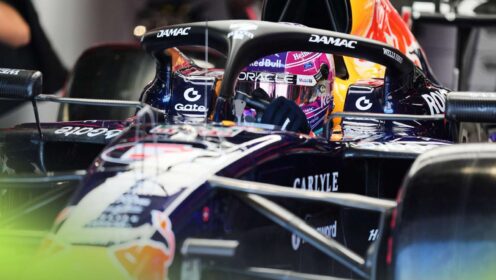
Ferrari added a winglet to the forward support spar on the halo in China, which they used during the Sprint but removed thereafter, following discussions with the FIA.
The leading edge of the floor and the fences on the Audi R26, the latter of which are dog-legged in shape to distribute the pressure in a specific way.
The internal bib arrangement on the Audi R26, along with the sprung mechanism at the front of the assembly
The internal bib arrangement on the Cadillac MAC-26 is much narrower than many of the other teams use, whilst the sprung mechanism at the front of the assembly employs a stack of bellville springs.
A close up of the internal brake fairings used by McLaren to supply cool air to the brake discs and calipers and keep them firewalled from each other.
A seemingly innocuous look at the underside of the bib extensions on the Audi R26 reveals the outlets created by the top surface geometry we saw earlier in the season (inset).
A look at the floating saddle-style arrangement for the coolers above the Red Bull power unit
A look at the Mercedes W17’s packaging, including the layout of their power unit and inboard rear suspension arrangement.
A top down overview of the Ferrari SF-26’s front wing and nose shows how large the mainplane is in context of the two upper flaps, whilst this view also provides more of a sense of how splayed the wing pillars are and how twisted the endplates are too.
The Haas front wing and nose solution, by comparison, has a very different nose and wing pillar arrangement. They’ve also bucked the trend with their footplate and have a squared-off profile for the looped outer section that creates a defined ridge line.
The Mercedes W17’s nose and front wing arrangement from above, showing the mainplane and flap distribution is very different, with a shorter chord mainplane and larger upper flaps, whilst the wing is hung from the second element, rather than the mainplane.
Peering into the rear cooling outlet on the Williams FW48 reveals some of the inboard suspension detailing, whilst the bridge on top of the crash structure used to mount the upper wishbone is also visible.
The Aston Martin AMR26 front wing with flo-viz daubed all over the left-hand side, as the team look for visual confirmation it’s performing as anticipated, with the specification in use introduced at the Australian Grand Prix.
Audi with flo-viz painted on the front wing and nose, as the team had introduced a new specification for both in China.
The rear brake fairing arrangement beneath the outer drum casing on the Aston Martin AMR26
Peering inside the McLaren garage as the MCL40 is being built we get a look at the floor fence design, which has notches carved out of their lower front corner.
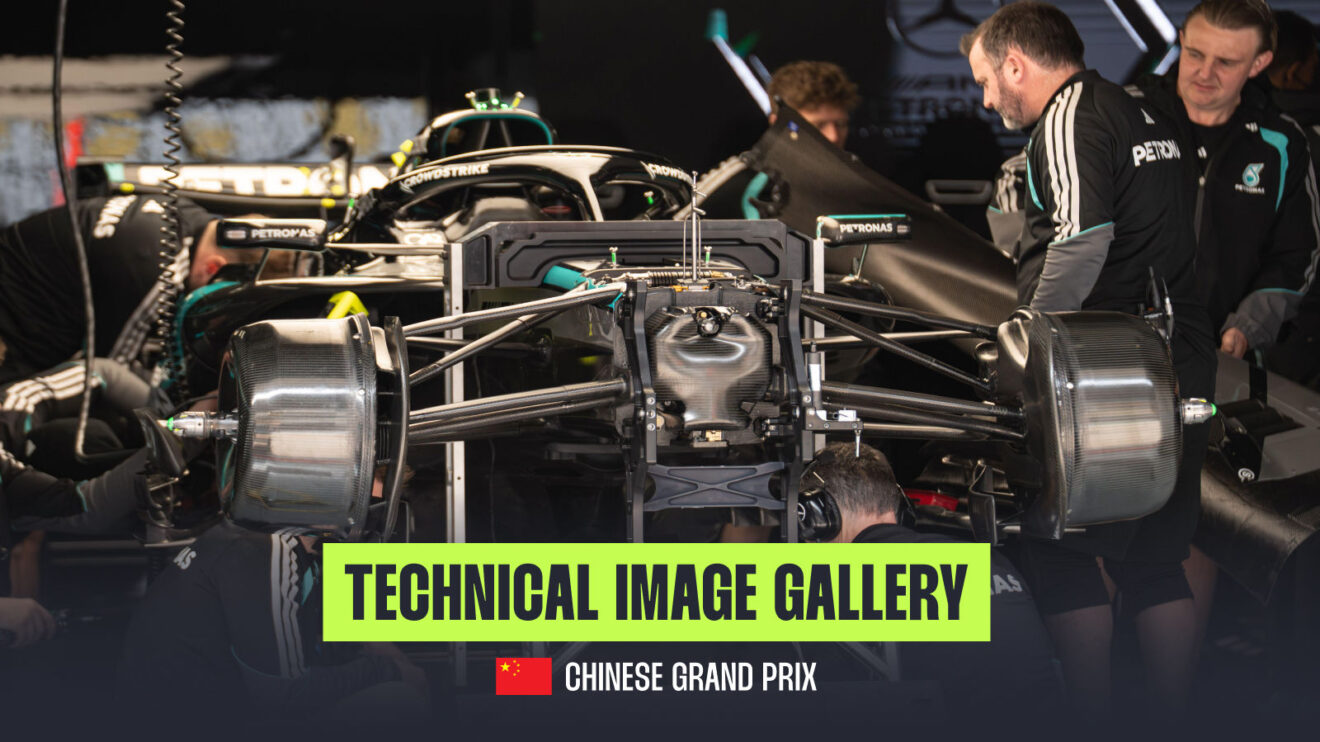
An overview of the Audi R26’s chassis, front suspension and front brake details as it’s worked on in the garage.
The rear brake assembly on the McLaren MCL40 from behind, with the cooling pins on the outer surface of the caliper visible, whilst the permeable material in the windows of the disc fairing is also to be noted. The topographic design of the upright is also visible alongside the fairing.
A close up of the inboard rear suspension on the Cadillac MAC-26, as a mechanic makes some adjustments.
The second drum in the nested arrangement employed by Aston Martin has a window to allow heat and airflow passage to the void that exists between the two.
Want to be the first to know exclusive information from the F1 paddock? Join our broadcast channel on WhatsApp to get the scoop on the latest developments from our team of accredited journalists.
You can also subscribe to the PlanetF1 YouTube channel for exclusive features, hear from our paddock journalists with stories from the heart of Formula 1 and much more!