

F1 2026 deflector array designs reveal major team differences under new rules


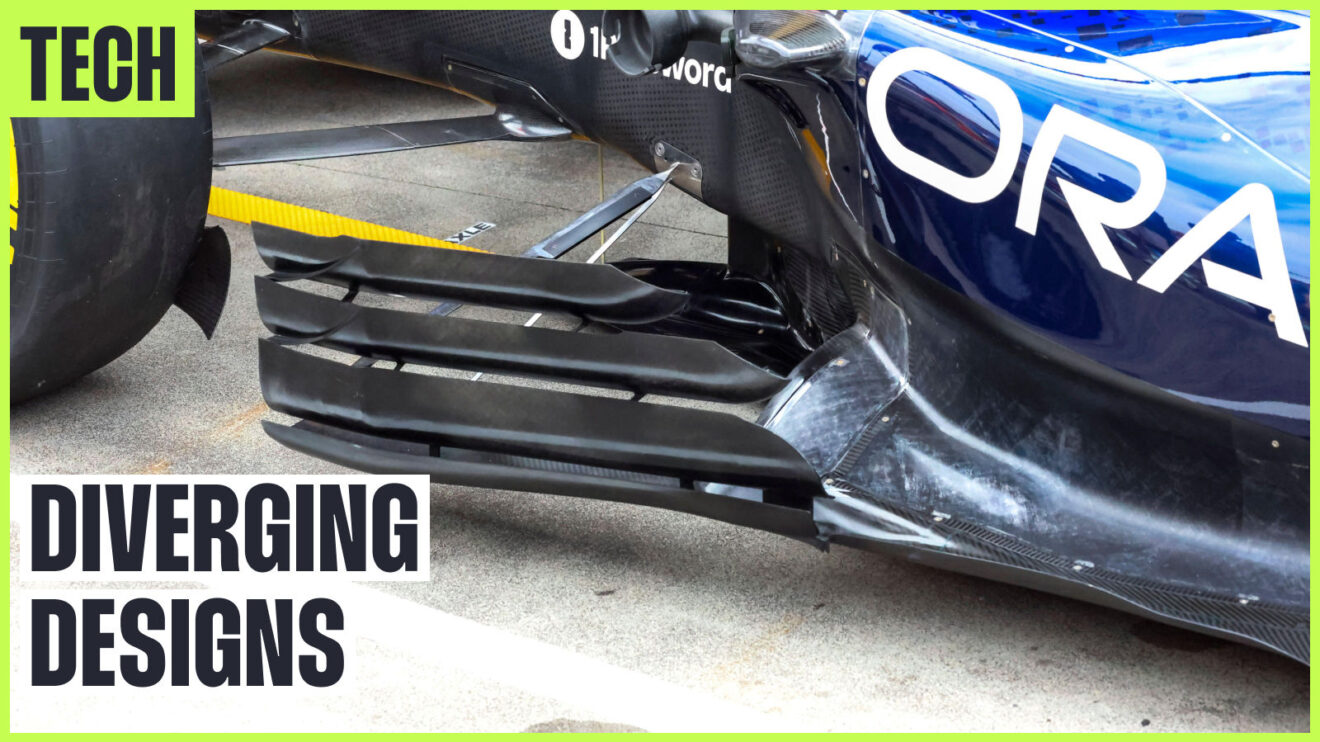
Formula 1’s new regulations have seen teams take distinctly different approaches to the design of certain elements.
The incoming ‘floor board’ or deflector array as I’ve decided to coin it, is one such element that’s resulted in diverging development.
F1 2026 deflection tatics
Want more PlanetF1.com coverage? Add us as a preferred source on Google to your favourites list for news you can trust.
The deflector array, which might appear similar to the bargeboards that Formula 1 has used in the past, are one of the elements introduced by the FIA to help reduce the dependency that the teams have on generating outwash.
One of the main things to consider when evaluating the design of this region is that the forward section of the elements (forward of XF=825) can have some degree of outwash to them, as they’re not bound by the same constraints as the rear section.
Meanwhile, they’re allowed to have up to three sections in any X, Y or Z plane.

Alpine’s three element arrangement has three horizontal elements, with a taller section that protrudes out of the top of the forward section of the uppermost element.
This taller section is angled to induce some outwash, much like the forward section of the two elements below.
There’s also two vertical slits in the upper element to help distribute the pressure across each side of the element.

Aston Martin has already made changes to their arrangement, switching to more of a sail-like arrangement.
This has resulted in a much larger triangular-shaped element in the rear section, whilst a shorter element has been added and offset in the forward section.

Audi has a much less complex solution on the R26, albeit with a few nice features thrown in for good measure.
It has opted for three horizontal elements, stacked one on top of the other, pitched to create some upwash, whilst the forward section is angled to invoke the available outwash.
The upper two elements have a diagonally tapered trailing edge, whilst the lowermost element has been slotted at the rear to create a fourth element.
Audi has also incorporated a winglet-shaped support bracket in the lower front corner of that lower element.

Cadillac’s solution perhaps looks the most rudimentary as it has such a large upper element which lacks any geometrical intricacy.
However, the lower two elements are twisted heavily in the rear section, having been inversely pitched at the front.

Ferrari’s deflector array consists of a tall, skyscraper-style element at the front of the assembly, which is twisted to present a different profile to the airflow and turbulence being received.
This speaks volumes of how the turbulence being generated by the front wheel assembly is altered across its height.
The team has also added six mini-vortex generators on the leading edge of the upper section of the element in order to propagate a row of vortices.
Three horizontal elements reach out from the surface thereafter and are pitched to create upwash.
The shape of the floor foot, below, also marries up with this geometry, to further assist in their endeavours.

Generally, the solution used on the Haas VF-26 fits in the same family as the ones seen on the Ferrari.
However, there’s simply not as much geometrical detail employed here as there is on the SF-26.

McLaren falls firmly in the sail-like design category with its effort, choosing to have a foresail, broken up from the mainsail by a slot that runs almost the entire height of the two segments.
Interestingly, the foresail section doesn’t have a uniform leading edge geometry, with a kick in the lower section to disarm the airflow in a slightly different way.
The angle of the foresail differs from the mainsail too, in order to take advantage of the allowance in that box region to invoke some outwash.
The lower two elements also have a different configuration in the forward box section, as they’re almost laid flat, before curving to create a scroll-like surface that mimics the floor foot to create upwash.

Mercedes is also in the three horizontal element group, with an arrangement that has taller chord elements the higher you go up the stack.
They also employ a twisted front section to take advantage of the angle that’s allowed within that box region.
Each of the elements are also less steeply pitched, with the lowermost aligned keenly with the geometry of the floor foot.
The bracket system used by Mercedes towards the rear of the assembly not only acts as a flow divider, it also allows the team to break up the elements and alter their pitch.
More F1 2026 tech insight from PlanetF1.com
Aston Martin continue AMR26 upgrade plan despite F1 2026 struggles
F1 2026 uncovered: Inside the RB22, SF-26, and W17 technical updates

Racing Bulls has already made changes to its deflector array this season, but we’ll concentrate on the current iteration.
This features more design elements than many of its rivals, with a semi-detached panel in the forward-most section that’s anchored to the main skyscraper element.
This panel and skyscraper element sit in the box region with more freedom and are angled outward, which is more noticeable when using the three horizontal elements thereafter as a reference.
The skyscraper element also has two floor foot mirroring vanes protruding out from it, which sit beneath the panel too.
Meanwhile, the horizontal elements are angled in order to invoke some upwash.

Red Bull has the more simplistic three element deflector array on the face of it.
However, there are some interesting and novel solutions being employed to leverage more performance.
As you’d expect, the front section of each element is angled to create some outwash but they’ve also included two metal stays between the upper two elements that act as winglets.
The rear curvature of the elements also create a more acute tip section than would otherwise be viable.

Williams also falls into the sail-like category with its deflector array as the rearmost section of the upper element features a design akin to that shape.
Nonetheless, its has made an interesting design decision with the trailing edge, with a half moon-shaped cutout in the lower corner.
The first element, which is angled differently to the remainder of the array, is L-shaped, with a skyscraper-like element at the fore, which merges with the horizontal tail section.
Another horizontal element sits between the aforementioned and is pitched to create some upwash, inline with the lower element and floor foot.
Want to be the first to know exclusive information from the F1 paddock? Join our broadcast channel on WhatsApp to get the scoop on the latest developments from our team of accredited journalists.
You can also subscribe to the PlanetF1 YouTube channel for exclusive features, hear from our paddock journalists with stories from the heart of Formula 1 and much more!
Read next – F1 facts that sound fake: Schumacher gives Ferrari a fright, record McLaren grid penalty