

Mercedes tackling persistent problem with new W16 floor duct?


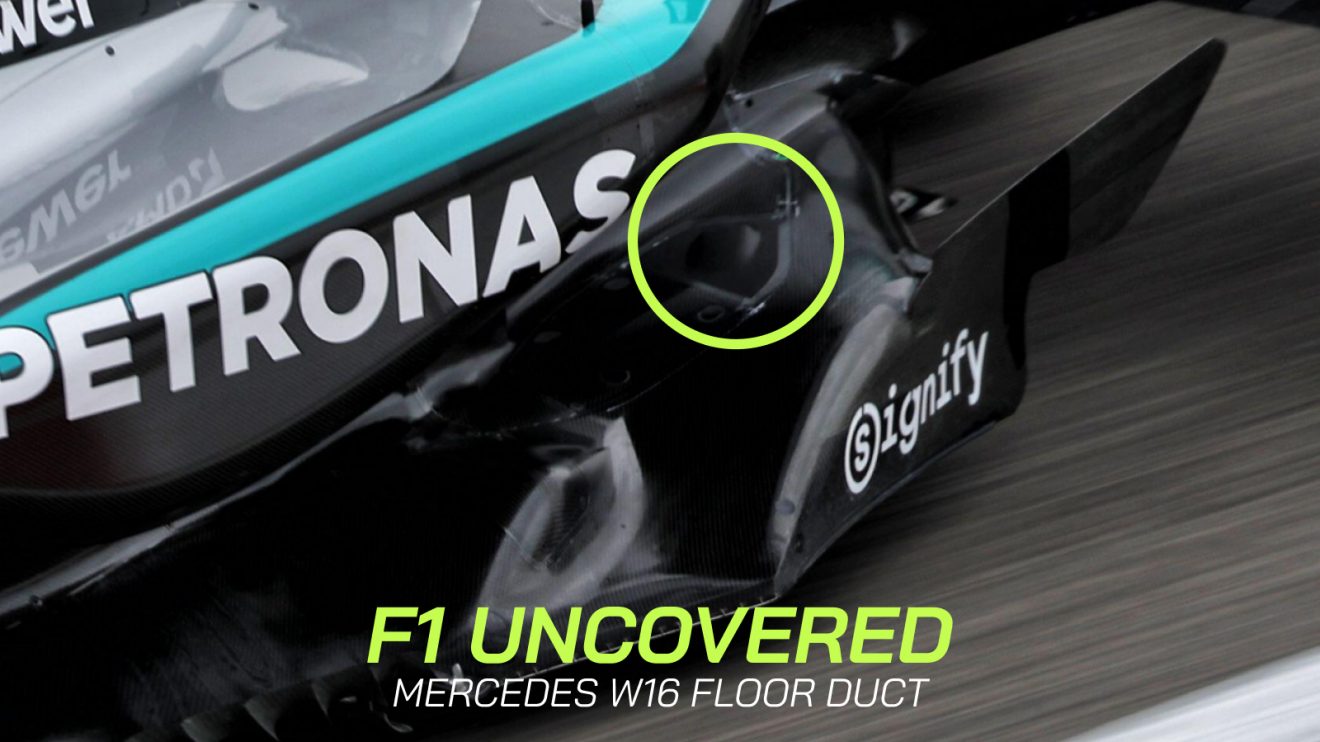
Another small but interesting technical detail that’s been discovered in F1 2025 testing, this time on the Mercedes W16, is a duct that’s embedded in the floor.
Given its location there’s some intrigue as to what the purpose of this duct could be, albeit it’s likely providing some additional cooling support.
Mercedes W16 floor duct catches the eye in F1 2025 testing
In all likelihood the reason for the introduction of this small duct is to help manage a recurring issue for Mercedes that came to something of a head for the team at Monza last season.
On that occasion both drivers were struggling with the heat around their seat, with Lewis Hamilton describing it as “like sitting in the sauna with no shorts on.”
It’s an issue that the team have attempted to tackle in the past too, but any cooling ducts added to the car are always going to be a compromise in terms of aerodynamic performance.
More tech analysis from F1 testing 2025 in Bahrain
? F1 uncovered: Previously unseen detail of Aston Martin AMR25 exposed
? Mercedes experiment with different nose tip solutions on striking W16
The issue is something that Mercedes are constantly looking at too, as described by Andrew Shovlin
“The seat and the car is always running pretty hot and there’s a lot of heat generated by the power unit that you’re trying to dissipate.
“You’ve also got a lot of electronic boxes and those are working quite hard, and they generate their own temperature, so you’re trying to lose that out of the cockpit.
“We are looking at ways that we can improve the situation for our drivers, within the sport as well, looking at means that we can apply additional equipment to the car at these exceptional races that will keep the drivers a bit cooler.”

The placement of the duct suggests that it’s in a section of the floor that can be removed easily, without having to take off the entire floor, as there’s multiple removal panels in that location.
This means the team can react to the drivers comfort level, albeit with it coming at the expense of the marginal losses that might be associated with having an additional duct on the car.
It’s also unclear at this stage whether the duct can be found on both sides of the car, with it a reasonable assumption that they could add the duct on both sides if they need more cooling and run the duct on one side, or the other, in certain temperatures.
After all, the W16 has been seen running on track with and without the duct in place during the course of the first two days of pre-season testing.
Read next: F1 testing 2025 gallery: All the latest technical details on display in Bahrain – Day 2


