

F1 2025 predictions: Have your say on this season’s title winners


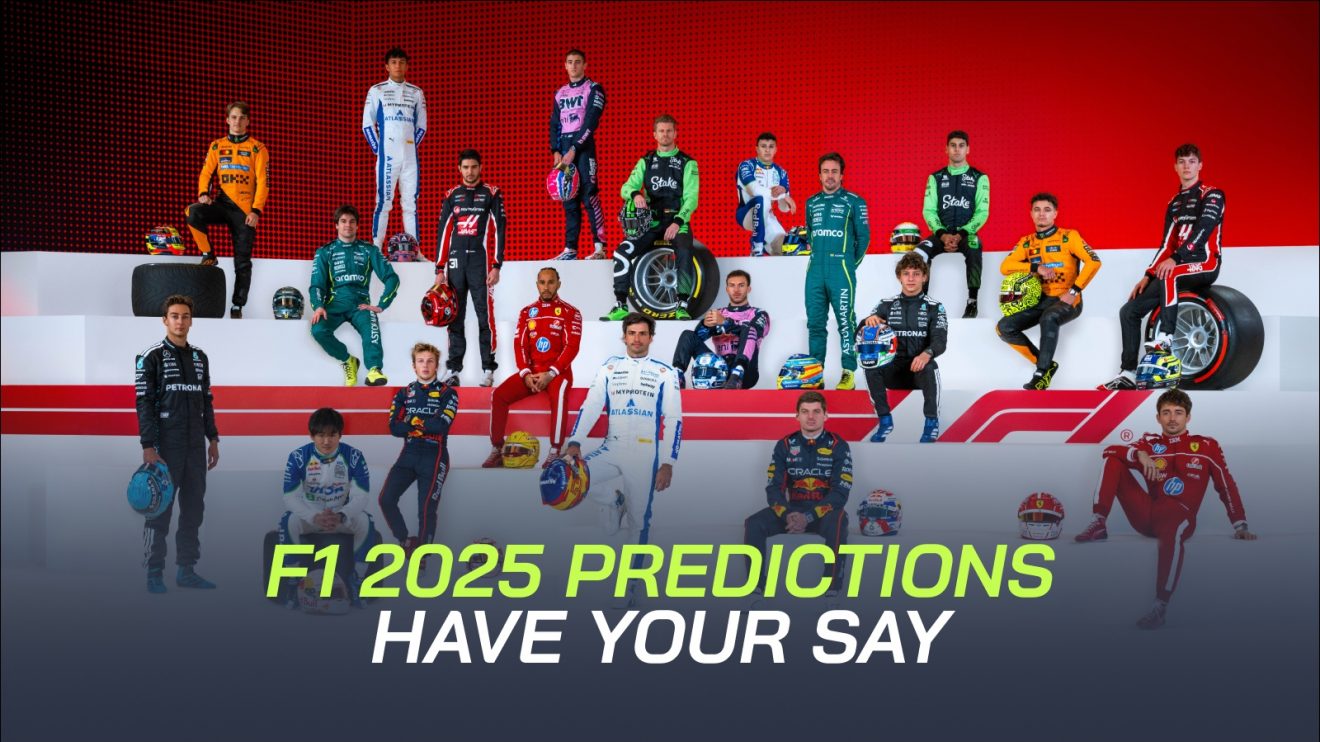
It's your turn to predict the 2025 season.
You’ve seen our predictions, now it’s time to hear what you think will happen in the F1 2025 season.
With our predictions released earlier, we are passing the mic to you and asking what you think will take place in the next year of Formula 1 racing.
F1 2025 predictions: Your chance to tell us how the season will go
The 2025 season looks to be one of the most exciting yet but also one of the most unpredictable with new drivers, an unclear pecking order and plenty of potential for surprises.
With that in mind, we are giving you the task of telling us just how the season will go. To take part, simply fill out the form below and we will collect the responses for an article later this week. Good luck!
How are the top teams shaping up?
To help you with your predictions, our resident tech expert Matthew Somerfield gave his verdict on the for frontrunners and what the teams have changed over the winter. Here’s what he had to say:
McLaren have continued to push the boundaries of their front suspension arrangement in 2025, with an already novel approach altered once more.
The team have moved the steering arm’s inboard pickup point from behind the rear leg of the lower wishbone, where it was positioned in 2024 (highlighted in yellow) and installed it ahead of that leg instead.
This also means that it’s no longer mounted in parallel with the rear leg too, with the steering arm crossing beneath the front leg and attaching to the upright on the front corner.
Furthermore, this reorganisation has also resulted in the team being able to lower the rear leg of the upper wishbone (arrow) and reap the all-round aerodynamic benefits that come with the reshuffle.
Ferrari have also made changes to their front suspension layout for 2025, moving to the pull-rod layout that their rivals first adopted at the beginning of this regulatory phase. However, it’s the team’s decision to fully optimise their sidepod layout that could pay the most dividends.
The Scuderia made the switch to an overbite layout last season but given the constraints imposed by the positioning of the internal components, which had been arranged to suit the underbite they started the season with, they couldn’t take full advantage of the switch.
In optimising the layout of the powerunits ancillaries the designers have been able to fully commit to a total overhaul of the external bodywork too, with a mid-wing now forming the overbite, whilst the a P-shaped inlet is pushed further rearward, allowing for the undercut and waistline of the sidepod’s bodywork to be re-imagined too.
Red Bull waited until the final day of pre-season testing to unveil a new nose and front wing solution for the RB21, with the team circling back to a solution that served them well on the RB19, as the new nose sits further back on the leading edge of the second element, rather than the mainplane.
Meanwhile, the nose has a more bulbous shape at the front, which tapers back towards the chassis, resulting in the adjoining static flap sections having to be narrowed in order to maintain the width of the two moveable flaps, which have also been reprofiled to accommodate their new surroundings.
The outboard portion of the wing has also been redesigned, with a vertical fin formed from the third flap tip’s connection to the endplate.
Given that teams had already begun work on creating more flexible front wing assemblies for 2025, before the FIA’s announcement that the load and deflection tests will be more stringent from the Spanish Grand Prix onwards, it’s probably safe to assume that this new design will be closer to the limits imposed for the first eight races of the season.
More analysis ahead of the F1 2025 season
Adrian Newey’s to-do list: The five most important Aston Martin tasks
F1 testing data discovery indicates true Red Bull pace compared to Ferrari, McLaren, Mercedes
Mercedes don’t seem fully convinced that their new nose design is the way to go, as the team have switched between their new and old solutions throughout the course of the test.
The new design, which features a longer nose tip, that finishes out ahead of the second element and closes off the gap between the two elements (left), made way for the older configuration (right, arrowed) on all three days of the test.
Regardless of the nose that will be fitted to the W16 come Melbourne, it’s clear that Mercedes have made progress, with the team completing the most mileage of any, as they looked to complete as much of their programme as was possible.
On the topic of interruptions, this test went by almost flawlessly for the teams, albeit there were a few niggles whereby teams had to retreat to the garage and fix their car behind screens.
But, in what must be a first for pre-season testing, there were no red flags called for failures on track, instead these were reserved for a circuit-wide power failure on day one, a piece of broken glass falling onto the pit straight and for an unauthorised vehicle being present on the track on day three.
It was a productive three days all-in-all then, with some teams completing the equivalent of eight Grand Prix distances around the Bahrain International Circuit, whilst the worst off still completed over five race distances, which will provide a huge amount of data for the teams to pour over between now and the first race of the season.
Read next: Lewis Hamilton makes firm F1 retirement claim after Ferrari move