
Hugenholtz: Why this strange Dutch GP corner claims so many victims


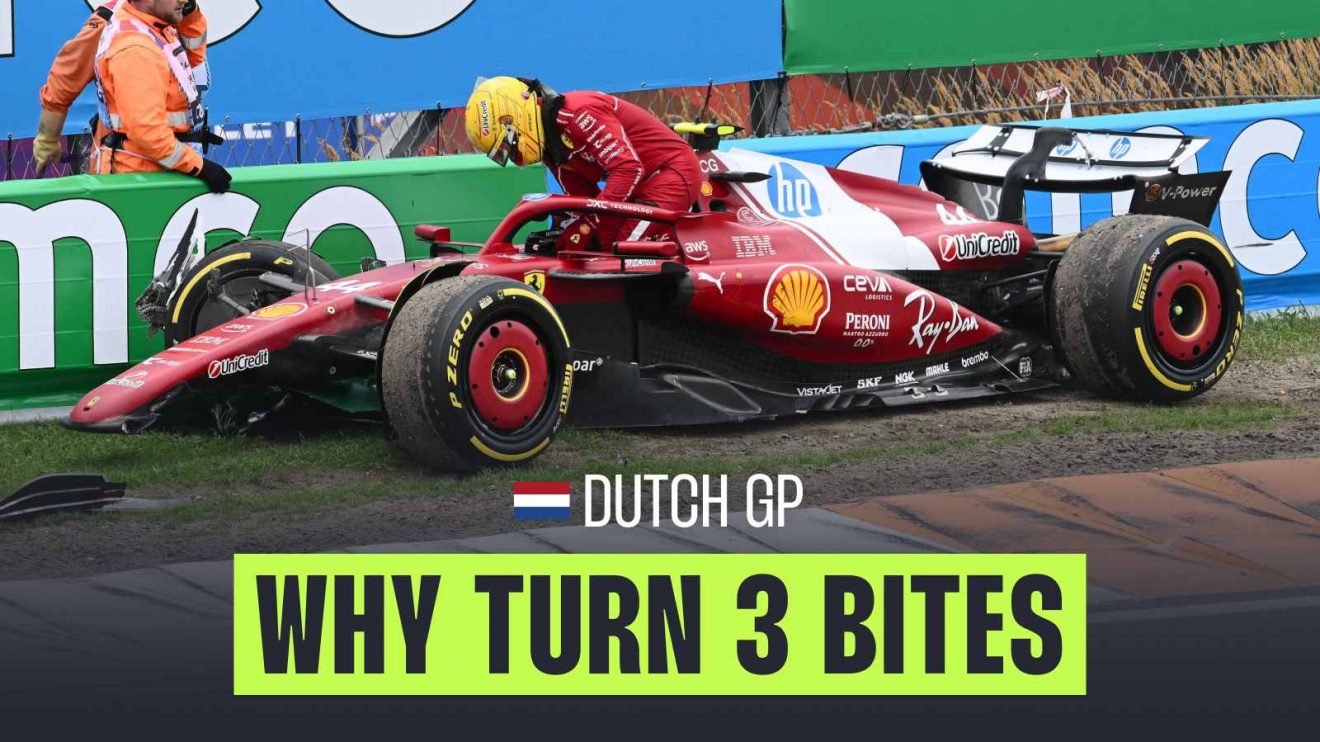
Turn 3 caught out Lance Stroll, Lewis Hamilton, and Charles Leclerc during the 2025 Dutch Grand Prix — but why?
It was a double DNF for the Scuderia Ferrari duo at the Dutch Grand Prix, with both drivers seeing their race come to an early conclusion at Turn 3, the banked Hugenholtz turn. Earlier in the weekend, Lance Stroll crumpled his Aston Martin at the same corner.
This isn’t the first time we’ve seen Hugenholtz claim a victim, either. But what is it about this particular corner that catches drivers out? We’re going to dive in and take a look.
Turn 3 bites back at the 2025 Dutch Grand Prix
The 2025 Dutch Grand Prix weekend has been characterized by a slew of crashes at Circuit Zandvoort’s Turn 3, also known as the Hugenholtz corner.
The banked turn is named after John Hugenholtz, one of the circuit’s original inspirations and the designer of other incredible tracks like Suzuka in Japan, Jarama in Spain, and Ontario Motor Speedway in California.
In Free Practice 2, we saw Turn 3 claim its first victim. During his initial fast runs, Lance Stroll’s Aston Martin AMR25 looked unsteady, which resulted in a loss of control that sent the Canadian into the barrier.
Thankfully, the driver was fine, but Stroll’s car required ample overnight repairs to get it back in running shape for Saturday’s FP3 and qualifying sessions.
Then came race day, and we saw two more. Lewis Hamilton ran a bit wide at Turn 3, his tyres brushing the painted section lining the turn as a few drops of rain fell. It was enough to send his Ferrari SF-25 out of control and, again, into the barrier.
Hamilton’s crash came just in time to throw teammate Charles Leclerc’s pit strategy into chaos, though that shortly proved to be a moot point when Leclerc’s day also ended in the T3 wall.
In the Monegasque driver’s case, he had just exited the pits on Lap 53 and found himself alongside the Mercedes of Kimi Antonelli. The rookie attempted to keep his car on the inside of the corner, near the bottom of the track.
Unfortunately, Antonelli washed up into the side of Leclerc, which sent the driver’s SF-25 into a spin that knocked off its front wing. He, too, was forced to retire.
But what is it about Turn 3 in particular that makes it so tricky to navigate?
Read more Dutch GP analysis from PlanetF1.com:
? Could Lando Norris’ Dutch GP retirement be the defining moment of F1 2025?
? Uncovered: McLaren deploy update tactic for Dutch GP performance gains
Zandvoort revival: Why opt for banked turns in the first place?
Circuit Zandvoort first opened in 1948, during which time it was a regular feature on the Formula 1 calendar until ongoing concerns about noise pollution and the failure of the business in charge of Zandvoort saw the track fall off the F1 calendar after its 1985 running.
But in 2019 came word that Zandvoort was set to return to the F1 calendar after in 2020 (which was ultimately delayed until 2021 due to the COVID-19 pandemic). The municipality of Zandvoort invested four million euros into bringing the track up to FIA Grade 1 standards, and a significant part of the redevelopment involved adding banking to Turns 3 and 14 to mimic the banking that already existed at the Tarzan turn.
Zandvoort CEO Robert van Overdijk told Dutch radio station BNR Niewsradio in 2020, “We are in fact making an American corner on an otherwise European circuit. That is absolutely unique.”
“The third corner [Hugenholtz] of the track will be banked as well for the F1 race,” van Overdijk explained.
“It will be made parabolic, so that two cars can get through the corner next to each other and more importantly at the same speed. The banking will vary between 8% and 18% for that purpose.”
Tarzan always possessed a bit of banking at Zandvoort, but when the track was pinpointed to join the calendar, circuit designers considered “following the theme” of the track by adding additional banking, Ross Brawn – then F1’s managing director of motorsports — told the F1 Nation podcast.
“Charlie [Whiting, the late FIA Race Director] was the first one to suggest that we put banking in to make the last corner flat-out and effectively extend the length of the straight,” said Brawn.
“And once we got that thought in place and started to work on things, we realised that we could actually make some really good features, not only there but Turn 3 and some other areas.
“So Tarzan, which is the first corner at the end of the straight, was always banked and had some contour already, so it was following in the theme of that, and we’re really chuffed because it worked remarkably well.
“And the great thing was, the drivers loved it. They were full of praise, they enjoyed it, and when you get a strong buzz from the drivers, it’s infectious.”
Turn 3: What makes the Hugenholtz corner so tricky?
The primary concern with Turn 3, Hugenholtz, is not that it is a banked corner, but that it is a strange banked corner.
Former F1 driver Jacques Villeneuve joined the Sky Sports F1 broadcast crew for the 2025 Dutch Grand Prix weekend and pointed out that, while most ovals go “uphill” — i.e., drivers wash up the banking as they enter the corner — drivers actually somewhat drop into Zandvoort’s Turn 3.
It creates a strange effect for the drivers. During pre-race media availability, Esteban Ocon explained that “it’s not really a corner, Turn 3.
“It’s very interesting. There’s a lot of different lines, potential overtakes as well through there.”
Isack Hadjar pointed out that drivers have to “actually aim for that wall, because the banking is slowing you down so much that you have to kind of out-brake yourself. It’s a bit scary!”
Meanwhile, Tom Clarkson asked drivers during the pre-race press conference this weekend if they’d prefer the high line or low line through Turn 3 — and there was a decisive answer.
“Well, I think everyone has been doing high line since the beginning,” Sauber’s Gabriel Bortoleto said.
But veteran Max Verstappen was far more decisive, stating, “Low line is not possible because the apex basically is too flat. They should have banked that as well; then it gives you an opportunity.”
All told, the banked Turn 3 is arranged in such a way that drivers have to keep their foot to the floor in order to maintain speed through the high forces and loads caused by the banked turn. Further, they need to maintain that speed heading through the high-speed Turns 4, 5, and 6 that follow immediately after.
Making it all the more challenging are the bumps through that corner, which threaten to throw a car off balance as they hit high speeds.
The result is one of the trickiest corners on the Formula 1 calendar, and we’ve seen it claim plenty of victims over the years.
In 2023, Daniel Ricciardo wrecked at Turn 3 trying to avoid the spinning McLaren of Oscar Piastri, resulting in a broken wrist that knocked him out of the championship for several events.
In 2024, Logan Sargeant had a massive off coming out of Turn 3 during the final practice session.
And then we have this weekend, which has seen T3 take Stroll, Hamilton, and Leclerc.
Turn 3 at Circuit Zandvoort requires maximum concentration, grip, and speed — and anyone who gets it wrong is likely to make good friends with the barrier.
Read next: Dutch GP: Piastri clinches Zandvoort win as Norris retires, Ferrari suffers double DNF