

Data reveals true brilliance of Max Verstappen’s Brazilian GP


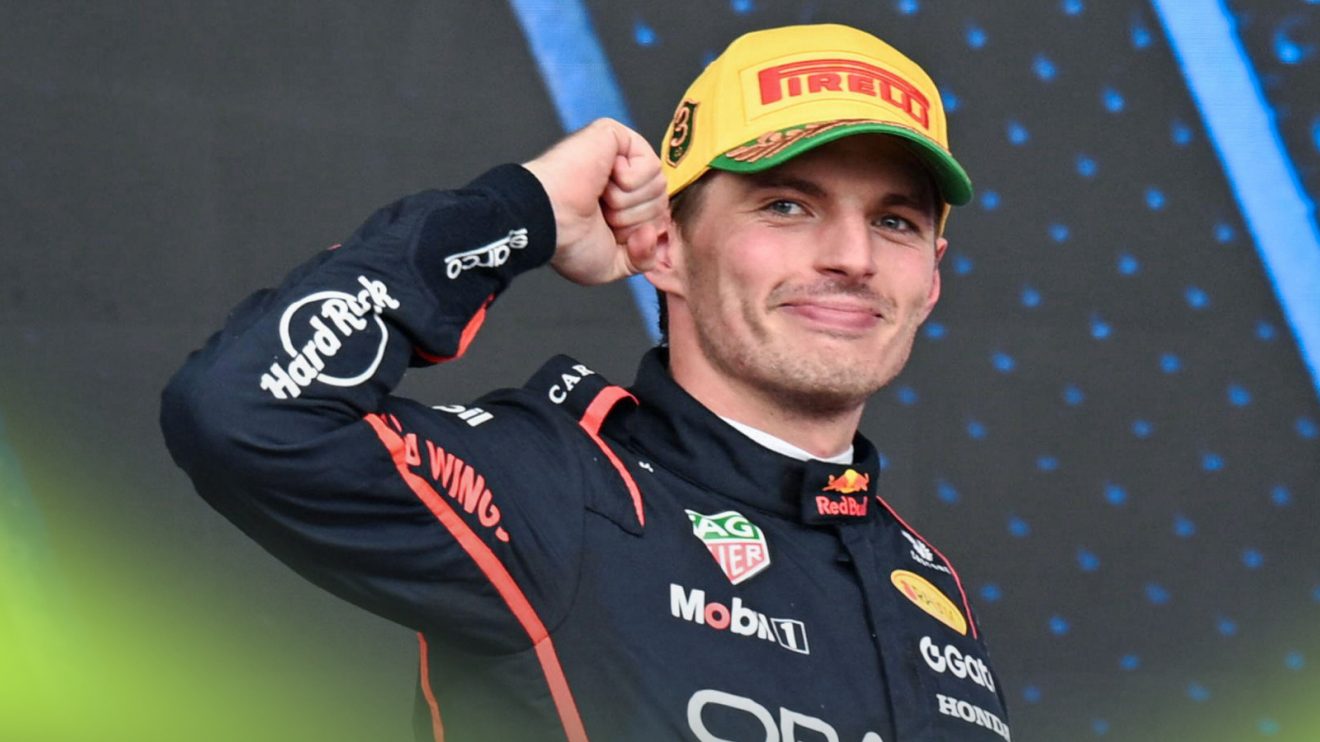
Max Verstappen celebrates
Max Verstappen simply never ceases to amaze. For the second time in a row at Interlagos, he produced a true masterpiece – this time, perhaps even more spectacular than the last, despite not taking victory.
So how did he manage to climb from the pit lane all the way to P3? Telemetry data gives us the answer.
Another Brazilian Grand Prix, another dose of Verstappen magic
After a disastrous qualifying session on Saturday, in which Max failed even to reach Q2, the team decided to break parc fermé, change the suspension setup on his car and fit a new power unit — all at the cost of starting from the pit lane.
Even though everyone knew what the four-time world champion was capable of, nobody realistically saw him in podium contention before the race began.
Verstappen started on hard tyres — a compound that later proved to be a poor race choice — most likely with the plan to extend his opening stint as long as possible and capitalise on a potential Safety Car. That Safety Car arrived as early as Lap 1.
It allowed Max to rejoin the pack and, on the restart, he gained two more positions with an excellent move into Turn 1. With Charles Leclerc out of the race, that put the Dutchman up to P13.
However, a puncture on his front-left tyre, likely caused by debris from the Kimi Antonelli–Leclerc contact, forced him into an early pit stop for a fresh set of medium tyres.
Counterintuitively, it might have been a good thing because the hard tyres were proving dreadful in terms of race pace. Fernando Alonso, who started from P11 also on hards, was clearly struggling based on his lap times.
Regardless, after his stop, Max found himself back at the tail of the field — but now on fresh rubber. What followed was a phenomenal drive from the four-time champion who, within just a few laps, overtook five cars, including Lance Stroll, Lewis Hamilton, Franco Colapinto, Nico Hulkenberg and Alexander Albon.
In the meantime, several drivers ahead who hadn’t yet pitted did so — notably including third-placed Antonelli — which promoted Verstappen to an incredible fourth, just 9.3 seconds behind George Russell’s Mercedes in third.

Verstappen’s charge didn’t stop there. During this phase of the race, he was occasionally even quicker than race leader Lando Norris, and up to Lap 28 he was consistently around half a second per lap faster than Russell.
His lap times then began to drop sharply as his medium tyres degraded, prompting Red Bull to call him in on Lap 35 for his second stop.

After rejoining, Verstappen immediately began to make use of his fresh tyres, steadily gaining positions over the next few laps.
It’s worth emphasising that Max’s race pace throughout was astonishing. Much of that credit goes to his team, who did a remarkable job — managing, without any setup testing on track, to give him an extremely fast car for Sunday.
Because he had pitted earlier than most, after a series of overtakes and pit cycles ahead, Max found himself leading the race by lap 51. Even his race engineer, Gianpiero Lambiase didn’t expect to be saying those words.
With 17-lap-old tyres and Norris eight seconds behind, it briefly looked like Max might try to stay out until the end to attempt a miraculous win. But just three laps later, he pitted again for softs.
It raises question as to whether Max could have been in contention for a potential victory had he stayed out on track. However, the situation isn’t that straightforward, as this move was prompted by several factors.
Firstly, his medium tyres were at the very end of their life, which was clear from the steep drop in his lap times — visible in the data below. Secondly, Norris was flying on fresher tyres, already gaining half a second on Max within a single lap after his stop. At that rate, the gap would only have continued to shrink.
Finally, because of his poor qualifying session, Max had an extra set of brand-new soft tyres available — something few others could rely on. That also factored heavily into the decision.
All things considered, the chance of Max keeping Norris behind him was very slim, almost nonexistent. And so, he was called into the pits.

What about second? Fighting for a potential win would have been ambitious, but trying to keep Kimi Antonelli behind sounded achievable. That way, Max could have still gained one more position than he ultimately did.
After Antonelli pitted on Lap 48, his pace was around 0.6 seconds per lap faster than Verstappen’s. If we assume an ideal scenario in which Max managed to completely neutralise tyre degradation and maintain a consistent pace, then with 24 laps remaining the Mercedes driver would have recovered roughly 14.5 seconds. At that moment, Verstappen’s advantage stood at 15.2 seconds, meaning that, in theory and under our best-case assumption, he could have had a real chance to hold on to P2.
However, the reality is that Max’s heavily worn medium tyres would have degraded much faster, and Antonelli would most likely have been gaining more than 0.6 seconds per lap. As we saw in Verstappen’s previous stint, once you reach the critical wear limit, performance drops off extremely quickly.
Verstappen had been running at a very strong race pace before that, so it was entirely expected that his lap times would fall sharply once he hit that threshold — which is exactly why Red Bull chose to bring him in for a third pit stop.

With brand new soft tyres, his pace was astonishing. The telemetry graph shows how quickly he was closing on the Mercedes cars ahead.
By lap 63, he had breezed past Russell, and his next target was rookie Kimi Antonelli. Unfortunately for Max, he ran out of laps; just a few more and he would almost certainly have taken P2. But it must be said — the young Italian drove superbly and fully deserved to keep his place.

Even so, to start from the pit lane and finish on the podium is an extraordinary achievement — one that very few drivers could pull off.
For comparison, Oscar Piastri in the McLaren started fourth, ran second behind Norris after the VSC restart, and still finished two places behind Verstappen (albeit with a 10-second penalty).
Just when we think maybe we’ve become accustomed to Verstappen’s brilliance, he finds new ways to impress.
Read next: Charles Leclerc lays blame after race-ending Brazilian GP clash


