

Data reveals explanation behind disappointing Ferrari sprint qualifying in Belgium


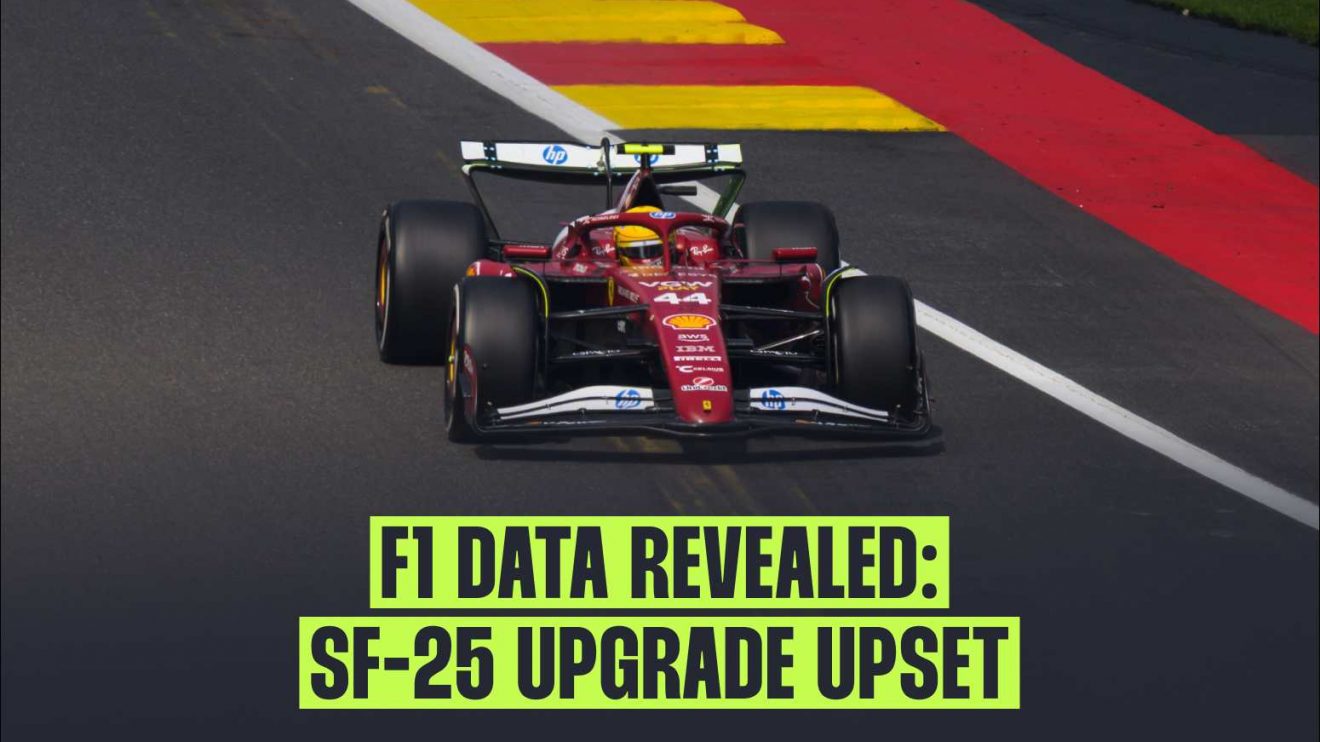
Scuderia Ferrari's SF-25 upgrades paint a picture of a challenging Belgian Grand Prix.
Ferrari arrived at the Belgian Grand Prix with a major upgrade package, aiming to address their main weakness this season: rear suspension.
Once again this year, fans of the Italian team dared to hope this might be the turning point where results begin to improve. However, data from the first day on track in Belgium suggests otherwise.
Is this Ferrari’s last chance for a stronger 2025?
As mentioned, the key updates Ferrari introduced this weekend for the Belgian Grand Prix focus on the rear suspension – an area of the car that has been a major headache since the season began.
This has been most evident in slow-speed corners, where stability and rear-end grip are crucial, especially on corner exit under throttle.
Another familiar characteristic has been the SF-25’s tendency to perform better in races than in qualifying. However, poor qualifying results in this generation of cars significantly compromise track position and make recovery through the field much harder.
Despite sitting second in the Constructors’ standings, the expectation for Ferrari this season was far higher, and it’s fair to say the first half of 2025 has been disappointing from that perspective.
More on the Belgian Grand Prix:
? Ferrari unveil highly anticipated ride-height solution at Spa
? Analysis reveals full impact of major in-season rule change
In an effort to shift momentum, Ferrari’s engineers likely took advantage of the short break between the British and Belgian Grands Prix to prepare and implement these upgrades. Additionally, they utilised promotional filming time to briefly test the new setup in real track conditions in Italy.
The first free practice session, however, didn’t offer much encouragement – Leclerc posted the fifth-fastest time, almost 0.9 seconds off the pace, while his teammate was even further back.

A comparison of the fastest FP1 laps between Charles Leclerc, Oscar Piastri and Max Verstappen reveals that Ferrari’s recurring issues remain unresolved.
The most glaring difference appears at Turn 10, where Leclerc is around 15 km/h slower than his rivals, leading to a significant loss of time. The same goes for the chicane at Turns 12–13, where the unstable rear end once again becomes apparent.
Despite this, Ferrari is actually the second-fastest team in this section of the track – which speaks volumes about McLaren’s current dominance.
While FP1 is rarely a reliable indicator of true performance, the trend didn’t improve much during the Sprint Qualifying session. Leclerc ended up fourth, 0.768 seconds behind the leading trio of the McLarens and Max Verstappen.
What arguably stood out more was Hamilton’s failure to advance to SQ2 after losing control of his car in the penultimate corner of his second push lap. It’s extremely rare to see a driver – especially Lewis Hamilton – lose grip in such a sudden and complete manner. While the exact cause is unclear, it wouldn’t be surprising if the new rear suspension was a factor.
Leclerc’s lap provides enough reference points for an analysis that mirrors FP1 — we once again see the same limitations of the SF-25, as well as McLaren’s clear superiority.


The first sector actually suits Ferrari well, showing times nearly identical to McLaren’s, with Red Bull slightly ahead.
But the real damage is done in sector two, where Leclerc loses more than half a second to Piastri — a substantial gap. Verstappen shows similar speeds to Leclerc through Turn 12, but Red Bull’s setup favours straight-line speed over cornering, so the context is quite different.
Ferrari, on the other hand, find themselves in a scenario where they match Verstappen in cornering speed but fall behind on the straights. McLaren and Red Bull have both committed to distinct aerodynamic philosophies, while Ferrari still seem to be searching for balance.
Another noteworthy detail is the visibly lower ride height of the Ferrari in Belgium. During FP1, a significant amount of bottoming-out smoke was seen as the SF-25 passed through the legendary Eau Rouge, indicating just how low the car was running.
While this isn’t necessarily a problem during practice, it could become a serious issue during the Sprint or Sunday’s Grand Prix. It’s important to remember that the wooden plank under the car must not wear beyond a certain limit – otherwise, the car is subject to disqualification under FIA regulations.
So, what’s the verdict? Is the new suspension working?
Looking at the current numbers, it’s clear that the goal hasn’t been achieved. Whether a step forward has still been made is difficult to say. We don’t expect a dramatic turnaround by the time qualifying for the main race arrives, and with rain likely on Sunday, the next proper test will come in Hungary.
The Hungaroring, with its abundance of slow corners, presents exactly the kind of challenge the SF-25 struggles with – but that also makes it the perfect opportunity to put these new upgrades to the test.
Read next: Belgian GP: Piastri survives scare to secure Spa sprint pole as Hamilton hits new low