

Christopher Polvoorde’s 27 miles to heartbreak at the Baja 1000


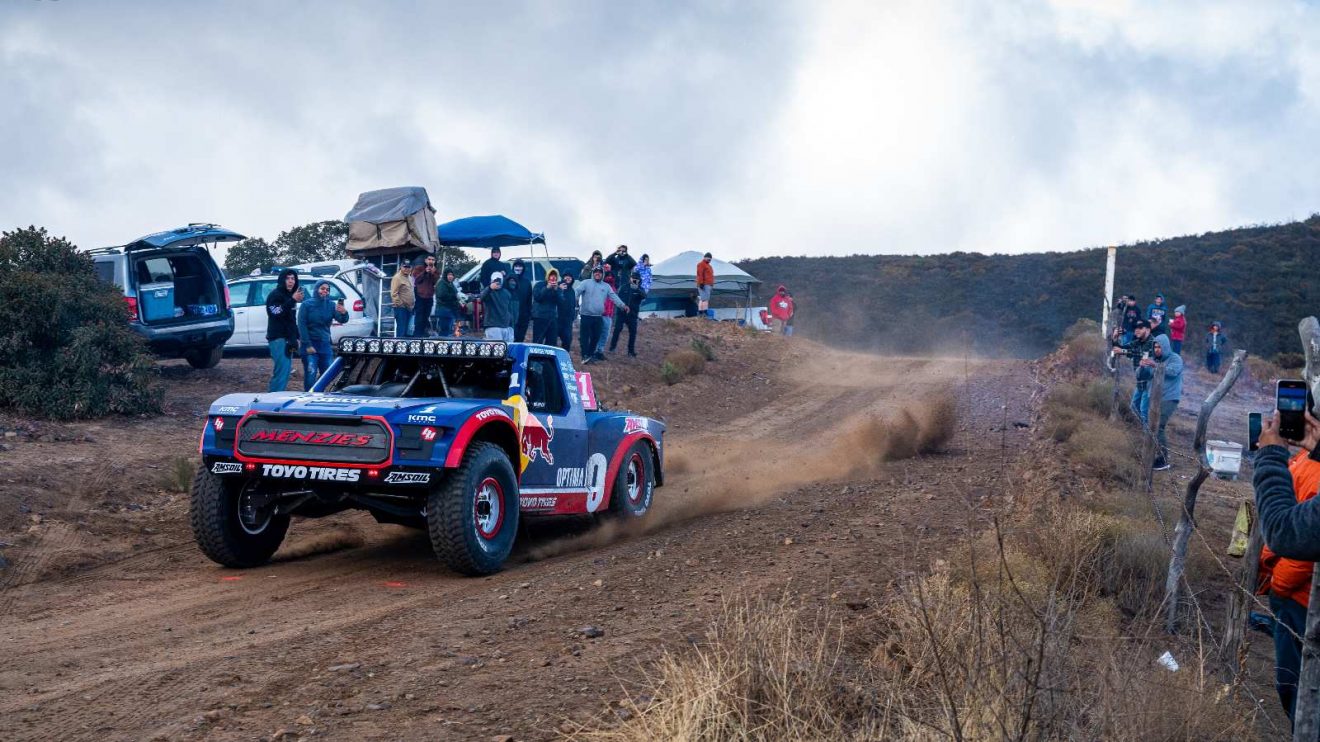
The Red Bull / Optima trophy truck of Christopher Polvoorde and Bryce Menzies at the 2024 Baja 1000.
Everything seemed to be going right for Christopher Polvoorde’s 2024 outing at the Baja 1000. The Optima Batteries driver had partnered with Red Bull’s Bryce Menzies — one of Baja’s most formidable competitors, and a driver that Polvoorde adored growing up. The 24-year-old racer had qualified the Menzies truck on pole position, five full seconds ahead of the next-fastest car. “Favorites” would be an understatement.
But then, early on race day morning: Disaster. At race mile 27 of 864, the Polvoorde/Menzies trophy truck ground to a halt. A power steering failure ended their day before it even had a chance to begin. But for a first-time attendee of the iconic off-road race, the misfortune of the driver I’d flown to Ensenada, Mexico to shadow turned out to give me a once-in-a-lifetime opportunity to experience the real Baja 1000.
Christopher Polvoorde takes on the Baja 1000, off-road racing’s most grueling race
In 1962, Honda wanted to put its upcoming CL72 Scrambler motorcycle through its paces. In an era before motocross, sporty off-road aficionados took part in scrambles, a rough-and-tumble form of racing that involved a few laps around a dirt circuit that might feature a jump or two. To ensure its newest two-wheeler was scramble ready, Honda needed to subject the bike to a worthy trial.
So, Jack McCormack and Walt Fulton of Honda America went to the most qualified person they knew: Bud Ekins. The California-based Ekins had become a legend in the off-road racing world; sweetening the deal, he was also a Honda dealer. If anyone would know a great route for the Scrambler, it would be Ekins.
Ekins suggested Federal Highway 1, a 950-mile sliver of roughly defined road in Baja California stretching from Tijuana to La Paz. Only some of the route was paved; a majority of it would require the CL72 Scrambler — and its rider — to conquer mountain passes, rock-strewn outcrops, dry lake beds, dunes of silt, and more sand than any single person would need in a lifetime. If the bike could come out on the other side unscathed, then it’d be a guaranteed hit amongst the off-road racing crowd.
Ekins’ brother Dave joined Billy Robertson Jr., the son of a Southern California Honda dealer, for the near thousand-mile journey. On March 22, 1962, the men kicked off what would become a 39-hour, 56-minute ride into the history books.
Enthusiast press was mesmerized. Honda received so much publicity for that early run that Meyers Manx announced that one of its buggies would take on the challenge, followed by countless other speed seekers. Before long, it became clear that Baja was popular, and that the race needed official sanctioning if it were to continue.
Starting off as the Mexican 1000 in 1967, the event was transformed into the Baja 1000 after being scooped up by the Mexican government, which soon hired the SCORE International sanctioning body run by legend Mickey Thompson in 1973.
Over the years, the course has changed, varying in both overall distance and in style. So too have the vehicles. This year, there were almost 50 different classes of vehicle ranging motorcycles fielded by riders of 60 years of age, to stock Volkswagen buggies, to production pickup trucks.
But the top-level class at the Baja 1000 is known as Trophy Truck (TT) Unlimited, which is basically an open-production, off-road class of pickup truck racing that allows for a huge amount of regulatory freedom, so long as you meet some basic safety standards.
This is where we meet our protagonist, 24-year-old Christopher Polvoorde.
Despite being born in the self-described “racing mecca” of Southern California, Polvoorde didn’t grow up in a racing family — which is a rarity in the racing world.
“Most of these families are in their third, fourth, fifth generation,” Polvoorde told PlanetF1.com. “We’re literally fresh as can be.”
He got his start in off-road go-karting back in 2012, quickly progressing up the ranks to his first professional racing championship in 2019, the Lucas Oil Midwest Short Course League, before getting interested in desert racing.
“I’m a very outdoorsy person. I’m always outside, so I think the Baja fits my personality,” he said.
“But I’m also a very, like, Type-2 fun person, where I go and hike a mountain and then nearly die. Then I come home, and I’m like ‘Oh, that was fun!’
“That’s my mentality. I think Baja fits perfectly — spending eight hours in a car where half of the time, it’s like, ‘Why am I doing this?'”
His passion for racing stemmed from a kart his father received in exchange for space to rent. Polvoorde started out toying around in the backyard before deciding to test his mettle against other kids his age.
It didn’t go well. In his first races, Polvoorde was a regular at the very rear of the field — but that simply inspired him to put his head down and train hard to see if he couldn’t improve. With self-discipline and assistance from his family, Polvoorde found that winning wasn’t quite as hard as it looked.
At the Baja 1000, as with at almost every other race Polvoorde contests, his family was out in full force to support him. His parents turn up to support their son, shadowing his races in a helicopter piloted by his brother-in-law, who by day is a sheriff’s deputy that follows high-profile police chases from the air.
“I think [my racing] became a family affair because I’m so young,” he said. “I grew up with them coming to the track with me — and when I started to make it a career, they were forced to chaperone me, basically.
“Now I’ve gotten to a point where I can be on my own, but they like to be part of it.”
Speaking to Polvoorde in the middle of the desert, I could understand the appeal. Their son was preparing to conquer hundreds of miles of desert at an event where spectators are known to assemble ‘booby traps’ in hopes of seeing a competitor go hurtling into the air. Having a birds’ eye view from the helicopter would not only allow them to spectate at every turn, but to be instantly available in the event of an emergency.
At mile 27 of 864, Christopher Polvoorde’s trophy truck came to a halt.
But first, let’s back up. The night before the race, I was invited to something I came to affectionately call the “Menzies compound.”
The 37-year-old Bryce Menzies is an icon of the off-road racing world, and his Red Bull sponsorship has launched him to stratospheric heights. To support his career in off-road racing, his family acquired a former hotel in Baja California to serve as base camp; after all, pre-running for the 1000 often kicks off over a month in advance of the actual race, with drivers and riders trying to familiarize themselves with the ever-changing conditions of the course. Having a local headquarters seemed smart.
But I didn’t quite realize quite how impressive the whole affair was.
Yes, the Menzies family had acquired a hotel, complete with a full-service kitchen, bar, and lounge area. But they’d also erected a state-of-the-art garage and brought in a fleet of chase trucks bedded down with all the supplies a person could need out in the desert.
I had spoken to Polvoorde about the extreme logistics involved in organizing an event; he told me that he usually has around 120 people in Baja to support him, with around 30 chase trucks, two helicopters, and two small planes to facilitate travel and repairs.
The sheer size of the operation, though, didn’t quite sink in until I arrived at the compound, where the Menzies/Polvoorde teams would be combing over route details, chase truck locations, and pit crew responsibilities before a hearty meal and an early bedtime.
There, a fleet of heavy-duty pickup trucks lined the plaza inside the compound, while each member of the crew flipped through a massive ring binder filled with detailed maps, truck information, emergency protocol, and so much more. Chase trucks would be stationed at roughly 30 locations around the course, and many would be driving from one station to the next in order to maximize efficiency.
After the debrief, I had a chance to head to the Menzies’ garage, where I laid eyes on the state-of-the-art trophy truck tucked safely away before its big day in the desert. An Optima engineer walked me around the truck, pointing out its slate of dashboard screens, its emergency equipment, and its powerful suspension.
It was like what I’d expect to happen if a Formula 1 team took over operations at Baja. In that squeaky-clean garage, it was easy to imagine Menzies and Polvoorde cruising comfortably to a win.
That didn’t happen.
On race day morning, I joined the Optima crew at the ceremonial start line in Ensenada to wave Polvoorde off on his second Trophy Truck outing at the Baja 1000. We dipped across the street during the gap between car releases to climb into a chase truck of our very own. We had a few hours’ drive ahead of us to make it to the first pit stop, and it was essential to get on the road as quickly as possible.
We flipped on the Starlink transponder in the truck and tuned into the official Baja 1000 livestream on YouTube, but we’d barely made a dent into our drive when we spotted something strange: Polvoorde’s truck had come to a stop.
At long-distance off-road races like the 1000, it’s next to impossible to have your finger on the pulse of every happening the same way you can in closed-course racing. All we could tell was that the truck had suddenly just stopped.
We continued a few more minutes in the chase trucks before finding somewhere to pull over ourselves. If the damage was minor, we could easily head on our way. If it was terminal, we could turn back to Ensenada. We didn’t know — and the race crew itself seemed just as perplexed over the radio.
We waited, anxiously, as the nearest chase truck rushed out to the scene — but after an hour, the problem was determined to be fatal. Polvoorde retired from the 2024 Baja 1000 before completing 30 miles.
More on the Baja 1000:
? Baja 1000: How innovative WiFi solutions are turning off-road racing into Formula 1
? Baja 1000: Five F1 drivers to tackle motorsport’s most dangerous race
With Christopher Poolverde out of the race, the Optima team and I turned back to Ensenada with heavier hearts than we’d had that morning. We’d have some lunch, we decided, and rally that evening to watch the motorcycles finish their race. Then we’d talk about plans for an early departure the following morning.
But that didn’t mean we tuned out. Instead, the Optima crew had the livestream of the Baja 1000 turned on as we drove back, and I was able to experience a different side to Baja — one I likely wouldn’t have noticed had I been invested in a single team.
I learned about the Ironman competitors, the class entirely dedicated to drivers and riders who contest the full event alone. Nothing but manpower and machine, a particularly arduous task for the bike riders who will travel hundreds of miles with nothing but what they could carry on their back.
I learned about the rider of the 279X, David Hunter, who crossed the Baja 1000 finish line with a Starlink WiFi panel strapped to his helmet. Why? Because he’d also strapped his cell phone to his chest, with his mom on Facetime, so that she could keep tabs on her son and ensure his safety.
I learned of David Guerrant, who Ironmanned an old Triumph motorcycle, carrying with him nothing but a dream, a backpack, and only the most rudimentary safety equipment possible.
I learned that Terrible Herbst Motorsport had mastered the art of the “double stack,” bringing both its trophy trucks into a pit for tire changes back-to-back — a massively arduous task for the sparse crews working with tires that could equal their body weight.
I learned of 17-year-old Eva Star, who finished all four of SCORE International’s off-road events in the UTV class this year, and of Kristen and Wayne Matlock, a married couple who have regularly competed against one another in big events like the Baja.
I watched drivers control the throttle via a wire with one hand, steering their trophy truck at high speed with the other. I watched flips and crashes. I saw co-drivers dig trophy trucks out of the silt, and moto riders careening through a lightless desert, balancing precariously on two wheels.
I saw the way multi-million dollar operations unfurl with military precision, transforming hotels into a hub for race operations, deploying fleets of specially-designed chase trucks to strategic positions all around the course, spending hours every day for weeks learning the nuance of the changing desert.
I also saw the homebuilt operations: The wives and children serving as a pit crew for their father; the friends working long hours just to achieve the goal they’d been dreaming about; the competitors who turned up with next to nothing, relying on the goodwill of the locals to see them through.
The whole of the human condition was on display at the Baja 1000, and it was truly stunning to witness.
Late on Saturday night, I joined the disheartened Optima Batteries crew at the bar of our hotel for a drink before we set off to the ceremonial finish line; the motorcycles were sure to be crossing the finish line at any moment, and if we couldn’t see the Optima trophy truck take the finish, we could at least cheer on the championship winners.
Not long after, Christopher Poolvorde arrived in the bar. It had been hours since his trophy truck broke down, but he was still decked out in his race suit. He made his way from table to table, shaking hands and swapping platitudes with the people who had joined him for a desert adventure cut far too short.
His disappointment didn’t stop him from making his way over to me, taking a moment to thank me for coming and to hope I’d had a good time, despite the early end. I had.
He’d been up in his room trying to film a quick video for Instagram to sum up the experience, but he found himself coming up short.
“I keep trying to come up with something to say, but it all sounds kind of ridiculous,” he told me.
We quickly debriefed on the day. Per Polvoorde, a minor $50 part in the drivetrain had failed, but it was enough to bring their race to a sudden halt. There would have been no way to make repairs on the course. The failure was terminal.
But Polvoorde somehow managed to be upbeat.
“The big thing is that no one got hurt,” he said, relaying how his trophy truck nearly veered into an easy-up tent full of fans during the drivetrain failure. “I’m here in one piece, and aside from that part, the truck’s fine.”
Not long after, Polvoorde disappeared back into the bowels of the hotel, where he finally filmed and posted a quick video for social media. I joined the Optima crew at the ceremonial finish, watching moto riders celebrate a job well done in the sprinkling rain.
I’d gone into the Baja 1000 week with a strong sense of the story I wanted to tell — one about a young competitor teaming up with driver he idolized as a child, about the grit and determination it takes to ignore your better sense and careen through the desert at full speed in pursuit of glory.
However, when only one person can win a race, a motorsport story is more likely to center around frustration, disappointment, and arrested desire. At an event like the Baja 1000, where hundreds of miles of unpredictable desert separate you from the finish line, the stakes are even higher.
But a ‘win’ doesn’t have to mean a victory — certainly not at Baja. A win can be the simple act of finishing, or of turning up in the first place. A win can look like David Hunter, giving his mom the Facetime call of a lifetime.
Or it can look like Christopher Polvoorde taking time to thank each and every member of his crew, to be grateful for the safety of the spectators, before finding the words to share with his fans.
Full disclosure: Optima Batteries paid for my travel, lodging, and meals so that I could attend the Baja 1000. All opinions, thoughts, and perceptions are my own.
Read next: World Destructors’ Championship: The complete F1 2024 crash damage standings