

Why has Christian Horner been sacked by Red Bull?


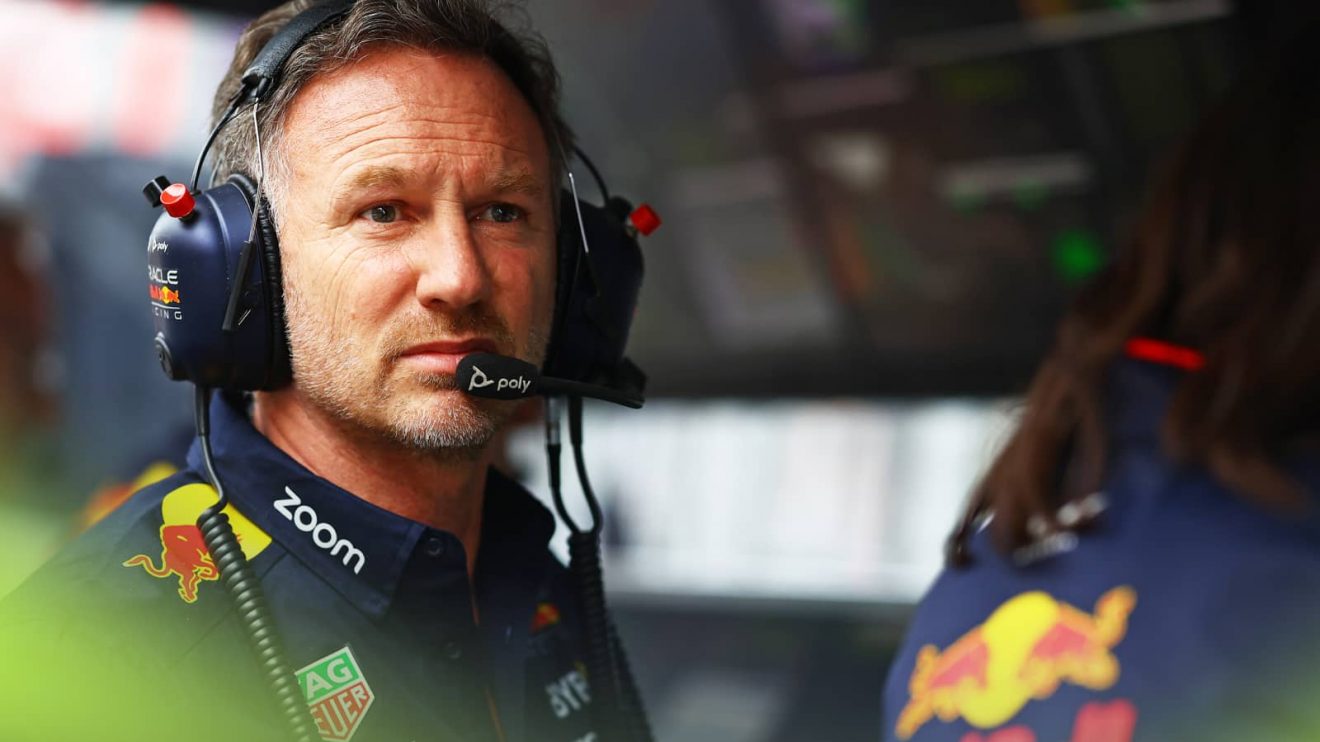
Christian Horner was the longest-serving team principal in F1, having been appointed by Red Bull in 2005
Christian Horner’s leadership of Red Bull has come to an abrupt end, less than two years after the most dominant season in F1 history.
The heady days of the F1 2023 season, in which Red Bull Racing swept all but one Grand Prix en route to both titles, seem a long time ago now, with the man who led the team being released from his job after 20 years.
Christian Horner released by Red Bull
On Wednesday, Red Bull GmbH released a short statement confirming that Horner’s time as team boss and CEO – a position that once seemed utterly unshakeable – has come to an end after 20 years.
Horner spoke to the assembled staff at the Milton Keynes headquarters on Wednesday morning, where it’s understood emotions ran high as he bid farewell. Staff on the ground are believed to have been vocal in showing disappointment at Horner’s departure, while senior figures within the team aligned with Horner are understood to have been stood down.
Oliver Hughes, chief marketing officer, and Paul Smith, Red Bull’s group director of communications, have been stood down from their duties, further adding to the staff’s disappointment that Horner, a very popular boss on campus, has been released.
What was once a chaotic lower-midfield team under its Jaguar iteration, Horner’s methodical building of Red Bull saw him turn the squad into race winners in less than five years and World Champions by year six.
It’s been an incredible two decades, with Horner overseeing six Constructors’ Championships, eight Drivers’ championships across two separate spells of domination, 124 victories, 107 pole positions, and 287 podium finishes.
“We would like to thank Christian Horner for his exceptional work over the last 20 years,” said Oliver Mintzlaff, CEO of Red Bull’s Corporate Projects and Investments and representative of the Mark Mateschitz Austrian side of Red Bull’s shareholders, as GmbH confirmed Laurent Mekies will succeed Horner as CEO.
“With his tireless commitment, experience, expertise, and innovative thinking, he has been instrumental in establishing Red Bull Racing as one of the most successful and attractive teams in Formula 1. Thank you for everything, Christian, and you will forever remain an important part of our team history.”
Two weeks ago, Horner had happily posed for photographs on the grid in Austria, standing alongside Red Bull majority shareholder Chalerm Yoovidhya; a man some reports last year suggested had been instrumental in helping him retain his job in the face of intense public scrutiny following last year’s internal investigation by GmbH.
Over the last year, reports have popped up at sporadic intervals suggesting that Horner was on the verge of being fired, the most recent of these coming ahead of the Emilia Romagna Grand Prix when reports emerged that the British executive’s future could revolve around the success of the upgrades introduced in recent races.
Why has Christian Horner been sacked by Red Bull?
Officially, no reason has been given for Horner’s release from the team, and it’s been indicated to PlanetF1.com that, at the factory, mystification abounds as to why this drastic action has been taken.
At surface level, his dismissal appears something of an overreaction to the team’s performance dip this season after last year’s sudden end to the dominance.
After all, peaks and troughs in performance are expected in Formula 1, and while championships are out of reach this season, Red Bull has won races on merit in F1 2025. The revolutionary rules on the way for 2026 will see Red Bull Powertrains become a constructor in its own right, and offer the chance for the outfit to become a fully self-sufficient manufacturer in its own right; leading to opportunities as a supplier and even a potential automotive disruptor.
The noise under which Horner has operated in the last year is in stark contrast to the relative tranquility Toto Wolff has been afforded at Mercedes through what has been a tough regulation cycle in which the Brackley-based squad has only shown sporadic blips of outright winning capability.
So what’s the difference? Why has Horner been axed in a season that, while being a big dip in form for Red Bull, would be beyond the wildest dreams of many of F1’s current teams?
The pressure started in January 2024, when it was made known that Red Bull GmbH was carrying out an internal investigation into allegations regarding his behaviour with a team employee.
This saga was blown up by the dramatic leaking of alleged material pertaining to Horner and the employee, by way of screenshotted material, to the F1 paddock by way of an anonymous email. The contents quickly disseminated around the globe, putting Horner and Red Bull in a very embarrassing and humiliating position, although the contents have never been verified as genuine.
Two separate investigations by two different KCs in the UK cleared Horner, including through an appeals process initiated by the complainant.
While the matter faded into the background, aided by Red Bull GmbH and Geri, Christian’s wife, as their respective support continued, the issue for Horner was that, on track, Red Bull Racing was starting to struggle.
Having lost Rob Marshall to McLaren in late 2023, Red Bull lost Adrian Newey as the illustrious engineer decided to cut ties with the team he’d overseen the design of every title-winning machine created at Milton Keynes.
Newey hinted that the matter involving Horner had played some part in his decision to leave Red Bull, while the stability of Horner’s role as team boss meant that Jonathan Wheatley, who felt he had hit a glass ceiling in his role as sporting director, chose to take a new opportunity at Sauber.
Losing high-profile people like this may have been fine had the performance of the RB20 remained stable. But, on the very weekend of Newey’s confirmed departure, McLaren’s MCL38 stepped forward and, while Max Verstappen was able to massage home the title after the dominance of the opening quarter, it was clear the pressure was on for 2025.
The RB21, designed by Pierre Waché outright as the French designer stepped forward to lead Red Bull’s technical department after Newey, is a difficult beast to figure out. Clearly not the class of the field, the RB21 has taken occasional victories and pole positions in Verstappen’s hands but, in the hands of Liam Lawson and Yuki Tsunoda, is toiling around at the back of the field.
This continuation of the pattern established last year, as Sergio Perez, a proven capable support driver to Verstappen in previous years, fell apart behind the wheel of the RB20.
In the hands of several drivers, the Red Bull is a dreadful machine. In the hands of Verstappen, it’s a car in the mix at the front. Either way, this disconnect has become something fundamental, a pattern of several years to create a one-driver outfit unable to contend for the Constructors’ Championship against more balanced teams like McLaren currently has.
Given the optics of the last year, perhaps Horner was given the opportunity to keep his job provided the performance level continued. With that not materialising, and no clear indication that the team, sans Newey, is going in the right direction, maybe it was only a matter of time before starting afresh became an inevitability.
Whether Horner deserved more benefit of the doubt to be given time to turn the team’s fortunes around is completely subjective. After all, given it’s impossible to guess at this point, will Red Bull be left looking silly if the new 2026 car and power unit turn out to be the standard-setters?
What role has the Verstappen camp played in Christian Horner’s firing?
Part of the pressure on Horner’s position recently is likely down to the fact that Max Verstappen has failed to publicly declare he’s not a potential target for other teams for next season.
He’s long been linked with a move to Aston Martin or Mercedes, and recent reports in German media suggested that Verstappen was looking for Horner’s removal in order to remain with the team for next season.
Verstappen is under contract with Red Bull until F1 2028, but the four-time F1 World Champion has never quite quelled the speculation that he could move elsewhere, particularly after the fall-out between Horner and Max’s father Jos last year.
If not for Verstappen’s results in a car that is clearly on the knife-edge of performance, Red Bull could well be also-rans this season, and the enormity of this has, presumably, not been lost on Red Bull’s shareholders.
It’s believed that Verstappen’s performance-related clause in his Red Bull contract pertains to his position in the championship by the summer break, after Hungary.
Following the two dismal weekends in Austria and Silverstone, Horner didn’t appear out of sorts as he spoke to the media on Sunday evening. The British GP weekend had actually appeared quite positive for Red Bull, despite the race itself having fallen apart in the rain.
The Dutch driver’s pole position was followed by the Verstappens heading off with Horner for a social evening together, and team sources had indicated that the feeling within the camp had become lighter as Verstappen’s position seemed to be solidifying on remaining with Red Bull next year.
Certainly, Horner’s dismissal appears to have come as a shock internally. The suddenness of this suggests both sets of shareholders have come to the conclusion that, despite the history and the promise of the future, the circumstances of the last 18 months or so have seen the team slip away too much.
The big question now is whether Horner’s release is due to Red Bull having been informed Verstappen intends to leave for a new team, likely to be Mercedes, or whether it’s a last-gasp effort to appease the Dutch driver that Red Bull is very firmly attempting to turn things around.
Is it the right thing to do? Only time will tell, as Horner’s pedigree is second to none of any of his peers on the grid. Perhaps it’s for this reason that, after the dramas of last year, he was given time to right the ship. With no indication that, from an operational or technical standpoint, Red Bull is back at the top, the plug has been pulled.
After all, even the optics of attempting to keep a star driver, the biggest name in F1, chained to Red Bull by way of a performance clause, as opposed to simply being a desirable option, is the antithesis of good marketing, which is primarily Red Bull’s entire modus operandi for being in F1.
What’s next for Christian Horner?
It’s hard not to feel sorry for Horner, to have had what has been a tenure of unmatched success come to an end in such ignominious fashion.
After all, Horner’s success has come as that of a mere employee as opposed to having any sort of ownership stake, although the British executive has long insisted this hasn’t bothered him.
Having been dropped, with little fanfare, Horner has made clear his commitment to Red Bull in a recent exclusive interview with PlanetF1.com, following rumours linking him with Alpine and Ferrari.
“Obviously, over the years, I’ve had different approaches, and it’s always flattering to be associated with any other team as they’re all great teams,” he said.
“But my heart and soul are in this team. I’ve invested a big part of my life in it, and I feel a responsibility to the people.
“It’s a group of 2000 people, and I’m really excited about what the future holds in terms of building our own engine. That’s very much the next chapter for us, having it all under one roof. You know, how many people have done that?
“So that’s a massive challenge but a great opportunity and something, as an organisation, we’re very excited about.
“The people are what make a team, and that’s who I feel a tremendous attachment to. Both in the team, obviously, and the shareholders that have supported, the sponsors and partners – we now have 58 partners that I’ve been responsible for bringing into the team, and we have a great relationship with so many of those partners. It feels like a significant part of my life.”
Just a few short weeks later, Horner’s time at Red Bull has ended; the full picture of why the parent organisation has turned its back on him is yet to emerge.
Is this the last we’ve seen of Horner in F1? Aside from off-track matters coming into play, it’s hard to imagine that he will walk away from the paddock. As a proven leader in the sport, the prospect of an Alpine switch, building up another foundering UK-based team, and taking up an ownership stake suddenly doesn’t seem unthinkable.
Horner is known to have a good relationship with Flavio Briatore; how long will it be until Horner picks up the phone?


