
PF1 verdict: Was Carlos Sainz’s Dutch GP penalty fair after Liam Lawson clash?


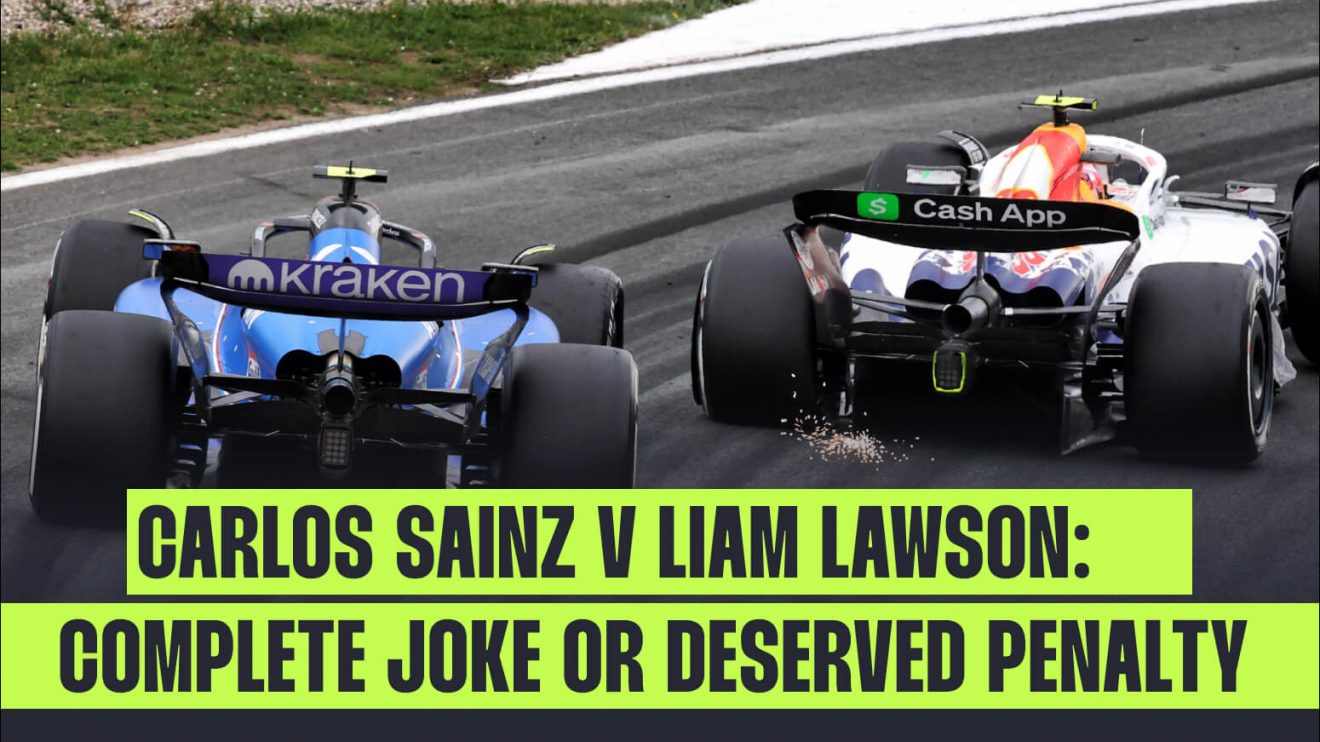
Carlos Sainz v Liam Lawson at the Dutch GP
Carlos Sainz was irate with “stupid” Liam Lawson after their Dutch Grand Prix coming together, but even more so when the stewards gave him a 10-second time penalty for being at fault.
Racing for position following a Safety Car restart, Sainz approached Lawson into Turn 1 and attacked around the outside. Seemingly having the racing position, Lawson closed the door on the Spaniard and the two made contact.
Both drivers were forced to pit for repairs, but Sainz’s day went from bad to worse as the stewards him with a 10-second penalty for causing a collision. The Williams driver, and many others, were baffled by the decision.
Here’s PlanetF1.com’s take on the incident.
‘He’s just so stupid’
By Michelle Foster
Stopping short of calling Liam Lawson stupid, I will question WTH was going through his mind as he shut the door on Carlos Sainz at the Dutch Grand Prix when the Williams driver clearly had the right to the corner.
Racing for position, and with his Williams showing better pace, Sainz took the audacious outside line on Lawson but he could, because he had the pace after the restart on lap 26.
Both drivers had room to make the corner, well they did until they didn’t as Lawson drifted to the outside, shut the door on Sainz and clattered into the Spaniard’s wing. Both cars suffered damaged, and failed to score points in a race that was theirs for the taking.
But in a baffling decision, the stewards gave Sainz a 10-second time penalty for causing a collision.
Say what!
The Spaniard had the momentum, the racing line, and everything as per the rule book that meant Lawson had to give him room. But the New Zealander did not.
Sainz was 100 per cent correct in his frustrated assessment that there was no reason whatsoever for contact in their wheel-to-wheel battle. No reason, that is, but Lawson’s action.
One cannot blame the former Ferrari driver for heading to the stewards to ‘discuss’ the matter as he was unjustly penalised. That the time penalty came with two penalty points only added to his ire.
One was right, one wasn’t wrong
By Henry Valantine
I can see why both Sainz and Lawson feel somewhat aggrieved at the situation before them.
For Lawson, it was clearly a chance to score good points, even when his teammate was about to finish on the podium, likewise for Sainz.
The stewards reasoned Sainz was penalised because, in short, it was Lawson’s corner and not enough of his car was alongside to warrant racing room.
True as that is, Lawson will also have known the Williams driver was there and, with multiple cars having gone around the outside at that corner in the past, Sainz will have looked to keep his foot on the throttle.
Ultimately, though, it feels as though the stewards punished the consequence rather than the action.
Had both drivers gone through the corner unscathed, it’s unlikely that it would have been spoken of again.
A 10-second penalty and two penalty points on his Super Licence feels a harsh punishment for Sainz, as from the outside at least, it simply looked like being a racing incident.
Of course, the stewards have access to more camera angles, more data and have the rulebook to hand, and Sainz could have backed out, but it ultimately felt like a minor moment which resulted in bigger consequences for both drivers than anticipated.
Another example of F1’s overinflated racing rulebook
By Oliver Harden
The drivers have brought this on themselves with the infamous ‘Driving Standards Guidelines’.
Since the guidelines were updates late last season, at the demand of the drivers in response to two high-profile incidents between Max Verstappen and Lando Norris in Austin, the kneejerk reaction whenever something remotely interesting happens on track has been to thumb through the painfully restrictive rules in search of ways to cancel it.
As opposed to, say, y’know, relying on common sense and good judgement.
The reason why Carlos Sainz was penalised at Zandvoort is the same reason why Verstappen and Lewis Hamilton were called to the stewards over an innocuous incident in Hungary.
The sensible thing on Sunday, with both drivers coming away with punctures, would have been to leave them to it and judge it as a racing incident.
Yet there seems to be an obligation now among the stewards to get involved in each and every incident, no matter how minor.
The sight of that blue banner appearing at the top of the screen, informing viewers that an incident has been noted or is under investigation, has become the ultimate passion killer.
Lawson fought his corner in response to Sainz’s post-race criticism, yet acknowledged that the guidelines are at the heart of the issue.
“It’s just the way the rules are written,” he told media including PlanetF1.com on Sunday evening.
As a former FIA race director, apparently quite popular at Lawson’s old team, might say: it’s called motor racing.
Going racing in a courtroom
By Elizabeth Blackstock
Has anyone else gotten the distinct feeling that we’ve been racing before an inscrutable judge and jury lately, or is it just me?
At the Dutch Grand Prix alone, multiple drivers were summoned to the stewards after the race to discuss infractions committed before the lights went out. Others were summoned for seemingly slam-dunk infractions (see: Charles Leclerc’s bold through-the-gravel move on George Russell) that resulted in no further action. And still others, like the Sainz/Lawson incident, were decided before either driver had a chance to speak with stewards.
Yes, I’ll grant that the FIA rulebook has been amended to state that the overtaking driver must be firmly alongside the car in front for a move to be legal. At the same time, I’d also argue that both drivers in this instance made errors, and both were naturally punished for it on track — so why was it necessary for Sainz to be hit with penalties before the stewards heard him out?
I don’t have an answer, and I suspect very few viewers do, either. What I saw was a racing incident. The stewards disagreed. But it all amounts to the sensation that Formula 1 is racing before a courtroom whose rulings can be difficult to understand.
Carlos Sainz has every right to feel aggrieved
by Thomas Maher
I’ll preface by saying that I don’t believe Liam Lawson did much wrong… but nor did Carlos Sainz.
As Oliver pointed out above, the changes made to the racing guidelines for this year have made things over-prescriptive and needlessly complicated.
It’s very strange that a driver on the outside, short of swooping in across an apex across their rival, can be at fault for a clash but that is exactly the situation F1 has found itself in with these strange guildines as they have all but nullified the chances of a driver being able to overtake around the outside without a lot of co-operation from their rival.
Amusingly, a good example of how it can be done was Lando Norris on Max Verstappen, with the Dutch driver only putting up a certain amount of fight against the McLaren driver but, ultimately, opting against running his rival out of road.
On paper, Sainz did, indeed, breach the guidelines as his front axle simply wasn’t far enough alongside Lawson to have earned the right to space.
But the fact this guideline exists in the first place, reinforcing a banal ‘first to the apex’ simplification of how overtaking moves can require momentum, positioning and, indeed, driver bravery to succeed, is robbing drivers of a chance to produce something special.
Sure, a move like Sainz’s won’t work the majority of the time, but the fact that the driver on the inside, who played a greater part in a small but costly collision, isn’t punished while the one on the outside, where physics reduce their contribution, is penalised is a path F1 has taken that just lacks common sense.
But, then again, I’m not in favour of penalties for run-of-the-mill racing incidents and collisions in general, and believe penalties should only apply to the most egregious collisions where intent is provable or the incident is particularly single-sided in culpability.
Penalties for on-track incidents should be irregular and earmarked for bad behaviour, not honest racing.
Read next: Hugenholtz: Why this strange Dutch GP corner claims so many victims