

The Brad Pitt F1 movie is powered by a death drive that doesn’t exist in modern F1


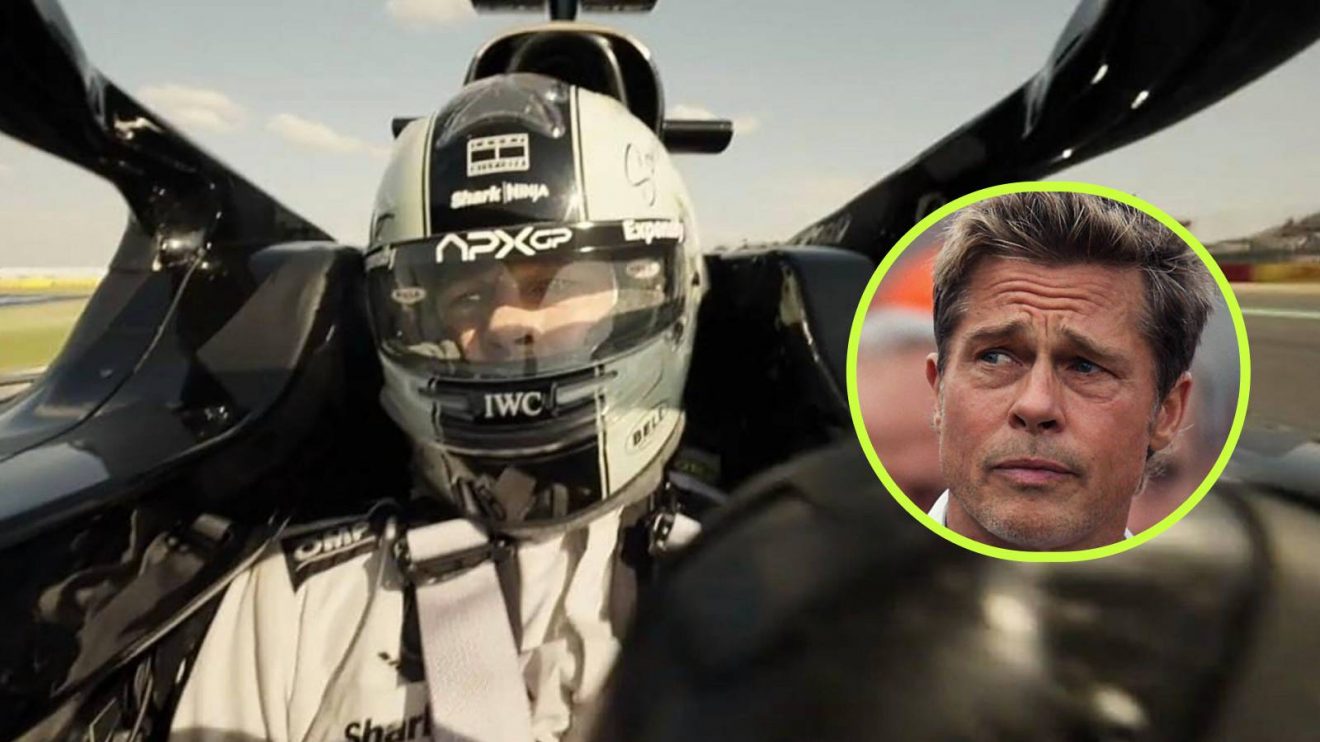
F1 has revealed the first clip from the long-awaited 'F1' movie, starring Brad Pitt.
From the moment its first trailer was released the F1 movie starring Brad Pitt has been seemingly powered by the specter of death, injury, and a cavalier approach to safety.
The only problem is that the death drive powering the film simply doesn’t exist in Formula 1 today. In fact, it has almost never existed.
Brad Pitt’s F1 movie looks to have succumbed to Hollywoodification
While we won’t know the exact storyline of the F1 movie until it’s released later this year (June 25 internationally; June 27 in the United States), the short selection of teaser clips we’ve seen have all pointed to one thing: This film is powered by a death drive that does not exist in modern Formula 1.
The film centers on Sonny Hayes (Brad Pitt), a “never-was” racer who washed out of Formula 1… until he’s asked to join the APXGP team to serve as a mentor to a rookie prodigy named Joshua Pearce (Damson Idris).
That could make for quite a compelling storyline in and of itself, but because this is a film pulling from the standard Hollywood playbook, the stakes must be higher. There must be death involved.
Our first indication of that came in the first 97-second movie trailer that was released in the build-up to 2024’s British Grand Prix.
In it, Kerry Condon — who serves as APXGP’s technical director — asks, “How am I supposed to make that safe?”
Pitt, as Sonny Hayes, answers, “Who said anything about safe?”
More on the Brad Pitt F1 movie:
? Brad Pitt F1 movie: Cast, release date, Lewis Hamilton involvement and more
? Brad Pitt F1 movie: An insider’s complete guide to the F1 film
Since then, each trailer has flirted with death in the form of snappy dialogue and plenty of crash footage.
In the latest trailer, amid shots of cars crashing, flipping, and lighting on fire, team owner Ruben Cervantes (Javier Bardem) asks, “How do you think I feel if you die on the track?”
And, of course, there have been plenty of brief clips showing contact with other drivers and single-car crashes, with one flame-wrapped wreck in particular seeming reminiscent of Romain Grosjean’s Bahrain accident.
Pitt’s cavalier attitude toward these wrecks, though, doesn’t exist in modern Formula 1.
Let’s look at Grosjean’s crash in particular. At the 2020 Bahrain Grand Prix, Grosjean’s Haas VF-20 pierced a barrier on the opening lap. The force of the hit wrenched the car in half and sent it bursting into flames.
“I sat back down and then thought about Niki Lauda,” Grosjean told The Guardian, “his accident, thought it couldn’t end like this, it couldn’t be my last race, couldn’t finish like this. No way.”
“I tried again, and I’m stuck,” he continued.
“So I go back and then there is the less pleasant moment where my body starts to relax. I am at peace with myself and I am going to die.
“I ask the question: ‘Is it going to burn my shoes or my hand? Is it going to be painful? Where is it going to start?’
“To me, that felt like two, three, four seconds. I guess it was milliseconds at the time.
“Then I think about my kids, and they cannot lose their dad today.”
Grosjean was miraculously able to break free from the burning car, and it immediately resulted in the FIA launching a “deep investigation” in order to understand how that crash happened, why the car deformed in such a way, and how to prevent it in the future.
The rest of the field was horrified.
“It was such a shocking image to see,” Lewis Hamilton said.
“When I get in the car, I know that I’m taking risk, and I respect the dangers that are in this sport. I posted about it [on social media] whilst I was in that break because it’s horrifying.
“The cockpit, I don’t know what Gs he pulled, but I’m just so grateful that the halo worked.
“I’m grateful the barrier didn’t slice his head off or something like that. It could have been so much worse.”
Sebastian Vettel even admitted that “I haven’t looked at the images a lot because I didn’t really want to.”
And George Russell, president of the GPDA, said, “Had the halo not been there I’m sure it would have been an incredibly different outcome. The way he walked away anyway was incredible.”
Safety advocacy has played a huge and evolving role in Formula 1 since the late 1960s, after Sir Jackie Stewart was abandoned in the Belgian countryside after a crash at Spa, covered in gasoline and relying on the kindness of fellow drivers and some local nuns to save his life.
Horrified by his experience, Stewart helmed a movement designed to force change in F1 — from making sure that loosely-assembled barriers were properly secured to arranging potential boycotts of particularly dangerous races.
In that era, there were a handful of hold-outs; Jacky Ickx in particular. Despite the fact that he experienced the terror of burning alive in the cockpit of his race car in 1970, he never subscribed to the idea that drivers should band together in protest. Danger, to him, was part of the sport, and removing it entirely would diminish the inherent risk that made motorsport attractive.
Yet Ickx never actively courted danger. In fact, he’s most notable for protesting the start of the 24 Hours of Le Mans that asked drivers to sprint to their cars and ignore their safety belts in order to launch into the first turn as quickly as possible.
In 1969, Ickx strolled slowly across the front stretch when the race started, taking his time to secure the seatbelts in his Porsche 917 before beginning his race. He went on to win.
And even before that, drivers like Alfonso de Portago addressed the questions of fear, death, and danger.
“When I have actually lost control of the car there is absolutely nothing I can do except sit still, frozen with fear, and wait for events to take their natural course,” he wrote in Sports Illustrated in 1957.
“Do we ever get frightened? We get terrified. Fear is the awareness of danger. Whenever a driver makes a mistake and loses control of his car even for a split second, the danger is acute, and he is frightened.
“Sometimes, when a friend is killed, you swear that you will never race again,” he continued. “The next day, you think, ‘this could never happen to me.’”
Motorsport has historically required a sort of dissociation regarding death and danger. Competitors know, faintly, that it it exists, but their success relies upon them pushing those fears to the side.
However, drivers don’t actively push those boundaries — especially not in the modern era. Even though the specter of death may be farther away than in the past, racers still have a respect for the trials of those who came before them and act accordingly to minimize losses.
But that’s a legacy that may be too complex to communicate in a two-hour film designed to awe.
Brad Pitt’s F1 film might be compelling, but this is at least one area where it will likely miss out on accuracy.
Read next: The big Hollywood trap that Brad Pitt’s F1 movie fails to escape