

Booing is a part of sport – so why should F1 be exempt?


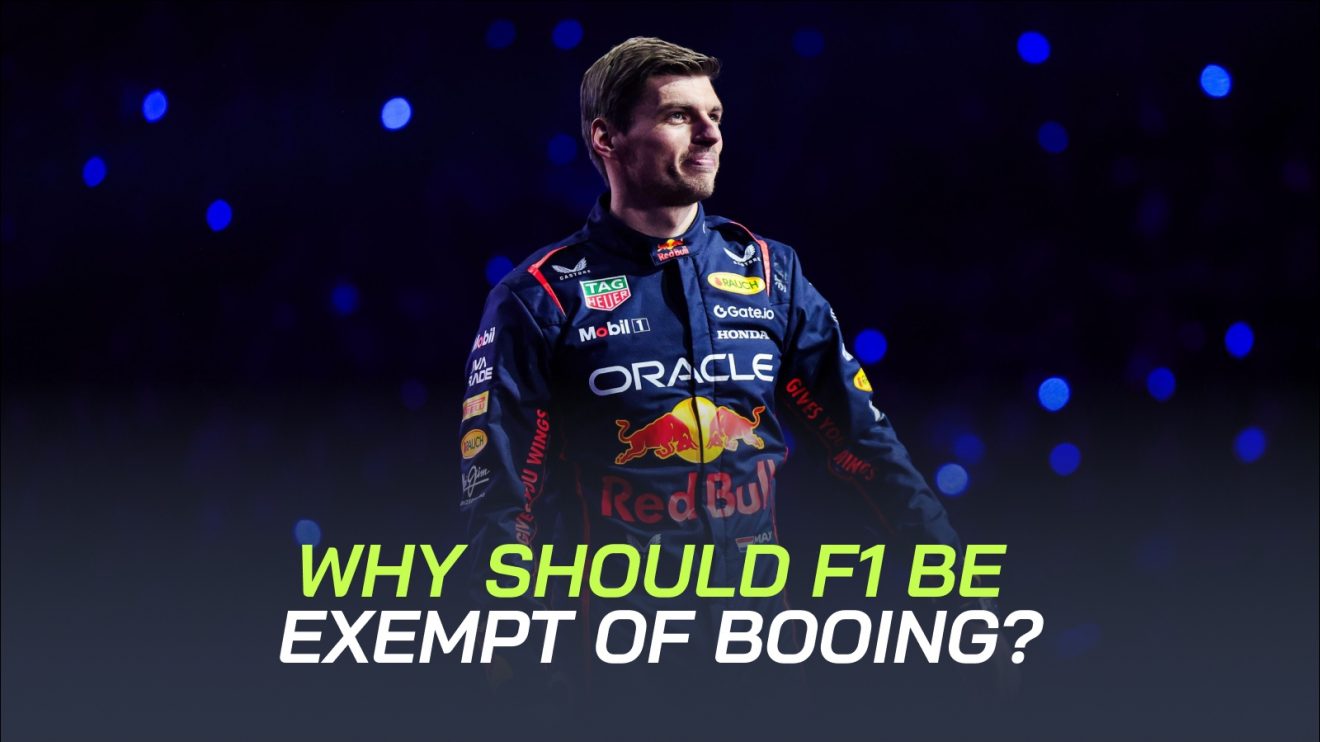
Max Verstappen was public enemy number 1 in front of the overwhelmingly British crowd.
The booing of Max Verstappen has ruffled feathers within F1 but why should this sport be exempt when, for so many others, it’s simply part of the game?
Every time Welsh football player Aaron Ramsey plays at the Stoke City stadium, he is roundly booed by the home crowd. For what crime I hear you ask? Daring to have his leg broken by a Stoke player in 2010.
Booing, applauding – both part of the fabric of sport
This is a particularly egregious example but a true point all the same – booing is part of the fabric of sport, in much the same way that applauding is.
The subject of booing has been brought into the F1 focus this past week after a small, but vocal, section of a 15,000-strong crowd booed Max Verstappen and Christian Horner at F1 75 in London.
London is a city where 41% of its inhabitants were born out of the UK, meaning the crowd at the venue was more diverse than many would assume, but naturally, there were more Britons present than other nationalities.
These Brits, like most nationalities, tend to support their home favourites. Lando Norris, George Russell and especially Lewis Hamilton are idolised in much the same way that Verstappen is in the Netherlands, Sergio Perez is in Mexico and Daniel Ricciardo is in Australia. A home crowd will almost always support their own drivers or players.
So when a Brit-heavy crowd arrived at the O2, some full of expensive but god-awful beer, is it any wonder that the boos came out? Verstappen is a natural rival to these fans.
He’s the man who has denied their favourite an eighth World title and/or prevented Norris from winning his first. Horner may be a born and bred Englishman but he is happy to play up to the pantomime villain role, making him a divisive marmite figure in F1 fandom.
But what did anyone expect? If this event was held in Amsterdam, the reverse would have been true, Verstappen himself even warned of it.
“When you go to a football match, when you go to a home ground the other opposition will be booed at some point,” Verstappen said in Zandvoort in 2021. “And it’s not up to then the local club to come onto the speakers and go ‘guys, you cannot boo’, because it will naturally happen.
“Also in football they are very passionate and they support their local team. So I don’t think it’s up to me to say to them they can’t boo, because I am not them and I have to just focus what I’m doing on track.”
In fairness to both Verstappen and Horner, they have not been the ones being vocal about this perceived slight.
The disapproval of the booing has largely come from two places, Jos Verstappen and the FIA. Verstappen Snr threatened that his son may never appear in England again but it was the FIA’s reaction that was perhaps the most excessive.
The governing body described it as a “growing threat”, saying they needed to protect the integrity of the sport, but if only they took a similar view to racing in countries like Saudi Arabia and Qatar where humans suffer far more than booing.
The FIA was booed the loudest of all, perhaps why they really felt like making a statement, but it also being an FOM event was another chance for them to land a blow in this long-running feud.
But this is ultimately the deal with the devil that F1 has made. Back when it was a niche sport, there was a general understanding that you did not boo because at the end of the day, the sport needed every fan it could get. Everyone had a shared passion and were rather proud of this sport they loved.
But Liberty Media changed the game and the Drive to Survive effect is very real. Formula 1 is no longer the niche sport it once was. 750 million people watched it in 2024, making it the most popular annual sporting series in the world and with it, they brought their own way of supporting (or not supporting) drivers and teams.
More on the booing of F1 75
FIA issue statement over Max Verstappen and Christian Horner booing
Jos Verstappen speaks out after Max Verstappen and Christian Horner boos
The manner of Drive to Survive and how it presents drivers has brought Formula 1 much closer to other sports in how fans view it. The tribal nature that Formula 1 used to turn its nose up at has appeared and given how the Netflix show portrays certain drivers and teams, is anyone surprised?
In the two seasons that Verstappen refused to do sit-down interviews with Netflix, his role became the silent villain. He-who-shall-not-be-named.
It is not Netflix alone. Sky Sports is the biggest broadcaster of Formula 1 but who is Sky’s most important audience? The Brits, because they are the ones who pay the big bucks. So then is it any wonder if there is a bias, whether conscious or subconscious, it is towards the British drivers? Does then whoever stops them become the bad guy for a sizeable portion of the F1-watching audience?
Another way to look at it is the fact that fans feel passionate enough to boo at a sterilised event like F1 75 shows just how engaged the fan base is. The idea of selling out one of London’s biggest venues to not even see the sport in action would have been fanciful a decade ago – but tickets sold out in minutes.
But ultimately, is booing really the worst crime that F1 has to deal with? Inconsistent stewarding, races in less than welcoming places and the rising cost to be a fan would be far higher on my agenda.
And besides, if an evening of being booed is part of the deal of earning $50 million, I am sure I would recover pretty quickly from the seat of my private jet on the way to my Monaco home.
Read next: Eight questions to answer as F1 2025 pre-season testing begins