
Azerbaijan GP conclusions: Piastri SOS, Lando’s big problem, Max’s post-Horner wavelength


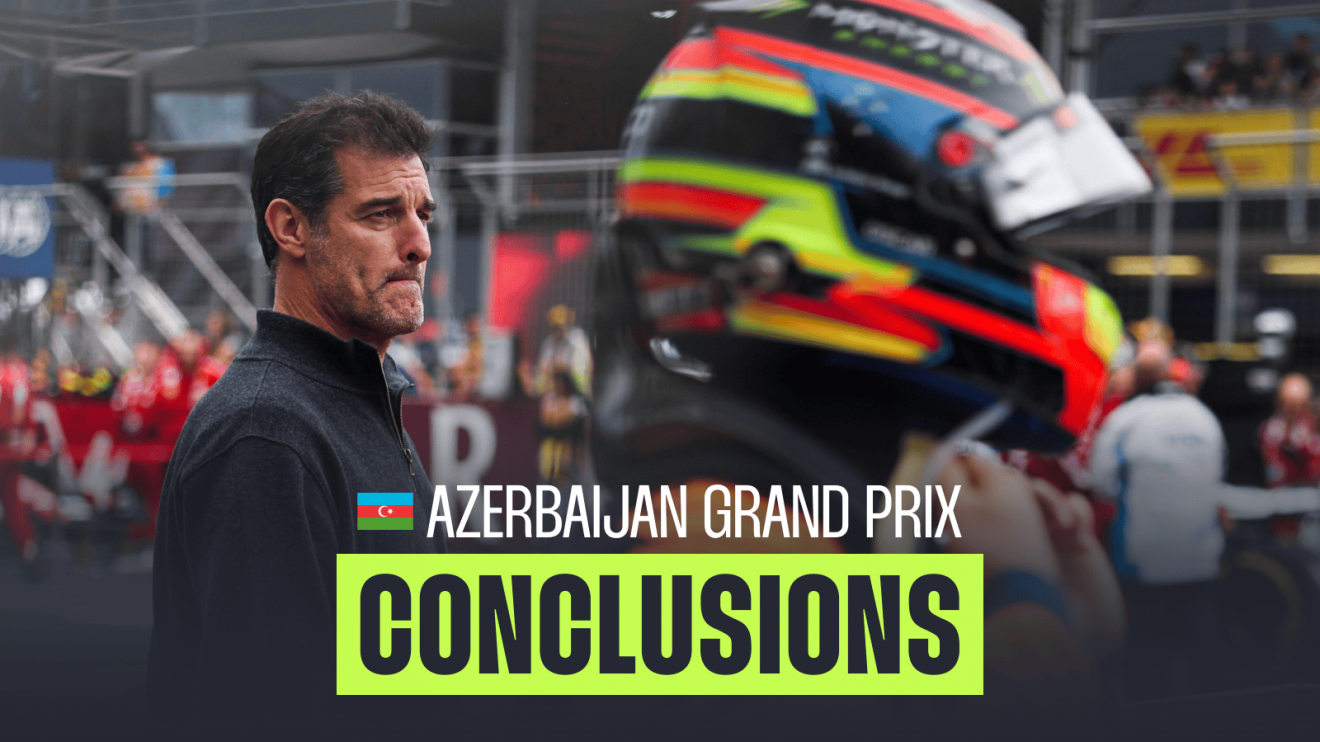
Does Mark Webber hold the key to Oscar Piastri getting back on track after Baku?
Red Bull driver Max Verstappen claimed his fourth victory of the F1 2025 season in the Azerbaijan Grand Prix at the Baku City Circuit.
Verstappen dominated from pole position to clinch a second successive win for the first time in F1 2025, with Mercedes driver George Russell second and Carlos Sainz clinching his first podium for Williams with third place. Here are our conclusions from Baku…
Oscar Piastri needs Mark Webber now more than ever
When Max Verstappen suffered a crisis of confidence in the early months of the 2018 season, a sort of mania took hold across the motor racing media.
Week after week, race after race, Max would be asked if he had any plans to ‘change your approach’ (whatever that means).
And week after week, race after race, Max would give the exact same answer: no.
This back and forth, you’ll recall, came to a head in a famous press conference in Canada in which Verstappen quipped – with half a smile, but never let the facts get in the way of a good story – that he might headbutt the next person to ask him that tired old question.
The same suggestions were put to the likes of Christian Horner and Helmut Marko, who were asked remorselessly how they planned to deal with The Verstappen Problem.
Oscar Piastri vs Lando Norris: McLaren head-to-head scores for F1 2025
? F1 2025: Head-to-head qualifying statistics between team-mates
? F1 2025: Head-to-head race statistics between team-mates
Would they be telling him – forcing him – to change his approach, even if it happened to be against Max’s own wishes?
And might they consider demoting him to Toro Rosso (!) if the situation did not improve given Red Bull’s history of dropping underperforming drivers?
To ask those questions of Horner and Marko was to totally misunderstand Max and the way his mind works.
Why? Because the only person he has ever really listened to, the only voice he truly values, is Jos.
His father was the only one who ever stood a chance of getting through to him and helping Max overcome that tricky time.
Indeed, when explaining in the closing weeks of 2018 how he managed to transform the trajectory of his season after such a sloppy start, Verstappen cited a piece of advice his father had given him back in the karting days.
Max said after winning that year’s Mexican Grand Prix: “He would always tell me: ‘Max, even if you think you’re not going fast enough, it’s still fast enough.'”
It is that role Mark Webber must now perform for Oscar Piastri after his first serious wobble of the 2025 title battle.
This was the weekend Piastri’s reputation as a ruthless, rock-solid, ice-cold competitor melted without warning, making more mistakes in the space of 24 hours than he did over the previous 16 race weekends of this season combined.
Since Piastri made his debut in 2023, there has been a temptation to view Webber as the Jos to Oscar’s Max, putting the lessons of his own career into practice to the benefit of his protege.
The parallels are unavoidable.
Recap: How the Oscar Piastri vs Lando Norris battle has ebbed and flowed
See, for instance, how the Piastri camp was so forceful in ensuring that Oscar began his career in the right place – not so dissimilar to how the Verstappens sought to keep full control of Max’s career until the time was right – even if it meant ruthlessly walking away from the company that funded his early days to take up a seat with McLaren.
See how Piastri carries himself with the same coolness – the same certainty – that characterised a young Max.
The influence of Webber is no doubt also why Piastri up until now has coped with the pressures and scrutiny of a title battle far better than most first timers, with the notable exception of Verstappen himself.
And it will be crucial now to ensure that this remains only a blip and not something that starts to snowball as the pressure intensifies.
Piastri has a good way of describing his relationship with Webber, remarking often – in a phrase that could so easily apply to the Verstappens – that “his hindsight is my foresight.”
He needs all that knowledge and experience – all that insight into how it feels when the title is close enough to touch yet still seems so far away – more than ever right now.
Over to you, Mark…
Lando Norris has not developed at all over the last 12 months
It was Liam Lawson, of all people, who best summed up the challenge facing the drivers in Q3 in Baku.
The tyres are still warm and grippy, giving the incentive to attack the lap as normal.
Yet droplets of water are appearing on the visor, the track surface has turned glossy and the white lines – all those nasty little white lines – are increasingly slippery. How to judge it?
“You’re trying to fight your brain and not back off and keep pushing,” Lawson said moments after alighting from the car on Saturday. “But it’s definitely tricky.”
Put another way, the moment the drizzle started in qualifying was the moment the session stopped being a technical challenge and instead became a psychological one. Classic risk versus reward.
Little wonder that drivers like Lawson and Carlos Sainz, both with little to lose and blessed with the gift of great car control, kept on pushing.
And no great surprise either that Lando Norris was once again found wanting in yet another high-pressure scenario.
There are two possible ways the human brain might react to the opportunities presented to Norris by Oscar Piastri’s various mistakes this weekend.
Either you seize it, take the shot and punish the error(s) with uncompromising ruthlessness, making Oscar rue the day he left the door wide open.
Or you become inhibited by the extra expectation placed upon your shoulders and find yourself drawn into errors too.


For Norris, Baku was chillingly reminiscent of the last occasion he wasted the chance of a lifetime in Brazil last year.
He had his title rival right where he wanted him that day, too, with Max Verstappen down in 17th on the grid and Norris on pole position.
Only for Lando to almost immediately let him off the hook, his call to carry out an additional formation lap without getting the signal setting the tone for an agonising afternoon in which he self-destructed in slow motion.
How much has Norris changed since that day? How much better, how much stronger, really is he for the experience of 2024?
Has he developed or improved in any way at all over the last 12 months?
Still so passive, still so weak.
Compare and contrast the title protagonists and it is relatively straightforward to pinpoint how Piastri has progressed since last season.
His struggles with tyre management, a theme for most of his first two seasons with McLaren, have long been consigned to the past.
And it is revealing that the races where he lagged significantly behind Norris in 2024 – China, Spain, Zandvoort – have brought some of his most accomplished victories this year.
Now that’s what you call progress – in leaps and bound – even if it is true that Oscar, starting from a lower base, had greater scope for improvement.
Norris?
He remains pretty much the same driver he was a year ago, capable of some breathtaking highs – higher, on balance, than those of Piastri – but with that one glaring weakness of his temperament undoing all the good.
It is such a big issue for him, that vulnerability under pressure, and threatens to act as a barrier to Norris ever realising his ultimate potential.


It remains significant, too, that even with one of the most dominant cars ever produced he is yet to string together more than two wins in succession.
And even on the one occasion he did manage to rub two together, his victory at Silverstone (seven days after his pole-to-flag win in Austria) owed much to a penalty for Piastri.
The result? Norris has struggled to generate much momentum, or apply serious and sustained pressure on Piastri, all season long.
Which only increases the emphasis on taking rare opportunities like Baku.
Yet cometh the hour, the man went missing. Again.
When the covers come off the cars at the beginning of each campaign, the teams all repeat the same mantra in unison: if you stand still in this business, you’ll end up being left behind.
The same, it seems, applies to the drivers. And the thought that should keep Lando awake at night?
What if Oscar keeps growing into 2026 and beyond?
He might not get an opportunity like this again.
Be afraid: Max Verstappen and Red Bull are back on the same wavelength
It is as though the heady days of 2023 have been magically restored over recent weeks.
Pole position: Max Verstappen, Red Bull.
Winner: Max Verstappen, Red Bull.
And with a comfortable gap to the rest filing in behind. So dominant. So in control. So easy.
So why has Red Bull managed to make it look so hard over the last 18 months?
As noted recently, the biggest thing Red Bull lost when Adrian Newey walked out the door last year was the special bond between Verstappen and the engineering team.
If Newey, with a rare ability for a designer to feel what the driver feels, builds racing cars for racing drivers, the last two produced by Red Bull have been racing cars built by engineers for engineers.
It is a small yet significant difference, that slight disconnect at the root of all of Red Bull’s problems since mid-2024.


Pierre Waché, the Red Bull technical director and effectively Newey’s successor, admitted as much last year, telling PlanetF1.com that the team had placed too much emphasis on pursuing raw downforce figures with the RB20.
The result?
Red Bull effectively fell into the same trap as Mercedes in 2022, the team’s determination to keep piling on the downforce having the unintended consequence of – as Waché put it – “introducing some characteristics that are not designed for the driver.”
Every move by Red Bull over the last 12 months has been targeted at reversing out of that hole, producing a more benign and driveable car at the beginning of 2025 with the aim of bringing more performance as the season developed.
The plan was plainly not working as hoped for the first half of 2025.
Can it be a mere coincidence that the results have become more apparent since Laurent Mekies – an engineer at heart, a common trait among today’s very modern team principals – was appointed?
The day Christian Horner’s charisma and bravado was replaced with Mekies’ instinctive feel for engineering matters, bringing a little bit of back-to-basics Racing Bulls thinking to Red Bull Racing, might come to be remembered as the day the team’s recovery truly began in earnest.
For all the talk of a tech breakthrough with the RB21, perhaps the real secret to Red Bull’s success over recent rounds lies in the team’s conscious decision to move away from simulations and rely more on the human touch – and not just Verstappen but Yuki Tsunoda, noticeably more competitive since the summer break – when it comes to setup direction.
It is something Helmut Marko had been calling for at least since the Japanese Grand Prix in April, when he urged Verstappen to trust his experience over whatever the sim said.
The transformation over the last two race weekends, as the post-Horner regime has achieved lift off, have been highly encouraging.
And yes, true, Monza is an outlier, the kind of circuit that conceals the natural advantage of a dominant car like the McLaren and opens the door to some surprise results from time to time.
And, yes, there is nobody better equipped than Verstappen to deal with the variables – the wind, the drizzle, the temperatures, switching between tyre compounds – that confronted the drivers in qualifying in Baku, putting an unusually large gap between himself and his typical opposition on the grid.
Yet after relying on Max for so long – the sort of dynamic that should never exist between a team and driver – Red Bull and Verstappen are now finally back on the same wavelength and working together as a unit.
Even better?
Just take a look at the world championship, where Max now sits just 69 points behind Piastri with seven rounds and three sprints remaining – just as McLaren and its drivers are having a little wobble.
He couldn’t. Could he?
Carlos Sainz badly needed something to cling on to at Williams
Curious, isn’t it, that Carlos Sainz should describe his first podium as a Williams driver as not only the best, but the favourite of his career so far.
Will that claim, you wonder, stand up to scrutiny when the sun rises on Monday morning and the emotion of the achievement has slightly drained away?
Let’s assume, for the sake of argument, that he doesn’t count his four F1 victories among those podiums.
Is it better, as he says, than the first time? Well, probably, actually, given that the rest of the paddock had already headed for home by the time a post-race investigation promoted him to third in Brazil in 2019.
But better than all those times with Ferrari? Taking in the view at Monza with that prancing horse on his chest in 2023, for instance?
Better than savouring the scene in Abu Dhabi last year, hoping like hell it wouldn’t be the last time but far from sure whether he would ever be up there again?
That last one, perhaps, cuts to the heart of why this podium means so much to him.
As the final races of his Ferrari career ticked down in 2024, Sainz was more than aware that he would almost certainly never have it so good again.
After being so widely acclaimed at Ferrari, it is impossible to overemphasise just how different the experience of this season has been for him.
From fighting for regular wins to struggling to score points; from measuring up well against Charles Leclerc for four years to suddenly trailing Alex Albon on pace and points.
Over recent weeks, as he has banged wheels with the likes of Liam Lawson and Oliver Bearman where he would once duel with the Max Verstappens of this world, Sainz has risked becoming just another driver lost in the crowd of F1’s midfield.
And he would not be human if he has not experienced the moments of self-doubt – is it the car or is it me? – that Lewis Hamilton has confessed to having in the years since his last period of sustained success.
Sainz is far too elegant to be dragged into a slanging match with another driver – “what everyone else does is none of my business,” he said in the post-race press conference when asked about beating Hamilton to a top-three finish in 2025 – yet it will surely bring some satisfaction that he has managed to sneak a first podium with his new team before Lewis with Ferrari.
It has long been obvious that the focus of Williams and Sainz is on next season and the opportunity presented by the new regulations.
But Carlos badly needed a result – some validation – like this to cling on to in what has turned out to be an unexpectedly difficult first season.
And to sustain him in the countdown to 2026.
Has Liam Lawson just ended Yuki Tsunoda’s F1 2026 hopes?
Turns out that Max Verstappen was right about Liam Lawson all along.
It was after qualifying in China, 24 hours before Lawson’s last race for Red Bull’s senior team, that Max raised the suggestion that his teammate would be faster in a Racing Bulls car instead of the RB21.
Lawson, punch drunk after qualifying last for the second day in a row, would not have thanked Verstappen for his interjection at the time.
Different story now, perhaps, having achieved two things in Baku – qualifying in the top three and finishing in the top five – Yuki Tsunoda has failed to do in the 15 races since.
It was widely reported ahead of the Azerbaijan Grand Prix weekend that Lawson and Tsunoda, those lost souls of Red Bull Racing, are in direct competition for the last remaining Red Bull-affiliated seat for next season.
With Isack Hadjar’s rise to Red Bull as Verstappen’s latest victim – sorry, teammate – now considered an inevitability, and with Arvid Lindblad supposedly assured of an F1 promotion with Racing Bulls, it is said that the final seat available for 2026 will go to one of Lawson or Tsunoda.
How fitting it was, then, that the closing stages in Baku pitted them against each other in the fight for fifth.
Yet even on arguably his strongest weekend to date as a Red Bull driver, one to further underline the senior team’s recent strides, still Tsunoda could not overhaul a car from the little team.
It did not reflect at all well on Yuki that he could find no way past even with the assistance of DRS all the way down that long stretch to Turn 1 and with medium tyres 18 laps – more than 35 per cent of the entire race distance – fresher than Lawson’s hards.
With Red Bull’s partnership with Honda coming to a close at the end of this season, it has long seemed clear that only sentiment – and perhaps a pang guilt for denying him the opportunity to explore external options a year or so sooner – will keep Tsunoda in situ for 2026.
Lawson, likely to have the last laugh, has just delivered another reason to cut the cord.
Want to be the first to know exclusive information from the F1 paddock? Join our broadcast channel on WhatsApp to get the scoop on the latest developments from our team of accredited journalists.
Read next: Explained: Why Oscar Piastri will escape a Singapore GP grid penalty