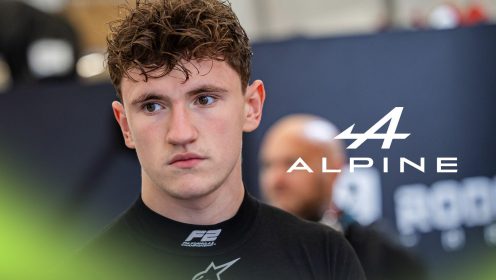

The secrets behind Alex Dunne’s stunning McLaren debut


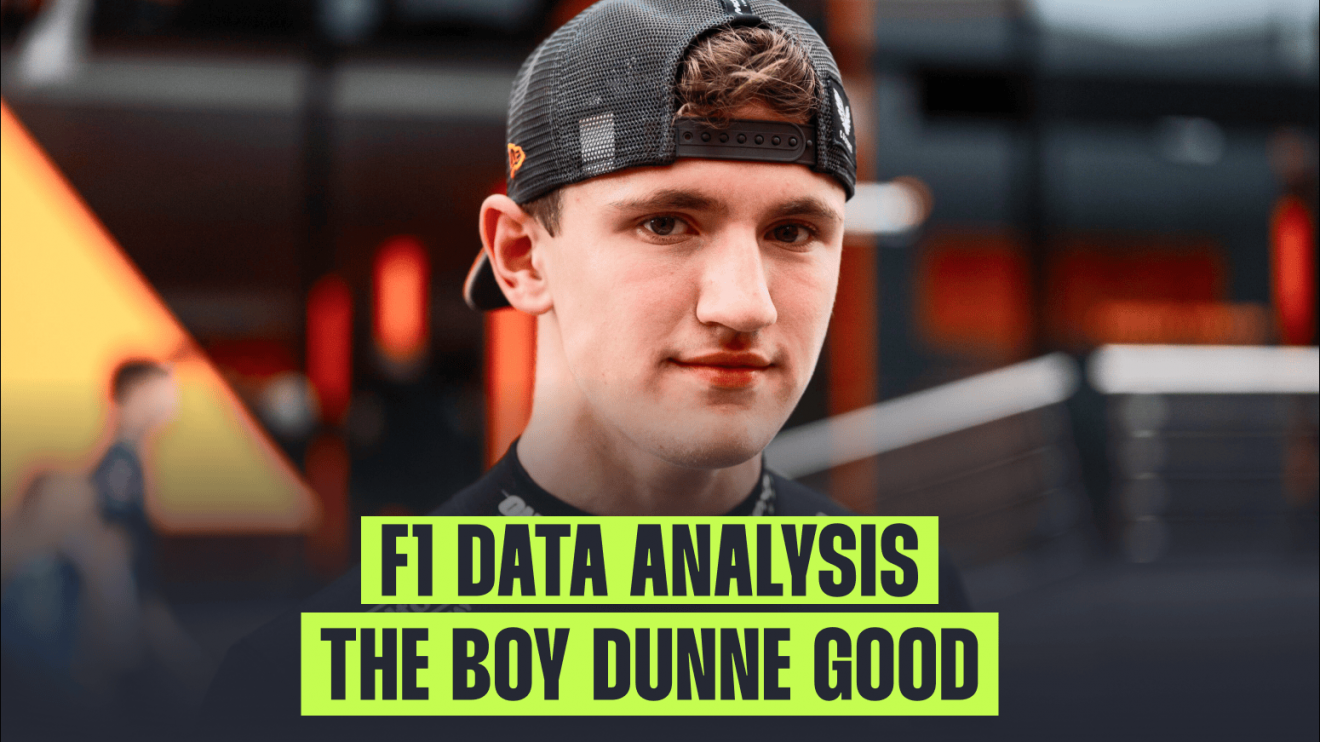
Alex Dunne impressed in his first FP1 appearance for McLaren in Austria on Friday
Young Irish driver Alex Dunne made a truly positive impression during FP1 at the Austrian Grand Prix, his first appearance behind the wheel of a current-day F1 car.
He ended the session in P4, less than a tenth of a second behind team-mate and F1 2025 championship leader Oscar Piastri.
Alex Dunne stars on McLaren MCL39 debut in Austrian Grand Prix FP1 debut
Additional reporting by Thomas Maher
Let’s dive into the telemetry data and uncover the details behind this standout performance by Dunne, who currently leads the Formula 2 championship.
McLaren arrived in Austria with a small package of upgrades, the most notable being a new front suspension featuring revised geometry designed to improve aerodynamics.
As a result, Dunne’s opening laps in an F1 car were spent gathering airflow data, which will later help McLaren’s engineers compare track testing with aerodynamic simulations back at the factory.
Once that was complete, Dunne ran a further six laps on the hard tyres and the results were genuinely promising.
Alex Dunne: McLaren’s latest F1 superstar?
? How Alex Dunne has found an ‘extra level’ as McLaren junior eyes F1
? The astonishing 43-year-old statistic Alex Dunne ended at Austrian GP
Right from the start of FP1, Dunne gave the team reasons to be encouraged.
But the moment where the Irish driver really demonstrated his pace came during his laps on the soft C5 compound tyres, where he clocked the fourth-fastest time of all.
The margins were incredibly tight — just 0.069 seconds separated him from his team-mate Oscar Piastri on P3 while he was only 0.224 seconds off George Russell’s benchmark time in the Mercedes.
Considering the conditions on track were far from ideal, as is often the case during FP1, to be that close was an outstanding achievement.
Comparing the data from his fastest lap with that of Piastri, we can see where Dunne made gains and where he lost time.
Right from the off, through Turn 1 Dunne was quicker, carrying more speed through this medium-speed corner.
However, by Turn 3 — arguably the trickiest on the circuit — he began to lose delta time to Piastri.
In both Turn 3 and Turn 4, there was a touch more instability from Dunne, particularly under braking, compared to his more experienced team-mate.
But given his limited experience and the fact the time differences were so small, it’s certainly nothing to criticise.


Dunne remained strong all the way to Turn 7, where a bigger mistake cost him an extra tenth.
This is a corner where drivers typically only lift the throttle momentarily, which Dunne did, but on getting back on the power, he made a small error that hurt his lap.
The time he lost was clawed back in the final corner where Dunne showed great confidence and precision.
In fact, the data shows he was only slower than Piastri in sector two at the Red Bull Ring — in both the first and third sectors, Dunne was quicker.
It has been suggested to PlanetF1.com by multiple sources that Dunne may have been running with his power unit turned up higher than Piastri.
Speaking to media including PlanetF1.com after the session, Red Bull’s Helmut Marko claimed that Dunne “wound the engine up, but still, he did a very good job.”
Perhaps most impressively, Dunne set his best time on his third attempt at a flying lap, a sign of growing confidence and his ability to adapt rapidly to a completely new machine.
In an era of Formula 1 where young drivers are increasingly earning the trust of teams, Dunne has every reason to feel optimistic.
Who knows? He may well be the sport’s next big star.
Read next: McLaren told the F1 2026 deal they should make happen for Alex Dunne