

Beer wars brew chaos: How Labatt vs Molson cancelled the 1987 Canadian Grand Prix


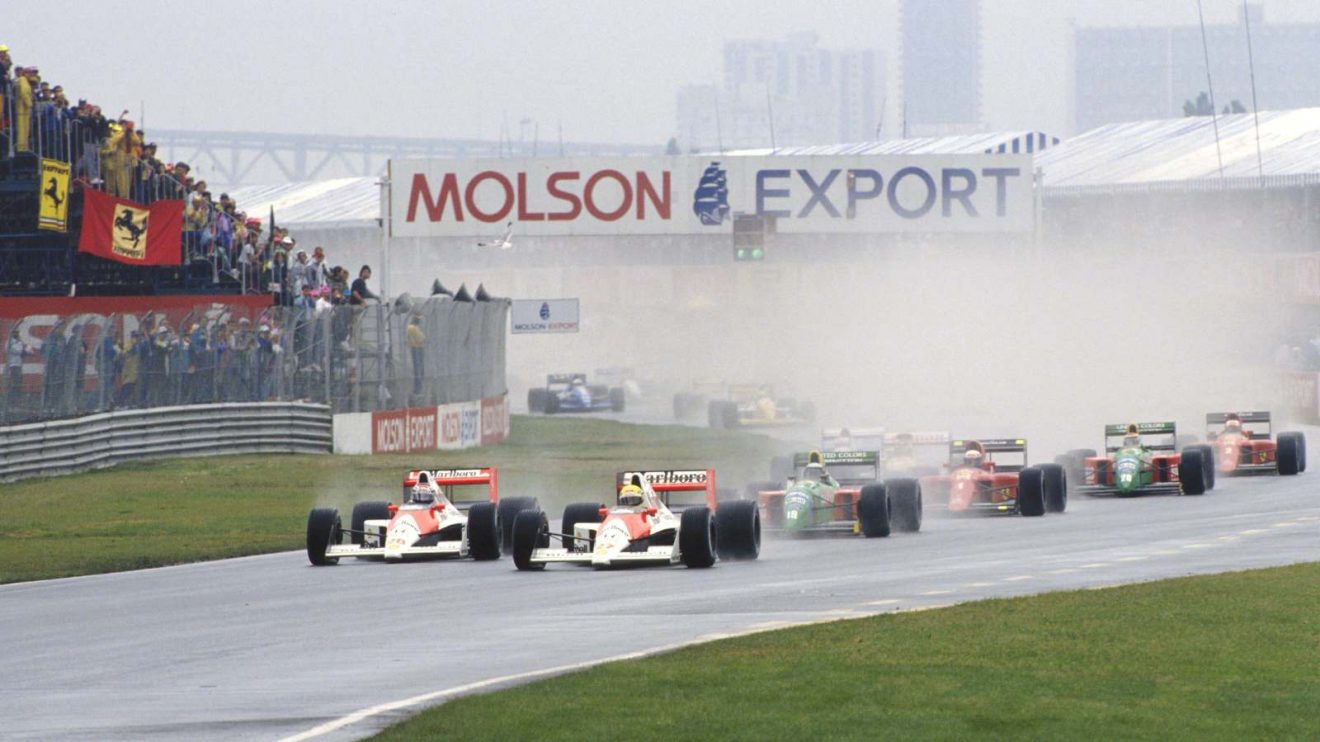
Molson may have ultimately won the naming rights to the Canadian Grand Prix, but it almost killed the event.
In 1987, the highly popular Canadian Grand Prix was canceled as two prospective title sponsors battled for the right to promote the race — both of them Canadian breweries.
On one hand was Labatt, which served as the title partner until 1987, when it was deemed to have the rights to the Circuit Gilles Villeneuve and not the Canadian Grand Prix. On the other, was Molson, which owned the rights to the Grand Prix but not the track. What followed was a legal battle that very nearly killed North America’s longest-standing F1 event.
Canadian Grand Prix: A (brief) history
Canada’s history as host of a Formula 1 World Championship Grand Prix began on August 27, 1967, when it staged the eighth of 11 races on that season’s F1 calendar. It was hosted at the 2.458-mile Mosport International Raceway just outside of Bowmanville, Ontario, designed to be part of ongoing celebrations for the Canadian Centennial Year.
What began as a one-off event soon transformed into an annual classic that changed hands several times: off to Mont-Tremblant in Quebec, then around again to Mosport, before Montreal offered its Circuit Ile Notre-Dame — now known as the Circuit Gilles Villeneuve — as a permanent home for the pinnacle of open-wheel racing.
The classic event has run almost continuously ever since its addition to the F1 calendar in 1967, with a few exceptions. Those were in 1975 and 2009 when disagreements about budgets kept F1 away from the North American country, while in 2020 and 2021, the COVID-19 pandemic brought public gatherings to a halt.
And then there’s 1987.
In the midst of a strong decade-long run of races, F1’s momentum in Canada came to a screaming halt as two major Canadian brewers — Labatt and Molson — engaged in a sponsorship dispute that very nearly ended the iconic Canadian Grand Prix.
More on the Canadian Grand Prix:
? Wall of Champions explained: How one Canadian Grand Prix corner gained its fearsome name
? The foolproof Canadian GP formula that new US F1 venues should copy
Shots fired in the battle of the beers
Canadians will recognize Labatt and Molson as the two major breweries in Canada, with Labatt headquartered in Toronto and Molson in Montreal. Both transformed their respective companies into beer-fueled empires, and in the late 1980s, both were hungry to sponsor Formula 1.
First came Labatt, which made a lot of sense; F1 found its footing in Ontario, so naturally an Ontario brand would offer up its services as title sponsor.
But in the late 1970s, Molson began challenging Labatt’s chokehold on both Canadian brewing and on Formula 1. The company’s traditional ’50’ ale had fallen out of favor, replaced by Molson’s Laurentide ale.
Bolstered by its success, Molson maintained its sponsorship of the Montreal Canadiens despite bids from Labatt, which it added to a repertoire of football and baseball sponsorship. On the motorsport front, Molson nabbed the rights to Can-Am races, putting up $250,000 in prize money over a four-year contract.
“Everyone benefits one way or the other,” Brian Hickey, spokesperson for Mosport, told the Hamilton Spectator in 1977. “Labatt’s has the Grand Prix, and Molson’s [sic] has the other events. It’s like having a pie. It has so many pieces and both companies have picked which ones they want.”
But would that be enough? Along with a few smaller racing events, Labatt largely only had the Formula 1 Grand Prix to its name, which prompted it to release a beer called “Grand Prix” in hopes of further strengthening its ties to the international motorsport scene. It was the one thing that Molson hadn’t managed to acquire — though the threat was quickly approaching.
In 1986, Molson fired the first shot in what was set to be named “the beer wars.”
In mid-June, just as the Canadian Grand Prix was gearing up for another running at the close of the weekend, a man named Jean-Pierre Toupin dropped a bombshell.
Toupin was the general manager in charge of a Canadian IndyCar race known as the Molson Indy. Though it took place on the streets of Toronto, Toupin singled out Formula 1’s Canadian GP venue as a potential future locale for the U.S. series.
“We are convinced that the Molson Indy, with Mario Andretti, Al Unser, A. J. Foyt, Emerson Fittipaldi and others, would present a unique show on Ile Notre Dame, (and) … A Molson Indy presentation would be possible without any kind of government subsidies,” he said, as reported in The Gazette.
That was a direct and pointed hit at Labatt: In the build-up to the 1986 Grand Prix, the sponsor had admitted that it had absorbed a loss of $26 million since it first began sponsoring the race in 1977. As such, federal and provincial governments threw in a financial boost in order to help the sponsor satisfy the ever-increasing F1 requirements.
Folks at the head of Labatt, like president Pierre Desjardins, had also noted that the brewery was considering pulling its sponsorship if additional financial aid failed to appear.
“We cannot expect Canadian or Quebec taxpayers to pay for a promotional vehicle for our sponsor,” said Molson’s Toupin.
Molson vice president of sales in the eastern region, Roger Samson, added, “We’re just throwing our hat into the ring. We’re serious. We’ve never hidden our wish or hope in bringing the Molson Indy down to Montreal.”
There was just one problem: Labatt’s contract with the Circuit Gilles Villeneuve guaranteed it exclusive use of the track. Molson couldn’t bring an IndyCar race to that location unless Labatt completely withdrew, or somehow lost out on that contract.
It was the first shot in what was to become a wild war.
1987 Canadian Grand Prix: The beer war begins
In the world of Formula 1, things were changing in the late 1980s. A brutal battle between the Formula One Constructors Association (FOCA) and the Federation International du Sport Automobile (FISA) had come to an unsatisfying conclusion that ultimately pushed power more in the favor of FOCA when many of its personnel were absorbed into the FIA. Commercial rights had become ever more important, and it was with that in mind that Bernie Ecclestone brought in a man named Jack Long.
Long was from California, and he’d been promoted to the role of Canadian Grand Prix promoter by FOCA. Right from the get-go, he knew what he wanted: Molson.
Labatt had displayed its weaknesses when it admitted it needed government subsidies to continue hosting the race. Never mind the fact that it had a year remaining in its contract to host the Grand Prix. Never mind the fact that Labatt retained the first right of refusal for the circuit should F1 want to continue competing there. Jack Long felt Molson had what it took to bring greater prosperity to the series, and he inked a deal with Molson.
The issue erupted into a January 1987 court battle. A lower court ruled that the City of Montreal was legally allowed to make a deal with Molson and Jack Long. But Labatt appealed, and the Quebec Court of Appeals overturned the initial ruling. As such, Long threatened to move the race back to Mosport.
After the 1986 race, where Labatt paid out $2.2 million Canadian in prize money, teams decided that they wanted the funds provided in U.S. Dollars, and that they wanted the sponsor to tack on an additional 12% purse increase to cover inflation.
Already suffering from heavy losses during its eight years of Grand Prix sponsorship, Labatt didn’t have the money — but it still wanted the race.
It was a messy battle, one in which no one was happy. Ultimately, Molson was told it had the rights to the Canadian Grand Prix, but not to the Circuit Gilles Villeneuve. Labatt, however, was told it had the rights to the track, but not to the Grand Prix.
Fed up, Bernie Ecclestone told The Canadian Press in a February 1987 review, “I will make an application on Monday to have [the Canadian Grand Prix] struck off the 1987 calendar.
“I’ve had enough now, I’m finished. And when they go, they go forever.
“There are other people waiting busily in line for races, so I don’t need these problems.”
Jack Long told the wire service that he hoped to talk Ecclestone out of it, but that there was one response entirely out of the question: Selling his rights back to Labatt.
“I have an agreement for me to run the race, and me only,” he said.
Ecclestone did exactly as he’d promised: He revoked the event’s Grand Prix status and began seeking replacements.
But the fight wasn’t done. In April, Labatt filed a lawsuit against Molson and Jack Long, seeking compensation for alleged damages caused by the breach of contract. Labatt promotions director Roger Doré estimated they’d start by seeking $250,000 in compensation, but that “the figure will be revised when all damages are evaluated.”
Ask Molson vice president André Tranchemontagne, though, and the suit was nothing but a diversion tactic on Labatt’s part.
“I think Labatt is trying to postpone things because it can’t deliver the goods,” he told The Gazette. “It’s using Molson as a scapegoat. Ecclestone has already said he won’t deal with them.
“I think Labatt realizes it can’t get the rights back from Ecclestone.”
Trackside reporter for the Elmira Star-Gazette Ron Levanduski placed the blame directly in FOCA’s camp, arguing that the only reason Labatt struggled to pay its bills was because FOCA kept asking for more and more money.
The threat of replacing Canada on the Formula 1 schedule wasn’t just centered on the 1987 season; according to Jack Long, he was looking to sign a six-year contract with any replacements, and the clock was ticking away toward the September 1 deadline required for any prospective F1 event to apply to be featured on the 1988 schedule.
FOCA boss Bernie Ecclestone sat down with Al Halberstadt of The Windsor Star for a lunch interview that was published on June 20, 1987 — and in that conversation, he expressed his frustration with the former sponsor.
“Labatt’s did nothing to improve the Montreal race for years,” he said. “They didn’t even bother to go to the city to ask about new facilities.”
Ecclestone was referring to a brand-new pit complex he had requested the circuit built, which would have cost around $2 million.
Another monkey wrench was thrown into things in June when Roger Peart, the president of the Canadian Automobile Sports Clubs (CASC), asked Labatt to back off.
“On June 29, we advised Labatt that we consider the arrangement we made with them to be invalid because they have not been able to conclude an agreement with FOCA,” he told media.
“Without FOCA, there would be no cars and no drivers.”
The executive committee of the city of Montreal agreed with Peart’s assessment.
Long reiterated once again his legal right to promote the event, stating, “If Labatt is able to stalemate this through litigation or anything, there will be no Canadian Grand Prix.”
And as for the city of Montreal itself, well — its lawyer François Godbout told media, “We want to have the Formula 1 back here at the Circuit Gilles Villeneuve. It is the Cadillac of car racing, the jewel of the sport. We don’t care who sponsors the race or who stages the race.”
Later in 1987, FISA stripped CASC of its organizing authority; officials argued that CASC didn’t have the right to negotiate a multi-year contract with a sponsor, as that would be in violation of the newfound Concorde Agreement.
Still, FISA admitted that it had handed the Canadian Grand Prix a tentative race date in 1988. Set to take place on June 12, the sanctioning body demanded confirmation of the event as quickly as possible — and it would come soon.
Labatt finally withdrew from its lawsuit in early December of 1987, opening the race up to be assumed entirely by Molson. The city of Montreal scheduled a meeting with Jack Long quickly after, and before long, Canada had once again earned its place on the F1 calendar for the upcoming 1988 season.
1988 Canadian Grand Prix: A new era
With its commercial rights to the Canadian Grand Prix reaffirmed, Molson went all-in on preparing the Circuit Gilles Villeneuve for the 1988 event. Within 50 days, construction had been completed on a brand new pit lane, garage complex, and control tower, as wells as several new grandstands — and while Motor Sport Magazine writer Denis Jenkinson admitted that the work wasn’t fully complete on some of the ‘creature comforts,’ the track was much improved.
For a brief moment in the early 1990s, the brewery battle looked set to continue when Labatt inked a deal with Williams — but it never exactly transpired.
In 1997, Molson stepped back from its title partnership of the Canadian Grand Prix, with that right moving first to Player’s cigarettes and then to Air Canada.
Read next: The coldest F1 race of all time was won by a winter sport master